Room · History · Monks, true and false
Are monks' liqueurs made by monks?
Two liqueurs, two monasteries in the imagery, two opposite stories. Six display cases to separate what belongs to the archive, to tradition and to advertising.
7 display cases · about 7 minutes
Start the visitKey object
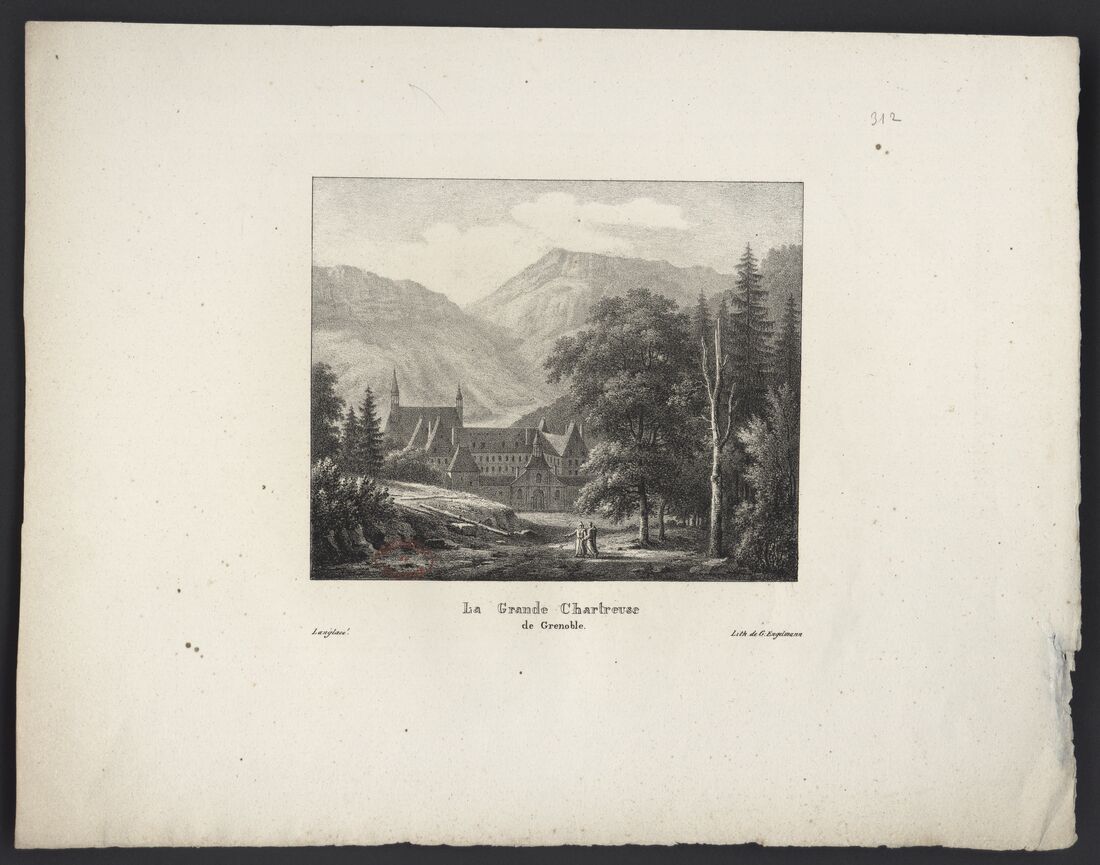
La Grande Chartreuse
Godefroy Engelmann (lithographe), d'après Jean-Baptiste-Gabriel Langlacé · XIXe siècle (avant 1839) · Lithograph
Godefroy Engelmann, after Jean-Baptiste-Gabriel Langlacé, La Grande Chartreuse, lithograph, first half of the 19th century. The monastery, founded in 1084, in its mountain “desert”: it is this place, and this name, that the label would carry away with it.
Source gallica.bnf.fr / BnF, ark:/12148/btv1b10488099r — public domain.
Display case 01 of 07 1605-1764
What did the manuscript of 1605 contain?
According to the Carthusian order, François-Annibal d'Estrées — later a marshal of France, then Marquis de Cœuvres — gave the Carthusians of Vauvert, in Paris, a manuscript in 1605: the recipe for an “elixir of long life”. This document has never been published; it can be neither read nor dated. It is a tradition, not an archive.
What follows is better attested. The text reached the Grande Chartreuse, above Grenoble, in the 18th century — tradition says 1737. An apothecary brother, Jérôme Maubec, worked on it there; after his death in 1762, Brother Antoine Dupuy took up the formula and, according to the order's archives, a manuscript of 1764 set down how it was to be prepared. This was the Élixir végétal, sold as a remedy by the monastery's pharmacy.
At the outset, then, a monastery remedy, one of many. What is unusual is what came next: this remedy would become an industry without ever leaving the monks' hands.
Fact or legend? « The Chartreuse recipe goes back to a manuscript of 1605. » Decide before you open it. See the answer
It is more complicated.
The 1605 manuscript is known only through the order's own account: no one has published it. What is better documented is the 18th-century elixir; the composition fixed around 1764 is known from the order's archives. The date of 1605 is a plausible tradition, not proof.
A pharmacy remedy became a liqueur, then a factory. Where, and how?
Next display caseHow we know
Degree of certainty
Reported — a story handed down, which the sources do not allow us to confirm.
Sources
- Chartreuse Diffusion, “Histoire”, chartreuse.fr (the order's account: 1605, 1737, Maubec, Dupuy, 1764)
- Wikipedia (fr), “Chartreuse (liqueur)” (the date of 1737 described as uncertain)
- Gallica: G. Engelmann, La Grande Chartreuse, lithograph, ark:/12148/btv1b10488099r
Key object
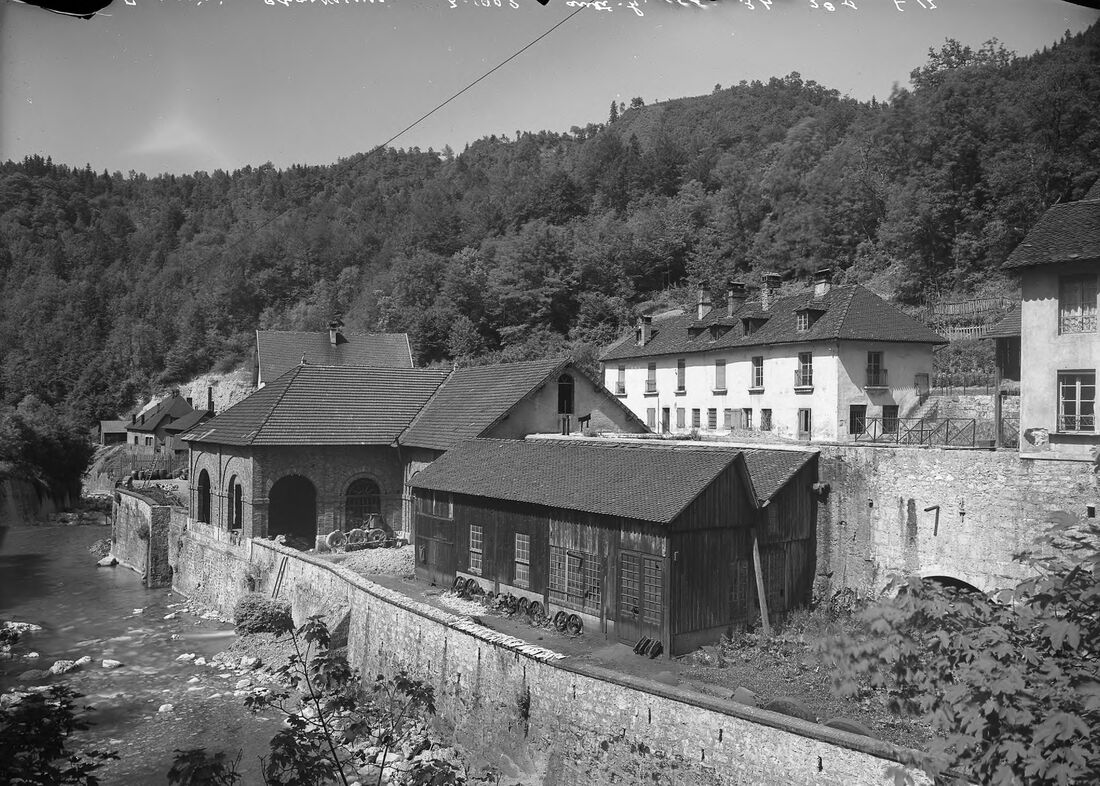
Fourvoirie : fabriques
Émile Duchemin (photographe) · 1890-1914
Émile Duchemin, Fourvoirie : fabriques (Fourvoirie: the works), photograph, between 1890 and 1914. The Carthusians' distillery at Saint-Laurent-du-Pont (Isère), now listed as a historic monument.
Source gallica.bnf.fr / BnF, ark:/12148/btv1b10665827w — public domain.
Display case 02 of 07 1838-1903
Can a monastery run a factory?
The liqueurs came late. In 1838, the Carthusians produced a white liqueur made with lemon balm; in 1840, Father Garnier began selling yellow Chartreuse, then the green. Demand grew, and distilling left the monastery: in 1860, it moved to Fourvoirie, at the entrance to the massif, on the banks of the Guiers Mort.
What the photograph shows is an industry: buildings strung out along the mountain stream, a road, a dam. The monks did not live there; they directed a production that employed lay workers, and whose income kept the order going.
From the 1860s, the name drew imitators: other distillers sold their own “chartreuse”. The order went to court. The question that arose then would run through the whole of the following century: who owns the name of a monastery?
The name became a trademark, and the trademark a matter for the courts.
Next display caseHow we know
Degree of certainty
Probable — historians agree, but a date or an attribution is still debated.
Sources
- Base Mérimée, record PA00125740 (Fourvoirie distillery, Saint-Laurent-du-Pont, moved there in 1860)
- Chartreuse Diffusion, “Histoire”, chartreuse.fr (white liqueur of 1838, yellow and green of 1840)
- Gallica: É. Duchemin, Fourvoirie : fabriques, ark:/12148/btv1b10665827w
Key object
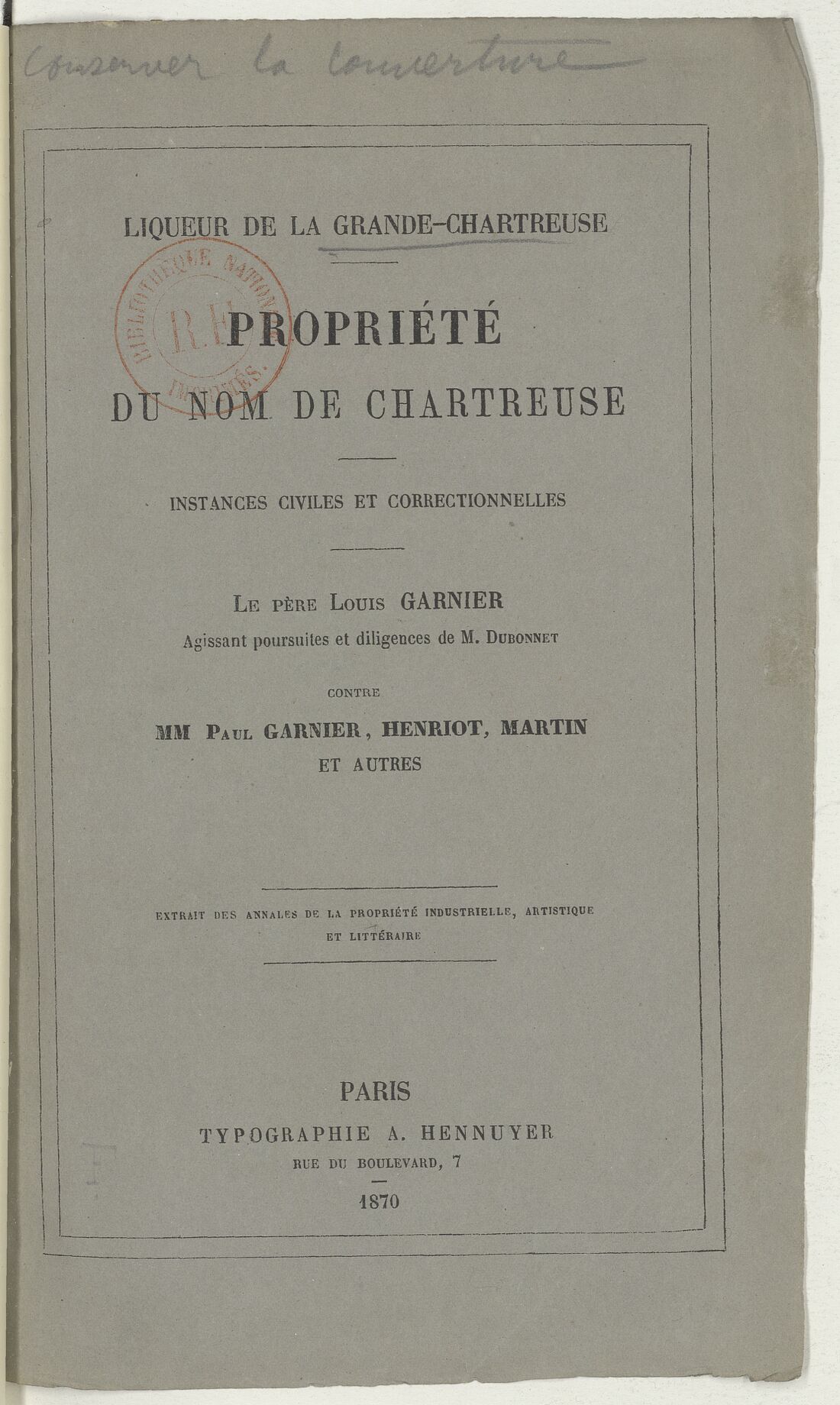
Liqueur de la Grande-Chartreuse. Propriété du nom de Chartreuse. Instances civiles et correctionnelles
Typographie A. Hennuyer, Paris · 1870
Liqueur de la Grande-Chartreuse. Propriété du nom de Chartreuse. Instances civiles et correctionnelles (Ownership of the name Chartreuse: civil and criminal proceedings), pamphlet, Paris, printed by A. Hennuyer, 1870. Title page: Father Louis Garnier against several manufacturers. Trademark law being written around a monastery.
Source gallica.bnf.fr / BnF, ark:/12148/bpt6k14295911 — public domain.
Display case 03 of 07 1870-1929
Who owns the name “Chartreuse”?
What people imitated was a scent. Chartreuse is made from a great many plants — one hundred and thirty, according to the order — which are macerated in alcohol, distilled, then aged for a long time in large oak vats; the green, the strongest, takes its colour from the plants themselves, while the yellow is milder. In 1870, Father Louis Garnier, procurator of the order, published the record of his lawsuits against those who sold a “chartreuse” without being Carthusians, and the judges found in his favour: the name denotes a provenance, not a style of liqueur.
In 1903, the law on religious congregations turned the situation upside down: the Carthusians were expelled from the Grande Chartreuse, their distillery and their trademark were seized, then exploited by a company that did not have the recipe. The monks took their secret to Tarragona, in Spain, and were distilling there from 1904.
The name came back to them in stages: in the United States in 1911, through a ruling of the Supreme Court; in France in 1929, when the company that had been using it went bankrupt and local notables of Voiron bought up its shares to hand them back to the monks. For a quarter of a century, the liqueur sold in France under the name Chartreuse was not the Carthusians' own.
While the Carthusians were pleading for their name, a Normandy merchant was building an entire monastery of his own.
Next display caseHow we know
Degree of certainty
Attested — documented by first-hand sources or by solid historiography.
Sources
- Gallica: Liqueur de la Grande-Chartreuse. Propriété du nom de Chartreuse, Paris, 1870, ark:/12148/bpt6k14295911
- Supreme Court of the United States, Baglin v. Cusenier Co., 221 U.S. 580 (1911)
- Chartreuse Diffusion, “Histoire”, chartreuse.fr (expulsion of 29 April 1903, Tarragona 1904-1989, buy-back of 1929)
Key object
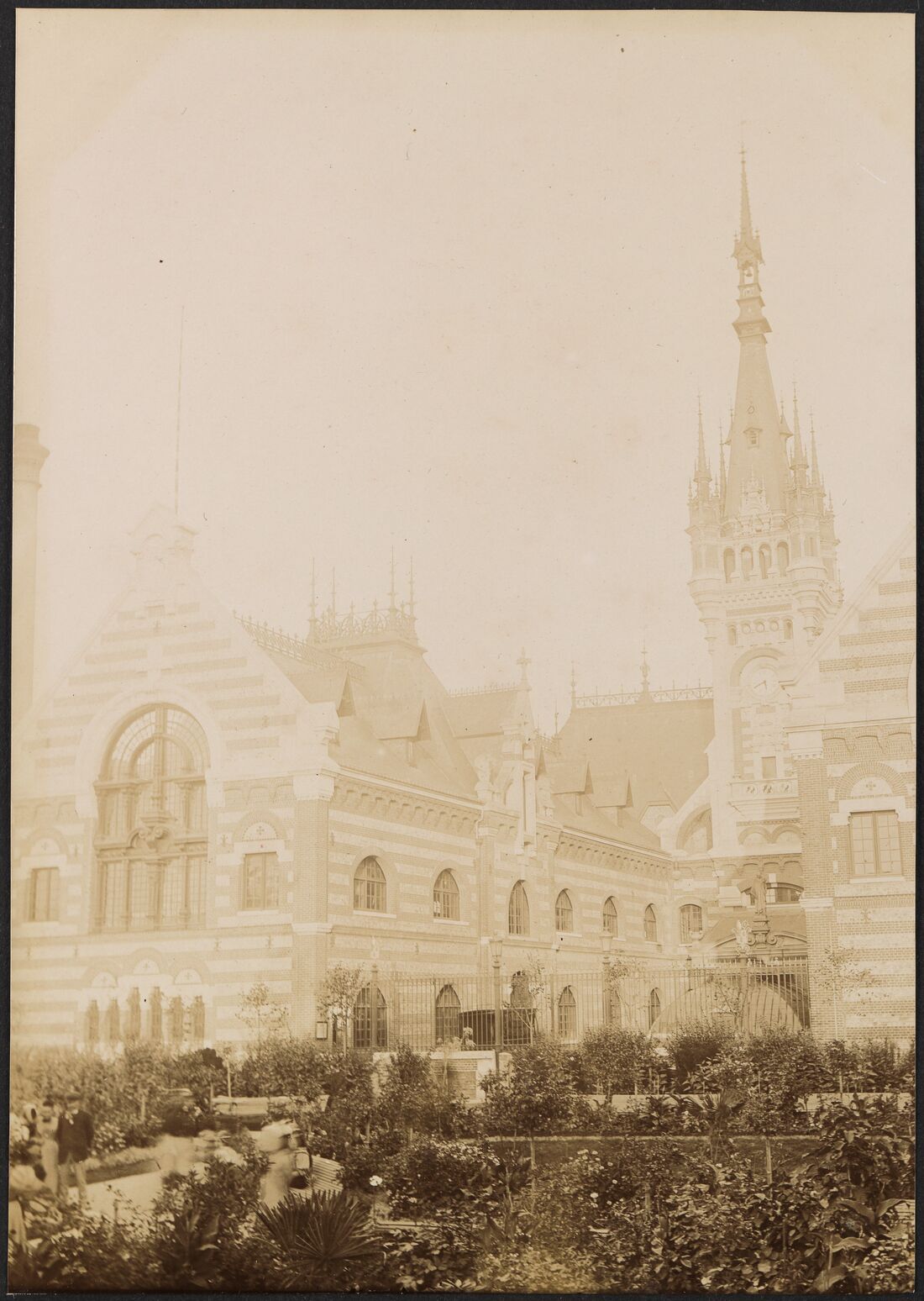
[Palais de la Bénédictine à Fécamp]
Photographie anonyme · 1890
Palais de la Bénédictine à Fécamp (The Bénédictine Palace at Fécamp), anonymous photograph, around 1890. Built from 1882 to 1888 to plans by Camille Albert, the building imitates an abbey that no monk ever lived in.
Source gallica.bnf.fr / BnF, ark:/12148/btv1b10679228r — public domain.
Display case 04 of 07 1510-1892
Who was Dom Bernardo Vincelli?
Bénédictine tells how, in 1510, a Venetian monk of the abbey of Fécamp, Dom Bernardo Vincelli, perfected an elixir of plants; and how, in 1863, a wine merchant of the town, Alexandre Le Grand, rediscovered the recipe in an old book from his collection.
No independent trace of Vincelli or of his liqueur has been found, and the house has never shown the document, either in whole or in part. When Le Grand launched his liqueur, the abbey of Fécamp had been empty of monks since 1791: there was no one left to make it, or to contradict him.
Le Grand was a shrewd businessman. From 1882, he had the architect Camille Albert build this neo-Gothic and neo-Renaissance palace, at once a stage-set abbey, a museum and a factory. Gutted by fire in 1892, it was rebuilt. The Bénédictine monastery is a set built by a merchant.
Fact or legend? « Bénédictine was created in 1510 by a monk of the abbey of Fécamp. » Decide before you open it. See the answer
It is a legend.
The only witness to 1510 is the brand's own story. No document has been shown, and no trace of Vincelli has been found outside that story. What is established is the commercial creation of the liqueur by Alexandre Le Grand in the 1860s.
To sell a monastery, you still have to show it. Advertising saw to that.
Next display caseHow we know
Degree of certainty
Attested — documented by first-hand sources or by solid historiography.
Sources
- J. Meehan, entry “Bénédictine”, in The Oxford Companion to Spirits and Cocktails, Oxford University Press, 2021
- Bénédictine, “Secrets de la Bénédictine”, benedictinedom.com (brand story: 1510, 1863)
- Geneacaux, record “Louis-Ambroise Blandin” (departure of the monks from Fécamp, 11 January 1791)
- Wikipedia (fr), “Palais Bénédictine” (Camille Albert, built from 1882 to 1888, fire of 12 January 1892)
Key object
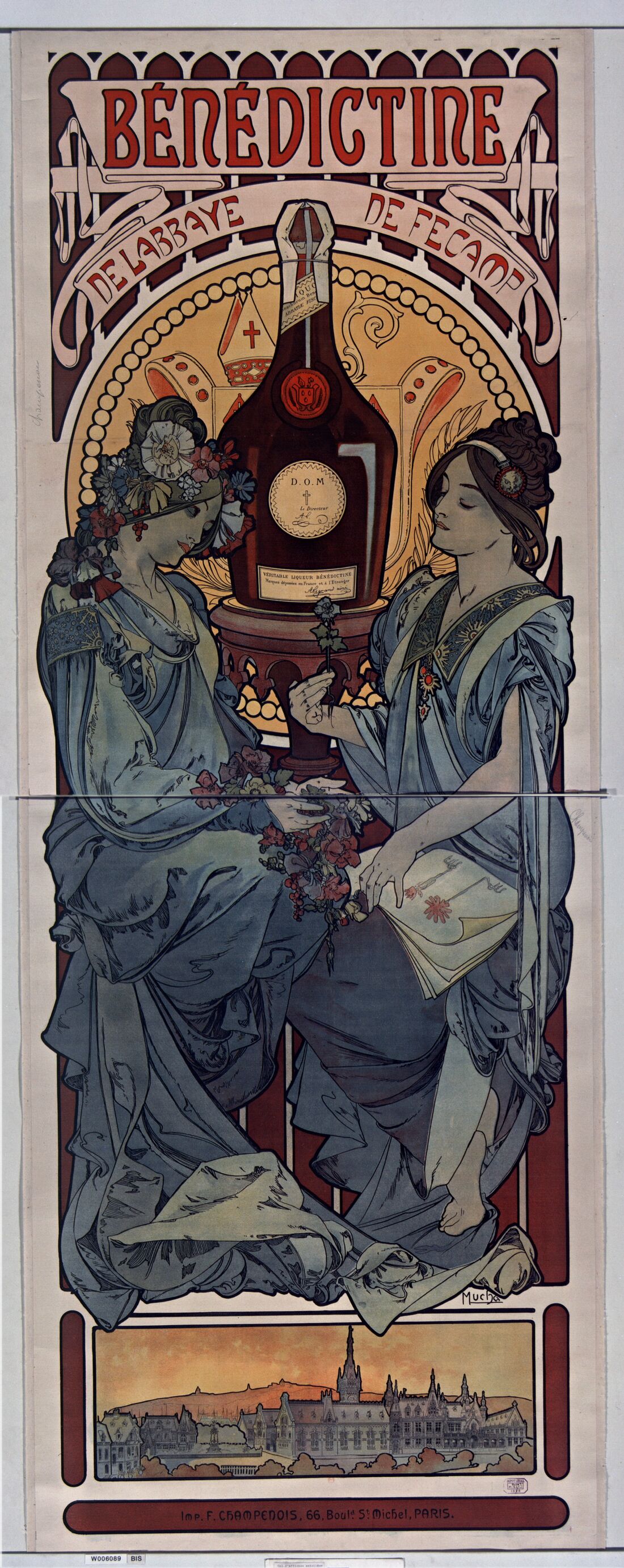
Bénédictine de l'Abbaye de Fécamp
Alfons Mucha (imprimerie F. Champenois) · 1898 · Colour lithograph
Alfons Mucha, Bénédictine de l'Abbaye de Fécamp, colour lithograph, printed by F. Champenois, 1898. A piece of advertising exhibited as a document: it shows monastic imagery melted into Art Nouveau.
Source gallica.bnf.fr / BnF, ark:/12148/btv1b9016446t — public domain.
Display case 05 of 07 1869-1898
Why so many monks on labels?
In the 19th century, the liqueur-making monk became a stock character. On 2 October 1869, Alphonse Daudet published in Le Figaro “L'Élixir du révérend père Gaucher” (The Elixir of the Reverend Father Gaucher), the story of a monk who saves his monastery by making a liqueur and loses his peace of soul in the process. The tale is a satire; it fixed a figure in people's minds.
Brands seized on it. Le Grand had “D.O.M.”, Deo Optimo Maximo, printed on his bottles, a Latin dedication that gives the label the look of a church inscription. Other liqueurs gave themselves a convent, an abbey or a brother, with no link to any religious order.
Mucha's poster of 1898 shows where this led: all that is left of the monastery is a small vignette at the bottom of the image. The religious reference has become one ornament among others, in the service of a brand.
Today, how can you recognise a liqueur genuinely linked to monks?
Next display caseHow we know
Degree of certainty
Attested — documented by first-hand sources or by solid historiography.
Sources
- Alphonse Daudet, “L'Élixir du révérend père Gaucher”, Le Figaro, 2 October 1869, reprinted in Lettres de mon moulin
- Victoria and Albert Museum, record O165139 (A. Mucha, Bénédictine, 1898)
- Gallica: A. Mucha, Bénédictine de l'Abbaye de Fécamp, 1898, ark:/12148/btv1b9016446t
Key object
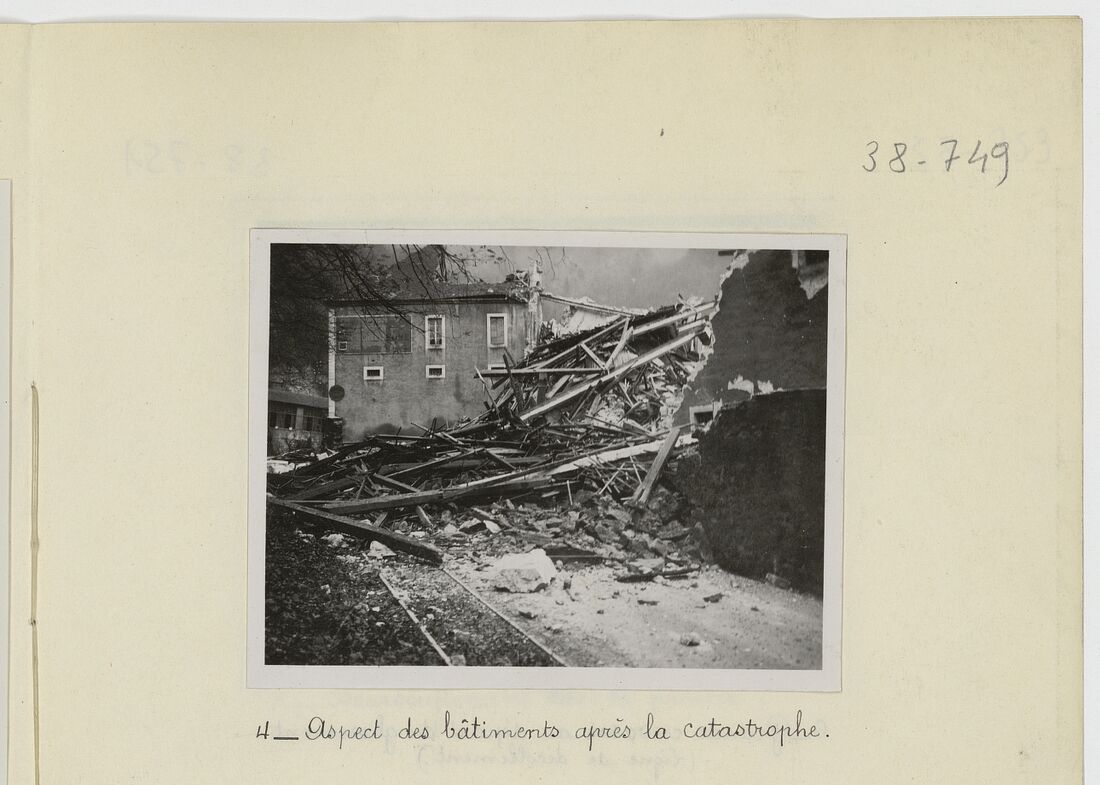
Glissement de Fourvoirie [novembre 1935], aspect des bâtiments après la catastrophe
Photographie anonyme · 1936
Glissement de Fourvoirie [novembre 1935], aspect des bâtiments après la catastrophe (The Fourvoirie landslide [November 1935]: the buildings after the disaster), photograph mounted on card, 1936. The original caption dates the accident to November; the order's account speaks of December 1935.
Source gallica.bnf.fr / BnF, ark:/12148/bd6t54546939x — public domain.
Display case 06 of 07 1935-2018
Where are the monks today?
At the end of 1935, a landslide destroyed most of Fourvoirie. The Carthusians moved their distillery to Voiron, where it stayed from 1936 to 2017; since 2018, it has stood at Aiguenoire, on land the order has owned since the 17th century. Production goes through a commercial company; according to the order, the composition is known to only two monks.
The making itself has hardly changed: the dried plants are macerated in alcohol and go through the still, then the liqueur ages for years in large oak vats. In Fécamp, Bénédictine follows a similar path: plants and spices, twenty-seven according to the house, several macerations and distillations, ageing in casks, honey and sugar, and an amber colour.
An abbey on the label proves nothing: the law reserves no “monastic” designation, and only private labels, such as “Authentic Trappist Product”, require production under the supervision of monks. Neither Chartreuse nor Bénédictine carries one: the former because Carthusians are not Trappists, the latter because no monk has ever worked there.
It remains to gather together what these six display cases have untangled.
What to take awayHow we know
Degree of certainty
Probable — historians agree, but a date or an attribution is still debated.
Sources
- Gallica: Glissement de Fourvoirie [novembre 1935], photograph, 1936, ark:/12148/bd6t54546939x
- Chartreuse Diffusion, “Les distilleries”, chartreuse.fr (Voiron 1936-2017, Aiguenoire 2018)
- Regulation (EU) 2019/787, Annex I, category 33 (liqueur)
- International Trappist Association, “ATP label”, trappist.be
Display case 07 of 07 Last display case
What to take away
Are monks' liqueurs made by monks?
The answer The monastery is first of all an image: behind Chartreuse, monks who have distilled since the 18th century and defend their name in the courts; behind Bénédictine, a 19th-century merchant who built his own abbey and invented his monk.
- Chartreuse has a monastic origin documented in the 18th century; the date of 1605 remains a tradition.
- The Carthusians defended their name in court from 1870, and kept it despite their expulsion in 1903.
- Bénédictine is a commercial creation of Alexandre Le Grand; Vincelli and 1510 are a brand legend.
- Green or yellow Chartreuse, amber Bénédictine: these are liqueurs of plants macerated, distilled, sweetened and aged in casks; an abbey on the label says nothing about how they are made.
Room opened on 3 October 2026. The texts are written by the SpiLi team and await review by the scholarly board.
← and → arrow keys: previous or next display case.