Room · Craft · Time and Wood
What does time do to an eau-de-vie?
A cask, a cellar, years. Six display cases to understand what happens between leaving the still and reaching the bottle, and what age statements really say.
7 display cases · about 7 minutes
Start the visitKey object
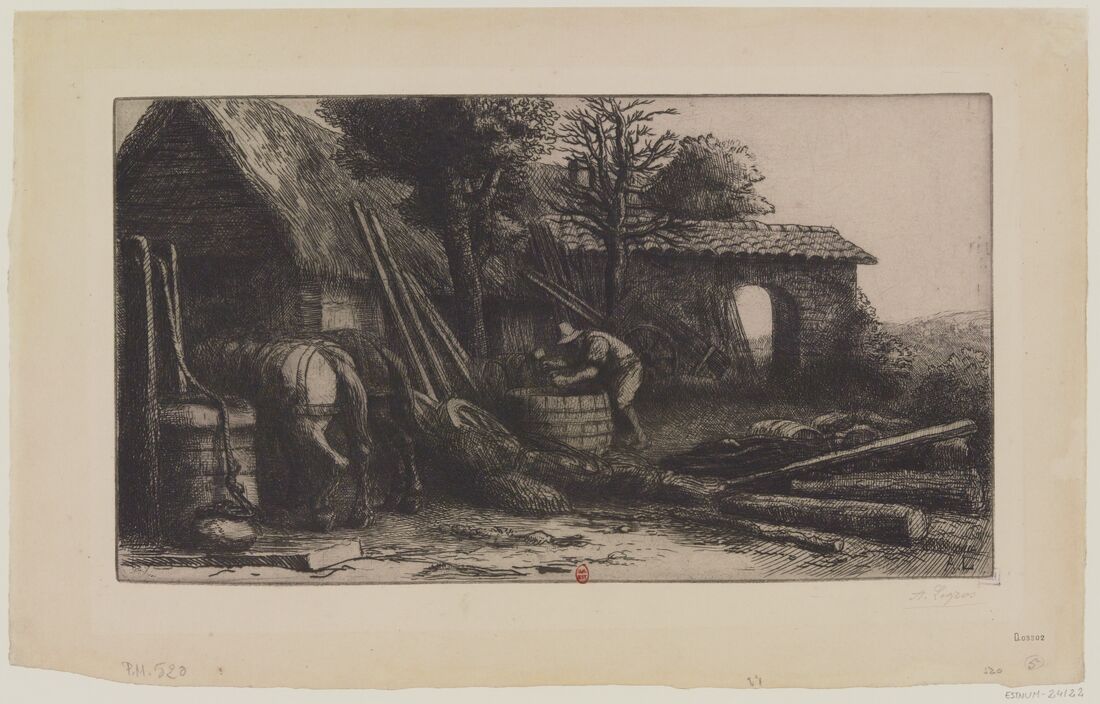
[Le tonnelier]
Alphonse Legros (graveur) · 1885-1893 · Etching
A cooper bent over his work in front of a thatched shed, etched by Alphonse Legros at the end of the 19th century. The cask is a craftsman's object before it is an instrument of ageing.
Source gallica.bnf.fr / BnF, ark:/12148/btv1b10545348c — public domain.
Display case 01 of 07 19th–21st century
Why oak?
In a Cognac cellar, the casks stand in several tiers, in the half-light and the smell of wood. The eau-de-vie, colourless when it goes in, spends at least two years there, and often decades. It may be aged only in oak: no other wood is permitted.
Two oaks, the sessile and the pedunculate, and two forests that have become reference points: the fine grain of Tronçais, in the Allier, which gives up its tannins slowly, and the coarse grain of the Limousin, more porous, which gives colour and substance more quickly.
Oak was not chosen for its taste, at first, but because it is strong, watertight and splits well into staves. Its aromatic qualities were recognised afterwards, and codified later still.
A cask is not a mere container: depending on its age, it gives a great deal or almost nothing.
Next display caseHow we know
Degree of certainty
Attested — documented by first-hand sources or by solid historiography.
Sources
- Product specification of the AOC “Cognac”, published in the BO Agri on 18 June 2026, part D, 9° (ageing) and part F (link with the origin: Tronçais, Limousin)
- Gallica: A. Legros, [Le tonnelier], etching, 1885-1893, ark:/12148/btv1b10545348c
Key object
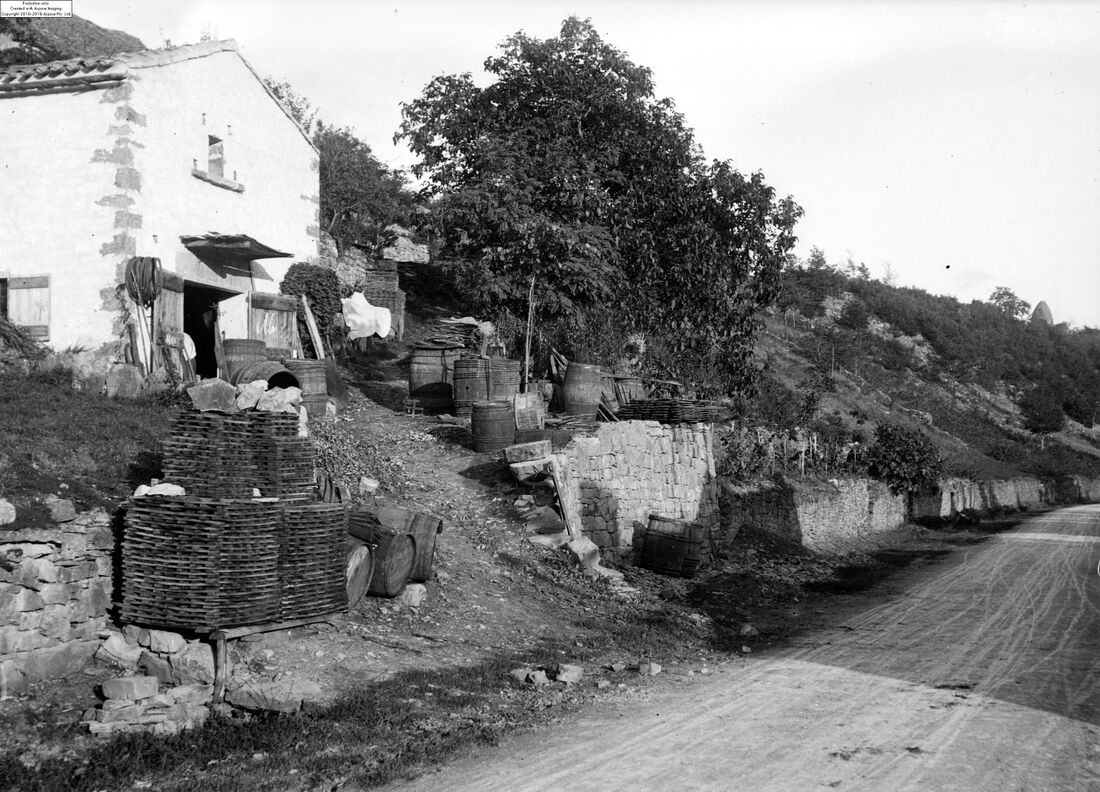
Tonnelier, Ginals, 26 septembre 1901
Eugène Trutat (photographe) · 1901 · Photograph
Barrels and wooden hoops set down by a roadside at Ginals, in the Tarn-et-Garonne, photographed by Eugène Trutat in September 1901. Casks were still made by hand, in every village.
Source gallica.bnf.fr / BnF, ark:/12148/btv1b10577669d — public domain.
Display case 02 of 07 1901
Do a new cask and an old cask make the same eau-de-vie?
The cooper splits the oak into staves, leaves them to dry in the open air for years, then bends them over a fire. This toasting browns the inside of the cask; it changes what the wood will give up to the eau-de-vie.
A new cask gives a great deal: tannins, colour, notes of vanilla. A cask that has already been used — at Cognac it is called “roux” — gives less, and more slowly. The cellar master moves an eau-de-vie from one to the other according to what he is looking for.
The cask also breathes. The wood lets a little air through: the eau-de-vie oxidises slowly, and it is this oxidation, as much as what it draws from the wood, that transforms it.
While the wood gives, the eau-de-vie itself slips away.
Next display caseHow we know
Degree of certainty
Probable — historians agree, but a date or an attribution is still debated.
Sources
- Product specification of the AOC “Cognac”, published in the BO Agri on 18 June 2026, part F (young casks and “roux” casks, extraction and oxidation)
- Gallica: E. Trutat, Tonnelier, Ginals, 26 September 1901, ark:/12148/btv1b10577669d
Key object
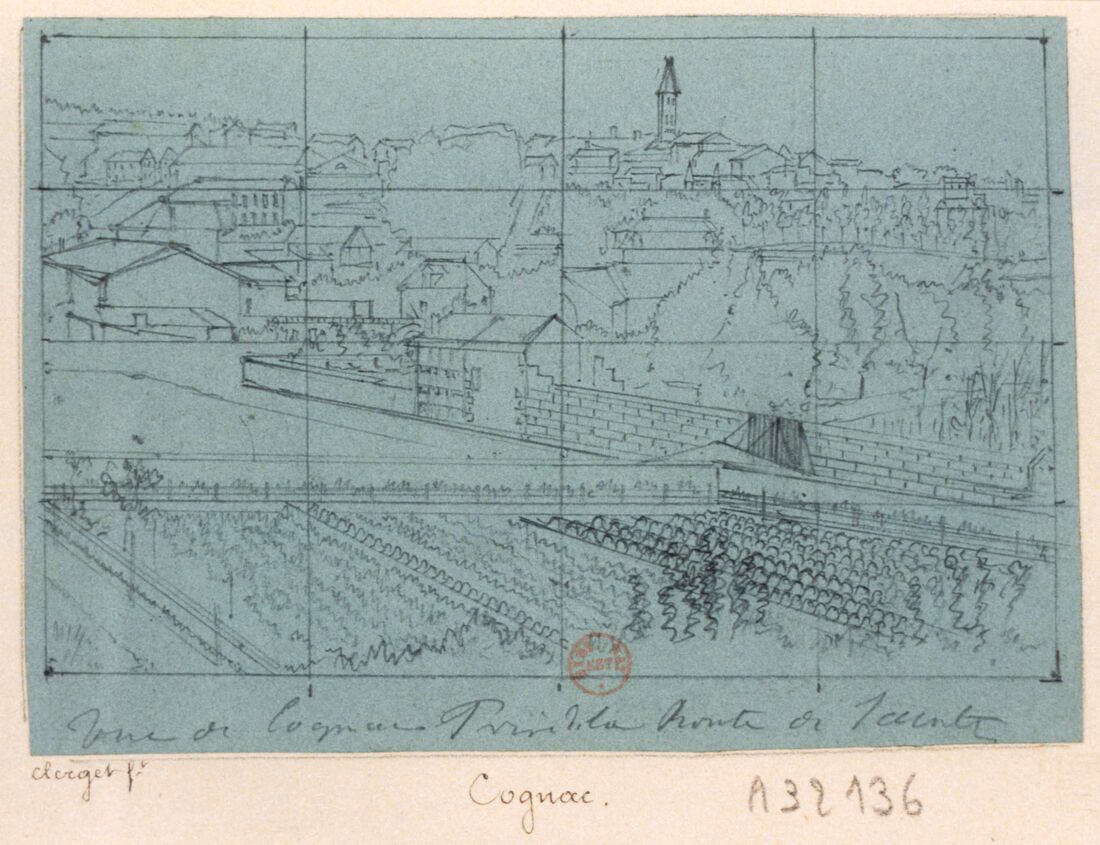
Vue de Cognac prise de la route de Saintes
Hubert Clerget (dessinateur) · XIXe siècle · Pencil on blue paper
The town of Cognac seen from the Saintes road, drawn in pencil by Hubert Clerget in the 19th century and squared up for engraving. The merchants' cellars stand in line along the Charente.
Source gallica.bnf.fr / BnF, ark:/12148/btv1b7741948x — public domain.
Display case 03 of 07 1872-2007
Where does the eau-de-vie that evaporates go?
Wood is not vapour-tight. Every year, part of the water and alcohol in a cask evaporates through the staves. The trade calls it the “angels' share”; the Cognac product specification itself uses the expression.
These vapours are not entirely lost. Around the cellars of Cognac, walls, roofs and trees are covered with a black deposit: a microscopic fungus that feeds on the alcohol in the air. The pharmacist Antonin Baudoin reported it in the 19th century; mycologists described and named it in 2007, Baudoinia compniacensis.
A town blackened by its industry, without any smoke: it is one of the most visible traces of ageing, and one of the least known.
« Ces vapeurs d'alcool (appelées poétiquement « la part des anges ») représentent chaque année l'équivalent de plusieurs millions de bouteilles. (These alcohol vapours, poetically called “the angels' share”, amount each year to the equivalent of several million bottles.) »
Fact or legend? « The angels' share blackens the walls of Cognac. » Decide before you open it. See the answer
It is a fact.
The black deposit on the walls around the cellars is a fungus, Baudoinia compniacensis, which feeds on alcohol vapour. It was described scientifically in 2007 (Scott et al., Mycologia); it is found around all large ageing facilities.
What remains in the cask is not yet a bottle: it still has to be chosen and blended.
Next display caseHow we know
Degree of certainty
Attested — documented by first-hand sources or by solid historiography.
Sources
- Product specification of the AOC “Cognac”, published in the BO Agri on 18 June 2026, part F
- J. A. Scott et al., “Baudoinia, a new genus to accommodate Torula compniacensis”, Mycologia, 99 (4), 2007, pp. 592-601
- Gallica: H. Clerget, Vue de Cognac prise de la route de Saintes, ark:/12148/btv1b7741948x
Key object
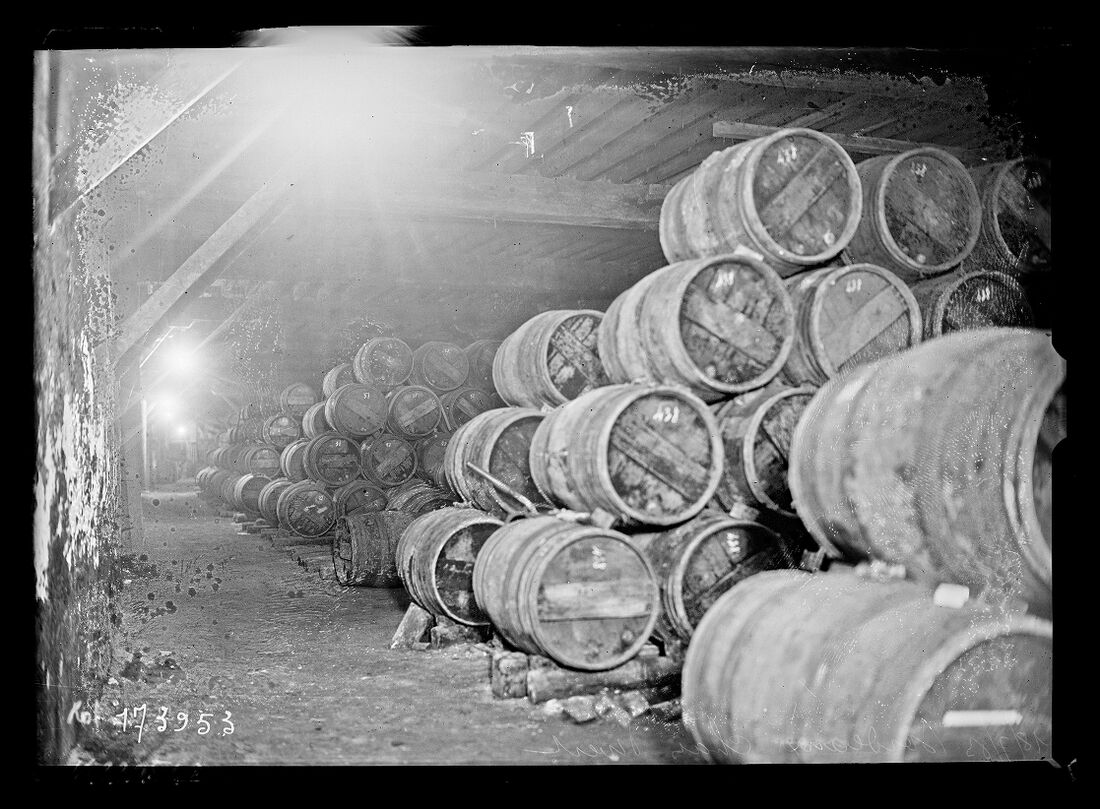
Bordeaux, chais Pivert [tonneaux empilés dans le chai]
Agence Rol (photographie de presse) · 1933 · Press photograph
A merchant's cellar in Bordeaux, in 1933: rows of casks lying on several levels. They hold wines, not eaux-de-vie, but the arrangement is the same as at Cognac — casks, rows, and someone who tastes and decides.
Source gallica.bnf.fr / BnF, ark:/12148/btv1b53277458h — public domain.
Display case 04 of 07 20th–21st century
Who decides what a cognac tastes like?
Almost no cognac comes from a single cask. The cellar master goes from cask to cask, draws samples, noses, compares; from lots of different crus, ages and woods, he composes an eau-de-vie that must stay the same from one year to the next. Blending is not a shortcut: it is the heart of the craft.
He also brings down the strength. The eau-de-vie leaves the still at about 70%; it must be put on sale at no less than 40%. It is reduced little by little with water, often over several years.
Lastly, he may make adjustments, within narrow limits: a little caramel for colour, a little sugar, an infusion of oak chips known as “boisé”. The taste of a cognac is a construction, made of memory and sense of smell, year after year.
A bottle that blends several ages: what age, then, does its label state?
Next display caseHow we know
Degree of certainty
Attested — documented by first-hand sources or by solid historiography.
Sources
- Product specification of the AOC “Cognac”, published in the BO Agri on 18 June 2026, part D, 10° (blending and finishing) and part B (minimum strength of 40%)
- Gallica: Agence Rol, Bordeaux, chais Pivert, 1933, ark:/12148/btv1b53277458h
Key object
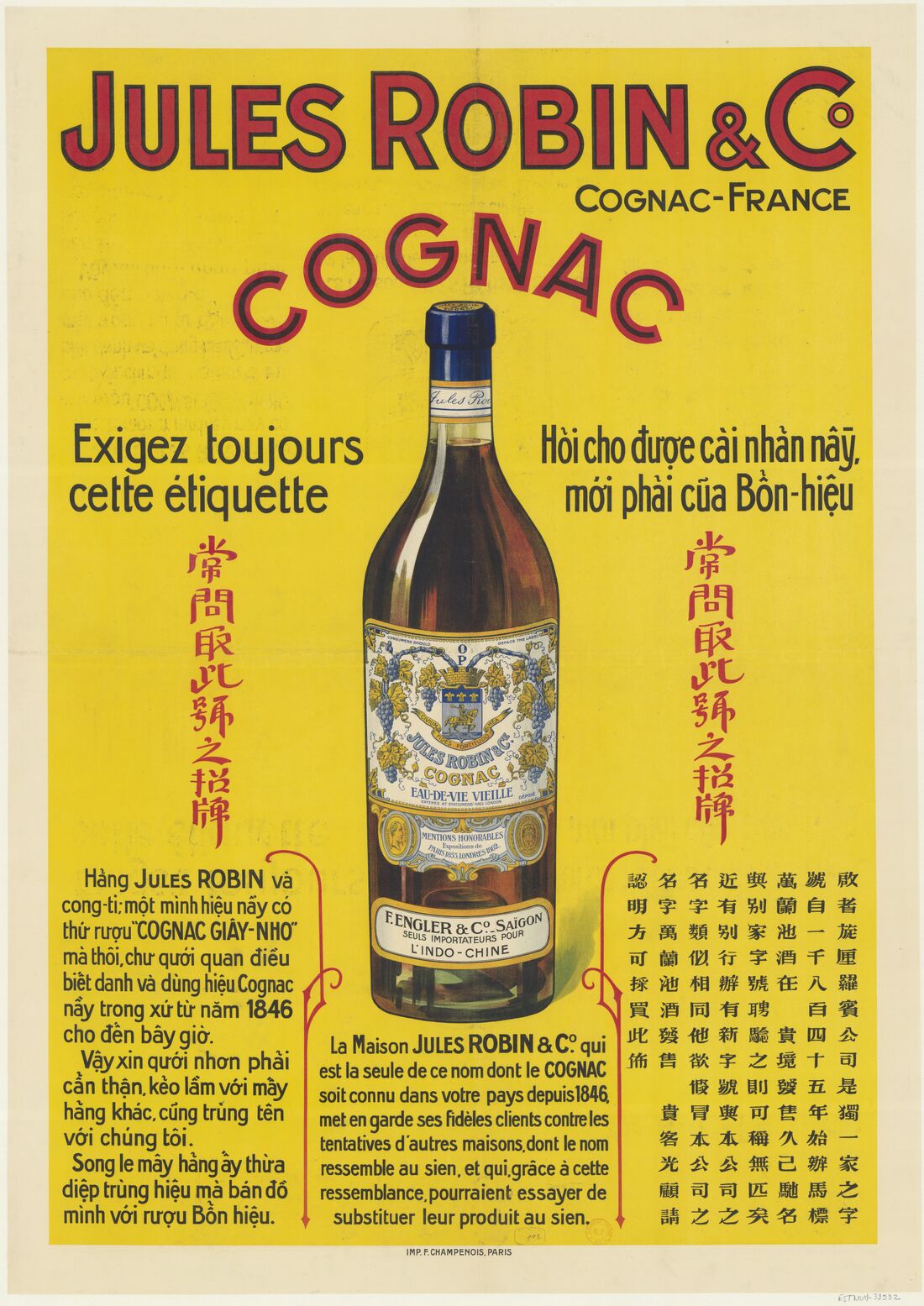
Jules Robin & Cº Cognac… Exigez toujours cette étiquette
Affiche non signée · 1913 · Colour lithograph
A 1913 poster written in French, Chinese and Vietnamese, which shows nothing but a label and asks people to check that it is there. A piece of advertising exhibited as a document: long before today's comptes, the label was already a guarantee that one learned to read.
Source gallica.bnf.fr / BnF, ark:/12148/btv1b53205534d — public domain.
Display case 05 of 07 1913-2026
What do VS, VSOP and XO mean?
At Cognac, age is reckoned in “comptes”, or counts. The year begins on the 1 April following the harvest; an eau-de-vie that has spent two full years in wood is at compte 2, four years at compte 4, and so on.
The designations on the label refer to these comptes. VS or “3 étoiles” (three stars): compte 2. VSOP or “Réserve”: compte 4. “Napoléon”: compte 6. XO, “Hors d'âge” or “Extra”: compte 10. XXO: at least fourteen years. The threshold for XO was raised from six to ten years in the 2010s.
The rule applies to the youngest eau-de-vie in the blend. An XO may contain eaux-de-vie thirty years old, but none younger than ten. The label guarantees a minimum, not an average.
What the years bring can be perceived by smell. Young, cognac keeps fresh fruit and vine blossom; old, it takes on notes of dried fruit, vanilla and spice, then what cellar masters call “rancio”, a note of walnut and forest floor.
Fact or legend? « The age indicated by a designation such as XO is the average age of the eaux-de-vie in the bottle. » Decide before you open it. See the answer
It is a legend.
The product specification sets the minimum age of the eaux-de-vie shipped: the designation applies to the youngest in the blend. An average is never guaranteed, and in practice it is higher than the threshold.
One question remains, which everyone asks in front of an old bottle: does it go on ageing?
Next display caseHow we know
Degree of certainty
Attested — documented by first-hand sources or by solid historiography.
Sources
- Product specification of the AOC “Cognac”, published in the BO Agri on 18 June 2026, part I, b) (age comptes and designations)
- BNIC, “Les comptes de vieillissement”, cognac.fr (XO raised to compte 10)
- Gallica: Jules Robin & Cº Cognac... Exigez toujours cette étiquette, poster, 1913, ark:/12148/btv1b53205534d
Key object
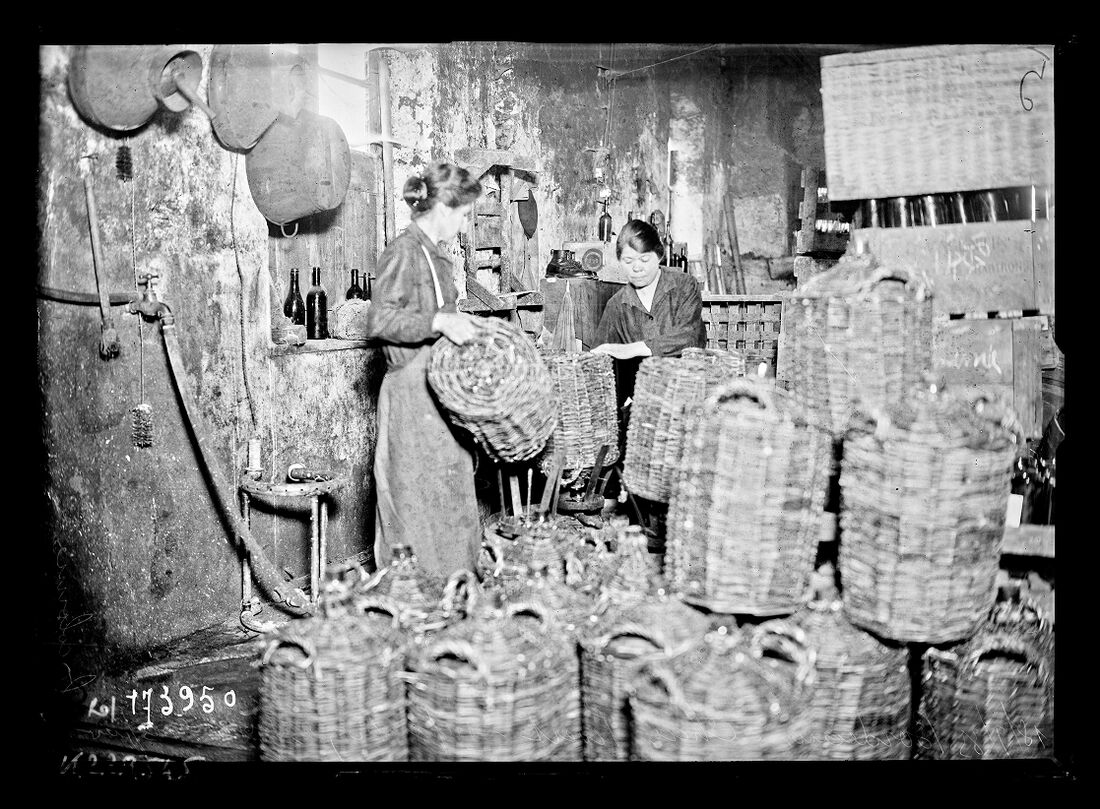
Bordeaux, chais Pivert, préparation des bonbonnes pour les colonies [nettoyage des dames-jeannes]
Agence Rol (photographie de presse) · 1933 · Press photograph
Cleaning wicker-covered demijohns in a Bordeaux cellar, in 1933. Glass halts ageing: it is where eaux-de-vie that have reached the point sought are kept safe.
Source gallica.bnf.fr / BnF, ark:/12148/btv1b53277460b — public domain.
Display case 06 of 07 1933-2026
Does an eau-de-vie age in the bottle?
As it leaves the still, an eau-de-vie is colourless. Its colour comes from the wood: from pale yellow, it turns over the years to gold, then to amber and mahogany. A new cask tints it quickly; an old cask, barely.
Colour is therefore no proof of age, all the more so as the cellar master may adjust it with a little caramel. That is why the label counts years, not shades.
In glass, the work stops. Without wood or air, an eau-de-vie hardly changes any more: those that have taken enough from the cask are stored in demijohns. A bottle from 1950 opened today is the age it was when it was bottled.
It remains to gather together what wood and time have done, and what they have not.
What to take awayHow we know
Degree of certainty
Attested — documented by first-hand sources or by solid historiography.
Sources
- Product specification of the AOC “Cognac”, published in the BO Agri on 18 June 2026, part B (colour, absorbance at 420 nm) and part D, 10° b) (caramel E150a)
- BNIA, “Le vieillissement”, armagnac.fr (ageing halted in glass demijohns)
- Gallica: Agence Rol, Bordeaux, chais Pivert, préparation des bonbonnes, 1933, ark:/12148/btv1b53277460b
Display case 07 of 07 Last display case
What to take away
What does time do to an eau-de-vie?
The answer Time alone does nothing: it is the wood that does the work. An eau-de-vie leaves the still colourless; oak, the air of the cellar and evaporation give it its colour and its aromas, then a cellar master blends the ages together. In glass, it ages no further.
- An eau-de-vie leaves the still colourless: the colour and aromas of ageing come from oak and from air.
- The angels' share is real and visible: it blackens the walls around the cellars.
- An age statement guarantees the age of the youngest eau-de-vie in the blend, not an average.
- In the bottle, an eau-de-vie no longer ages.
Room opened on 3 October 2026. The texts are written by the SpiLi team and await review by the scholarly board.
← and → arrow keys: previous or next display case.