Room · Craft · The Still
Who invented the still?
A vessel, a head, a tube that cools: the apparatus has changed little in nearly two thousand years, but what is asked of it has changed completely. Six display cases, from the quest for gold to the law on home distillers.
7 display cases · about 7 minutes
Start the visitKey object
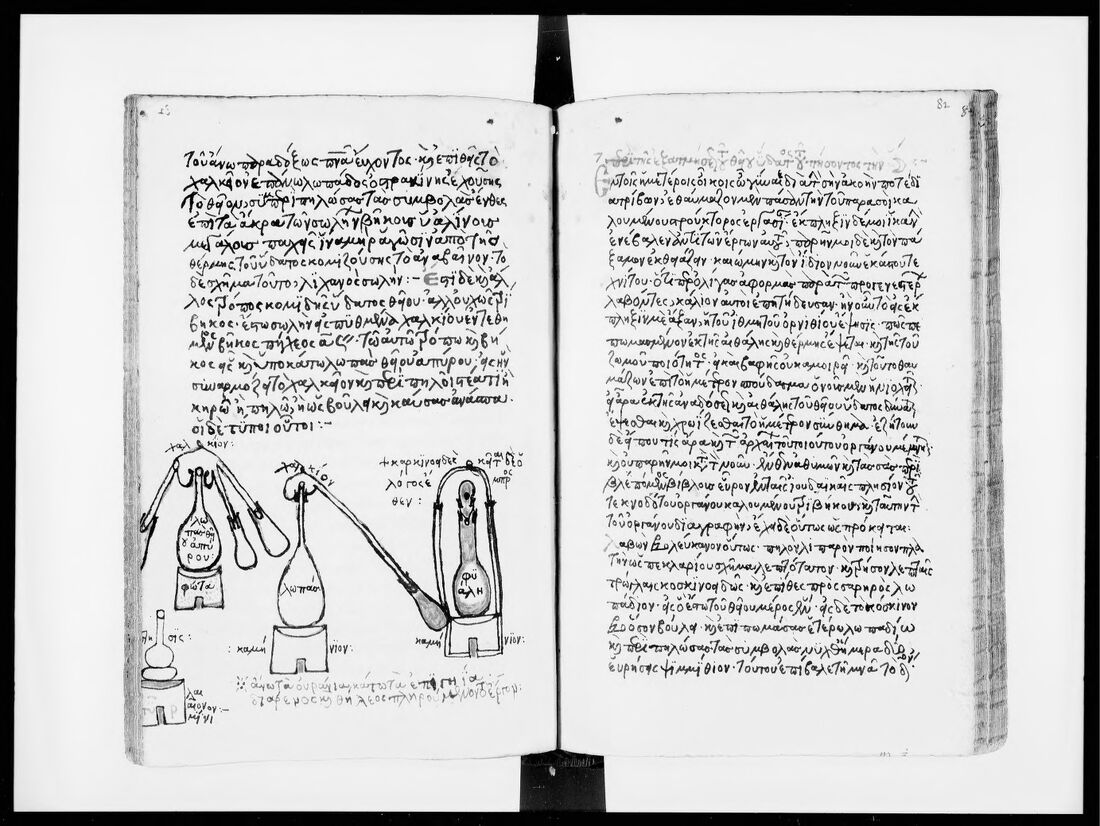
Grec 2327 : recueil des alchimistes grecs, dessins d'appareils
Théodore Pélécanos (copiste) · 1478 · Manuscript on paper, ink
The apparatus of Zosimos and Mary, drawn in pen beside the text, in a Byzantine copy of 1478. No ancient original has survived: what we know of these instruments comes to us through copies made more than a thousand years later.
Source gallica.bnf.fr / BnF, ark:/12148/btv1b10723905w — public domain.
Display case 01 of 07 c. 300
What were the first distillers looking for?
Around the year 300, at Panopolis, in Egypt, the alchemist Zosimos described apparatus that heats a substance, collects its vapours and condenses them. He attributed it to an earlier woman, Mary the Jewess, known only through his quotations: a three-spouted vessel, the tribikos, and other devices fitted with a head.
These scholars were not trying to make something to drink. They worked with sulphur, mercury, metals; they sought to separate the spirit of a substance from its body. For them, distillation was an operation of transformation, not a way of making drinks.
The word has survived. The Greek ambix meant a vessel; Arabic-speaking scholars made it al-anbiq, and medieval Latin alambicus. The object travelled with its name, from one translation to the next.
Fact or legend? « The bain-marie owes its name to Mary the Jewess. » Decide before you open it. See the answer
It is more complicated.
Heating in a water bath is indeed described in the Greek alchemical texts. But the name “bain-marie” appears only in medieval Latin, balneum Mariae, and linking it to Mary the Jewess is a tradition: others have traced it to the Virgin. The link is plausible; it is not proven.
A thousand years later, the apparatus was put to another use: wine went into it.
Next display caseHow we know
Degree of certainty
Probable — historians agree, but a date or an attribution is still debated.
Sources
- M. Mertens (ed.), Zosime de Panopolis, Mémoires authentiques, Les Alchimistes grecs, vol. IV, Paris, Les Belles Lettres, 1995
- M. Berthelot and C.-É. Ruelle, Collection des anciens alchimistes grecs, Paris, 1887-1888
- Gallica: BnF, Grec 2327, ff. 81v-82, ark:/12148/btv1b10723905w
- CNRTL, “alambic”, etymology (TLFi)
Key object
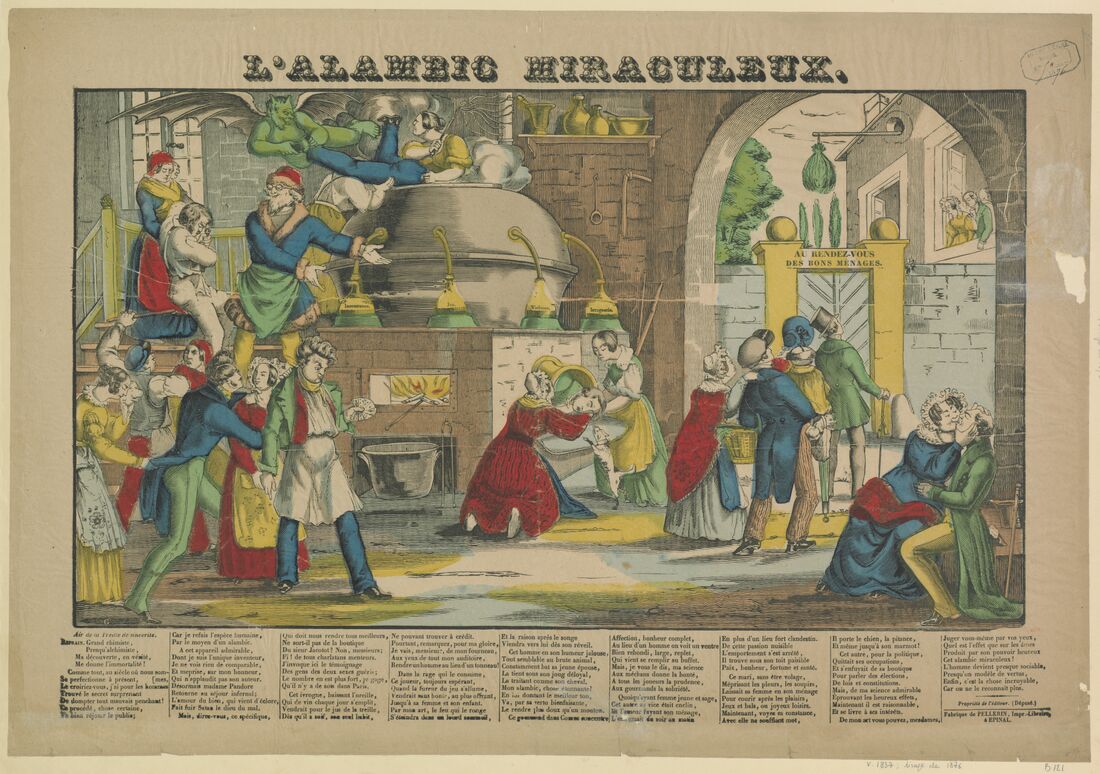
L'alambic miraculeux
Georgin (imagerie Pellerin, Épinal) · 1837
A popular Épinal print of 1837: old people go into a giant still and come out young again. Six centuries after the physicians of Salerno, the promise of aqua vitae had become a subject of mockery — proof that everyone still knew it.
Source gallica.bnf.fr / BnF, ark:/12148/btv1b6937925s — public domain.
Display case 02 of 07 12th–14th century
When was alcohol first drawn from wine?
The first reliable Latin recipes for a “water that burns”, aqua ardens, drawn from wine, date from the 12th century. One of them was added to a collection of technical recipes, the Mappae clavicula, partly written in cipher, like a trade secret. They are linked to the medical milieu of Salerno, in southern Italy.
In the 13th century, the Florentine physician Taddeo Alderotti, who died in 1295, described the cooling of the tube and the virtues of aqua vitae, “water of life”. The name says what it was for: a medicine, reputed to preserve and revive, prescribed by the spoonful.
This was a turning point. The alchemists' apparatus became an apothecary's instrument. For two more centuries, aqua vitae was sold by apothecaries.
The physicians' knowledge stayed in rare manuscripts. Printing would set it circulating.
Next display caseHow we know
Degree of certainty
Probable — historians agree, but a date or an attribution is still debated.
Sources
- R. J. Forbes, A Short History of the Art of Distillation, Leiden, Brill, 1948
- Taddeo Alderotti, De virtutibus aquae vitae, 13th century (edited in his Consilia)
- Gallica: Georgin, L'alambic miraculeux, Épinal, Pellerin, 1837, ark:/12148/btv1b6937925s
Key object
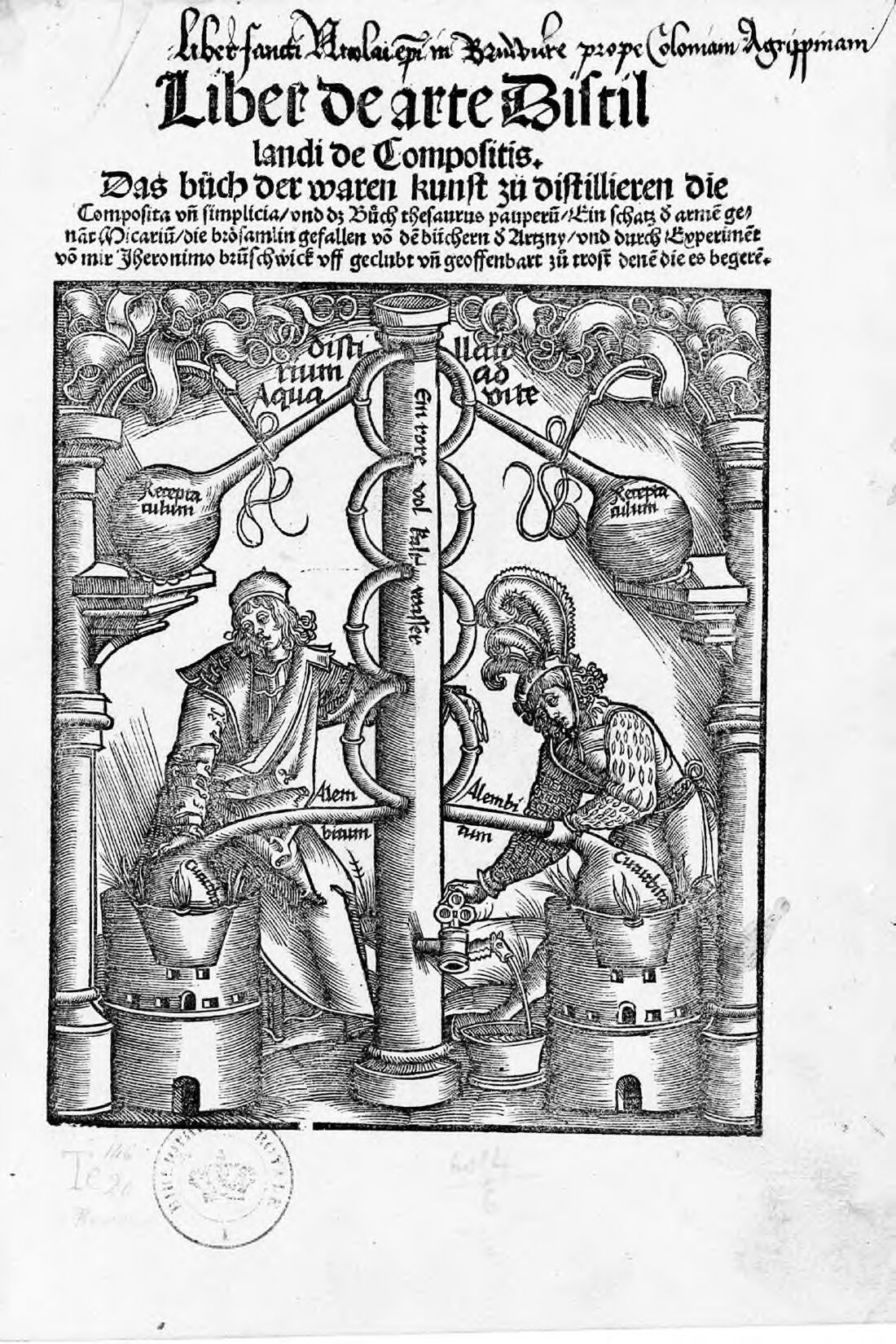
Illustrations de Liber de arte distillandi de compositis
Hieronymus Brunschwig · 1512 · Woodcut
The title page of Brunschwig's great book, in 1512: two distillers, on either side of a column, each tend their own apparatus. Cooling by a vessel of water, which the physicians had described, is shown here for all to see.
Source gallica.bnf.fr / BnF, ark:/12148/btv1b2100006k — public domain.
Display case 03 of 07 1500-1512
How did a secret become a manual?
On 8 May 1500, the printer Johann Grüninger published in Strasbourg the Liber de arte distillandi de simplicibus by the surgeon Hieronymus Brunschwig: a manual of distilling, in German despite its Latin title, illustrated with woodcuts showing the furnaces, the still heads, the coils.
In 1512, a second, fuller book followed. These were not treatises for scholars: they were addressed to apothecaries, surgeons and private individuals, and described for each plant the water drawn from it and what it cured.
With print, the forms of the apparatus became fixed and were copied from one country to another. The still was no longer the tool of a closed circle: it could be learned from a book.
Three centuries later, in the Charente, the still heated over an open flame became the rule of an appellation.
Next display caseHow we know
Degree of certainty
Attested — documented by first-hand sources or by solid historiography.
Sources
- Hieronymus Brunschwig, Liber de arte distillandi de simplicibus, Strasbourg, Johann Grüninger, 1500
- Hieronymus Brunschwig, Liber de arte distillandi de compositis, Strasbourg, 1512
- Gallica: illustrations from the Liber de arte distillandi de compositis, ark:/12148/btv1b2100006k
Key object
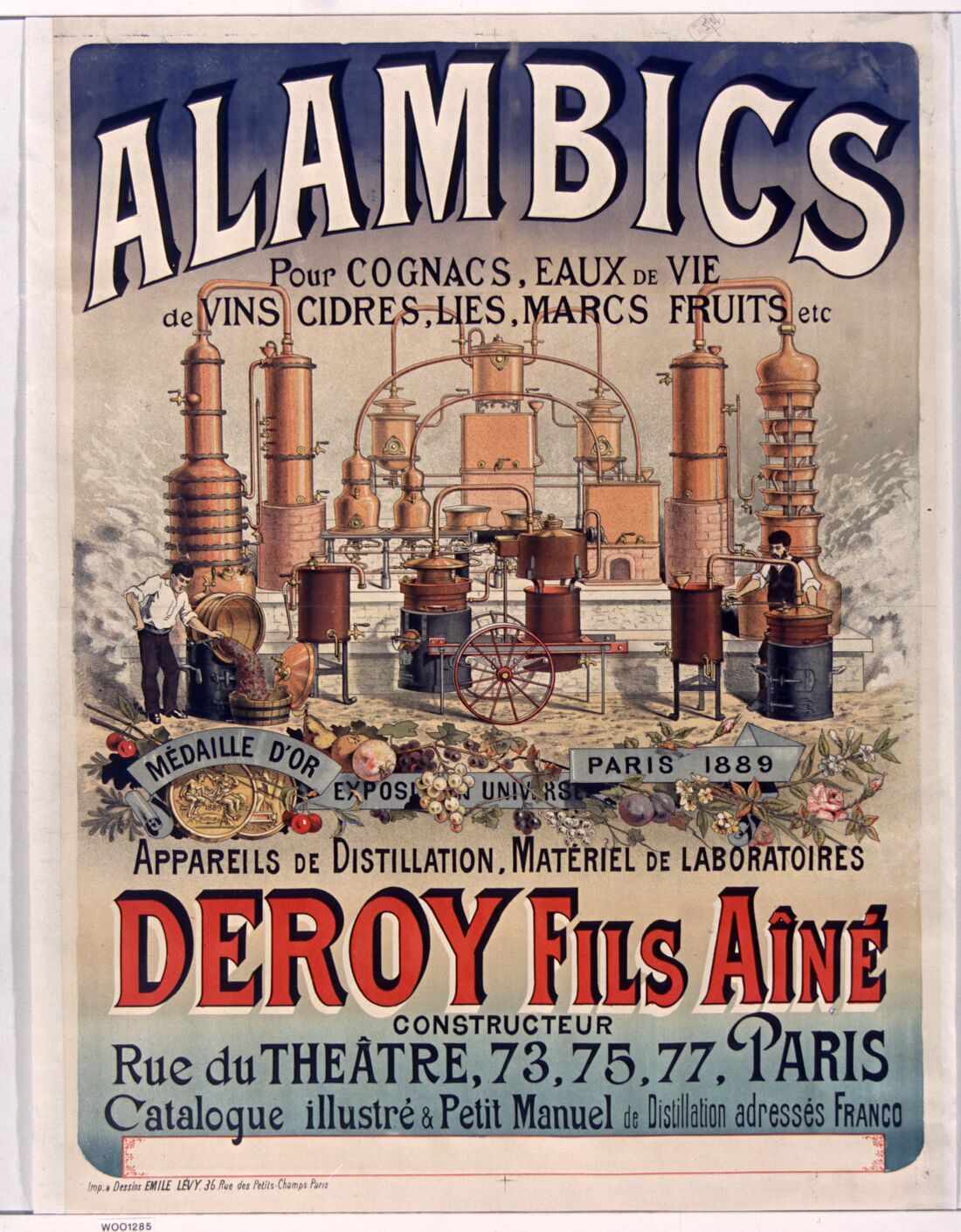
Alambics pour cognacs, eaux-de-vie de vins, cidres, lies, marcs, fruits… Deroy fils aîné, constructeur
Affiche non signée · 1890 · Colour lithograph
A Parisian manufacturer's poster, around 1890, lines up its models from the smallest to the largest — for double distillation, with a column or on wheels. The still had become an industrial product chosen from a catalogue; the appellation rule would keep only one.
Source gallica.bnf.fr / BnF, ark:/12148/btv1b9005152x — public domain.
Display case 04 of 07 17th century–2026
Why distil twice?
In the Charente, wine is distilled twice. The first heating gives the brouillis, low in alcohol; the second, the “repasse” or “bonne chauffe”, gives the spirit, from which the distiller sets aside the beginning and the end, too heavily laden with unwanted compounds.
The work is slow. In the copper still heated over an open flame, the wine boils gently; its vapours rise into the head, pass through the swan neck and come down again to condense in the coil, immersed in cold water. At the spout, the distiller watches the clear stream and its strength to know when to cut: the heads, then the heart, then the seconds and the tails, which go back into later distillations. The season lasts all winter, until the 31 March following the harvest.
Distilling in small charges, watching every cut, keeps in the distillate part of the aromas of the wine and its lees. The Cognac product specification has made it a rule: the Charentais still, made of copper and heated over an open flame, has become part of the definition of the product.
At the same time, other distillers had chosen the opposite: never stopping the apparatus.
Next display caseHow we know
Degree of certainty
Attested — documented by first-hand sources or by solid historiography.
Sources
- Product specification of the AOC “Cognac”, published in the BO Agri on 18 June 2026, part D, 8° (distillation)
- Gallica: Alambics pour cognacs... Deroy fils aîné, constructeur, poster, ark:/12148/btv1b9005152x
Key object
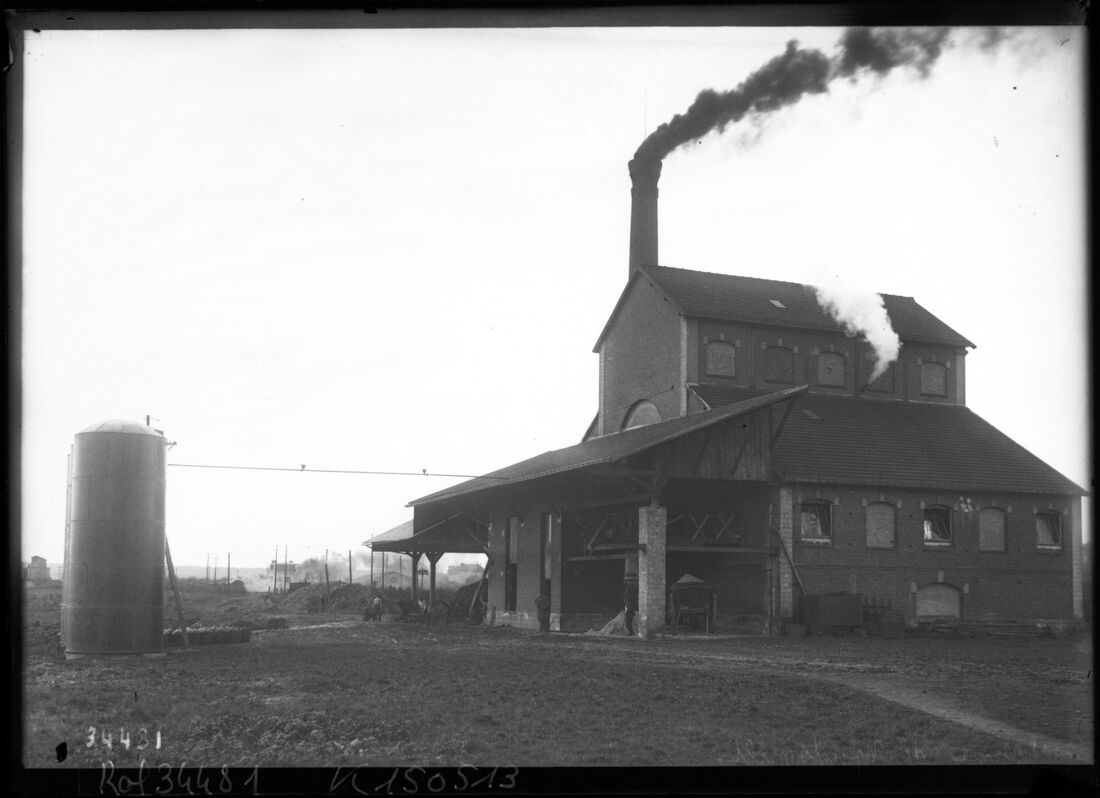
Distillerie de Montsoult, vue générale du bâtiment
Agence Rol (photographie de presse) · 1913 · Press photograph
The Montsoult distillery, in the Val-d'Oise, photographed in 1913: a hall, a boiler house, a tall chimney. This is no longer an apparatus to be watched over; it is a factory that runs.
Source gallica.bnf.fr / BnF, ark:/12148/btv1b6927784p — public domain.
Display case 05 of 07 1801-1830
Can you distil without stopping?
The classic still works in batches: fill, heat, empty, start again. At the beginning of the 19th century, several inventors were looking for an apparatus that would distil continuously. In Languedoc, Édouard Adam patented a multi-vessel apparatus in 1801; in 1813, Jean-Baptiste Cellier-Blumenthal patented a column in which the wine runs down from plate to plate to meet the rising vapour.
The British carried the work forward: the Scot Robert Stein patented a column in 1826, then the Irishman Aeneas Coffey, in 1830, the one that bears his name. It produced a very pure alcohol, in large quantities and at low cost: it became the apparatus for grain, beet and molasses spirits, and then for great factories like this one.
In Armagnac, a more modest column, the Armagnac still, became established in the 19th century. It yields a spirit of between 52 and 72%: continuous distillation does not erase every aroma; everything depends on how the apparatus is run.
Yet at the other end of the scale, there remains a still that travels from village to village.
Next display caseHow we know
Degree of certainty
Probable — historians agree, but a date or an attribution is still debated.
Sources
- R. J. Forbes, A Short History of the Art of Distillation, Leiden, Brill, 1948 (Adam, Cellier-Blumenthal, Stein, Coffey)
- Product specification of the GI “Armagnac”: continuous distillation, strength of 52 to 72%
- Gallica: Agence Rol, Distillerie de Montsoult, 1913, ark:/12148/btv1b6927784p
Key object
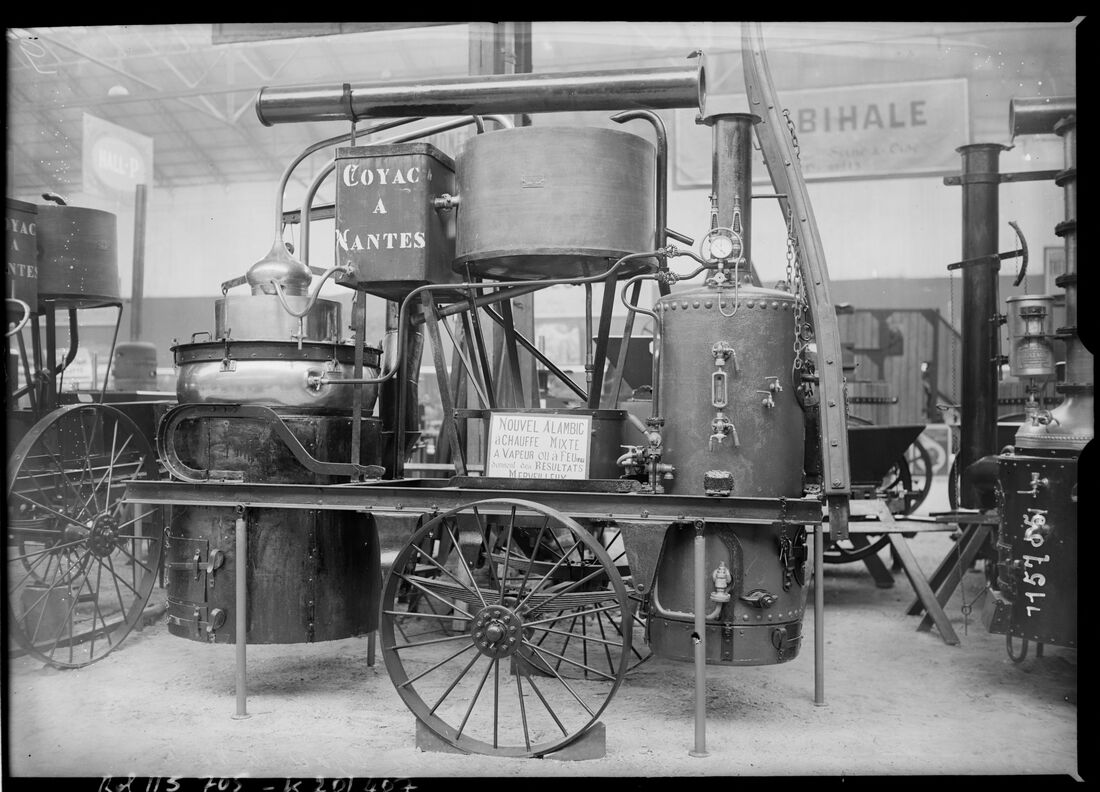
VIe salon de la machine agricole, alambic Coyac de Nantes
Agence Rol (photographie de presse) · 1927 · Press photograph
A still mounted on a four-wheeled chassis, shown at the agricultural machinery fair in 1927. It is the French form of peasant distillation: the apparatus comes to the orchard, not the other way round.
Source gallica.bnf.fr / BnF, ark:/12148/btv1b53172665b — public domain.
Display case 06 of 07 1916-2007
Who has the right to distil at home?
In autumn and winter, in orchard country, the travelling still arrives on its trailer and sets up for a few days on the village square. Owners bring their barrels of fermented fruit — plums, pears, apples — or their grape marc; the distiller lights the fire, and the spirit runs off through the day, every litre declared to customs.
Those who have their own harvest distilled are the bouilleurs de cru, the home distillers. From 1916 to 2007, an allowance exempted their first ten litres of pure alcohol from duty; closed to new holders in 1960, it died out on 31 December 2007 with the last people who still had it.
The right to distil remains; the village still, though, is becoming rare. What goes with it is a peasant practice: spirit drawn once a year from one's own harvest, on the square, among the neighbours.
Fact or legend? « The home distillers' privilege was granted by Napoleon to his former soldiers. » Decide before you open it. See the answer
It is a legend.
No imperial text created this privilege. The ten-litre allowance was born of a law of 1916, in the middle of the war, and extended to all producers in 1923. The tale of Napoleon's “grognards”, his old soldiers, is a fireside legend.
From Zosimos to the home distiller's trailer, it remains to say what this long history teaches us.
What to take awayHow we know
Degree of certainty
Probable — historians agree, but a date or an attribution is still debated.
Sources
- Ordonnance n° 60-907 du 30 août 1960
- Assemblée nationale, ministerial answers to written questions on home distillers (bouilleurs de cru), 13th legislature (allowance of 1916, extension of 1923, end on 31 December 2007)
- Gallica: Agence Rol, VIe salon de la machine agricole, alambic Coyac de Nantes, 1927, ark:/12148/btv1b53172665b
Display case 07 of 07 Last display case
What to take away
Who invented the still?
The answer No one: the still has no inventor, only a long chain of people who passed it on. From the alchemists of Egypt to the physicians of Salerno, from the printers of Strasbourg to the builders of columns, each age transformed it for a different use — and it is the apparatus, as much as the fruit, that makes the spirit.
- The still has no inventor: its forms come from Greek alchemy, and its name passed through Arabic.
- Wine has been distilled in the West since the 12th century, at first as a cure.
- Print, in 1500, made distilling a body of knowledge that could be learned from a book.
- The choice of apparatus — double distillation or column — is part of the definition of a spirit.
Room opened on 3 October 2026. The texts are written by the SpiLi team and await review by the scholarly board.
← and → arrow keys: previous or next display case.