Room · History · The Green Fairy
Why did France ban absinthe?
In 1901, absinthe resurfaces at the source of the Loue; in 1915, it is outlawed. Seven display cases following a pharmacy elixir that became an industry, an emblem, a scapegoat, then a geographical indication.
8 display cases · about 8 minutes
Start the visitKey object
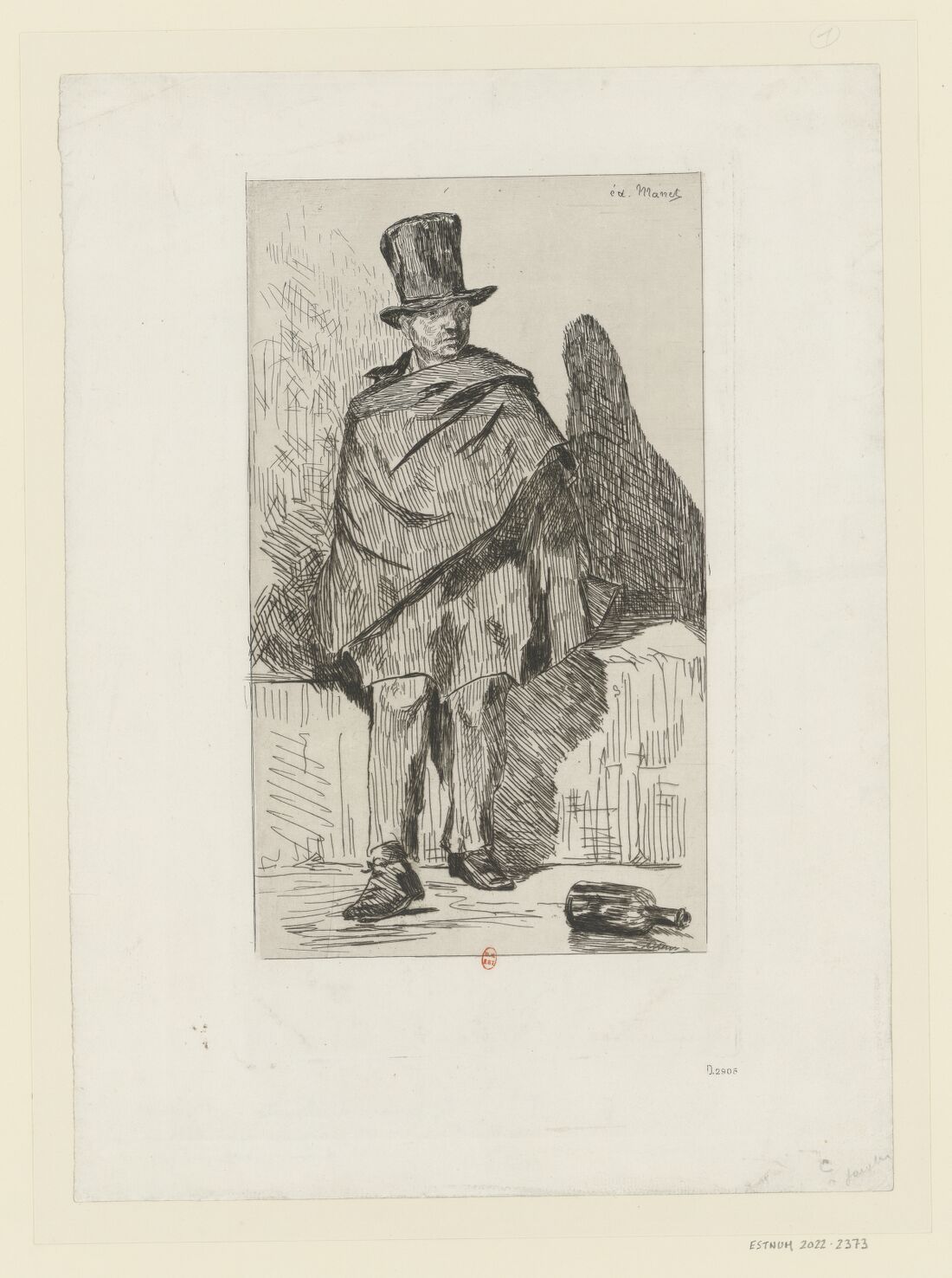
Le Buveur d'absinthe (1er état)
Édouard Manet · 1862 · Etching
Édouard Manet, Le Buveur d'absinthe (The Absinthe Drinker), etching, first state, 1862. An engraved version of the painting rejected by the Salon of 1859, now in the Ny Carlsberg Glyptotek, Copenhagen. BnF, Department of Prints.
Source gallica.bnf.fr / BnF, ark:/12148/btv1b53259142b — public domain.
Display case 01 of 08 1859-1862
How did a drink find its way into images?
Under the Second Empire, absinthe was the most talked-about drink in Paris. Chroniclers spoke of a “green hour”, the hour of late afternoon; caricaturists and painters seized on the cloudy glass as a sign of the modern city.
In 1859, Édouard Manet submitted to the Salon a full-length portrait of a ragpicker, with a glass set down beside him. The jury rejected it. Three years later, Manet took up the figure again in this etching: a man without heroism, draped in a worn cloak, and the name of the drink in the title.
Absinthe thus entered imagery before it entered the law. The face it was given then — that of the outsider — would serve as an argument fifty years later.
The glass is Parisian; what it holds comes from a small town in the Doubs, on the Swiss border.
Next display caseHow we know
Degree of certainty
Attested — documented by first-hand sources or by solid historiography.
Sources
- Gallica, BnF, Prints: É. Manet, Le Buveur d'absinthe, 1st state, 1862, ark:/12148/btv1b53259142b
- Ny Carlsberg Glyptotek, Copenhagen: É. Manet, Le Buveur d'absinthe, oil on canvas, 1859, rejected by the Salon of 1859
Key object
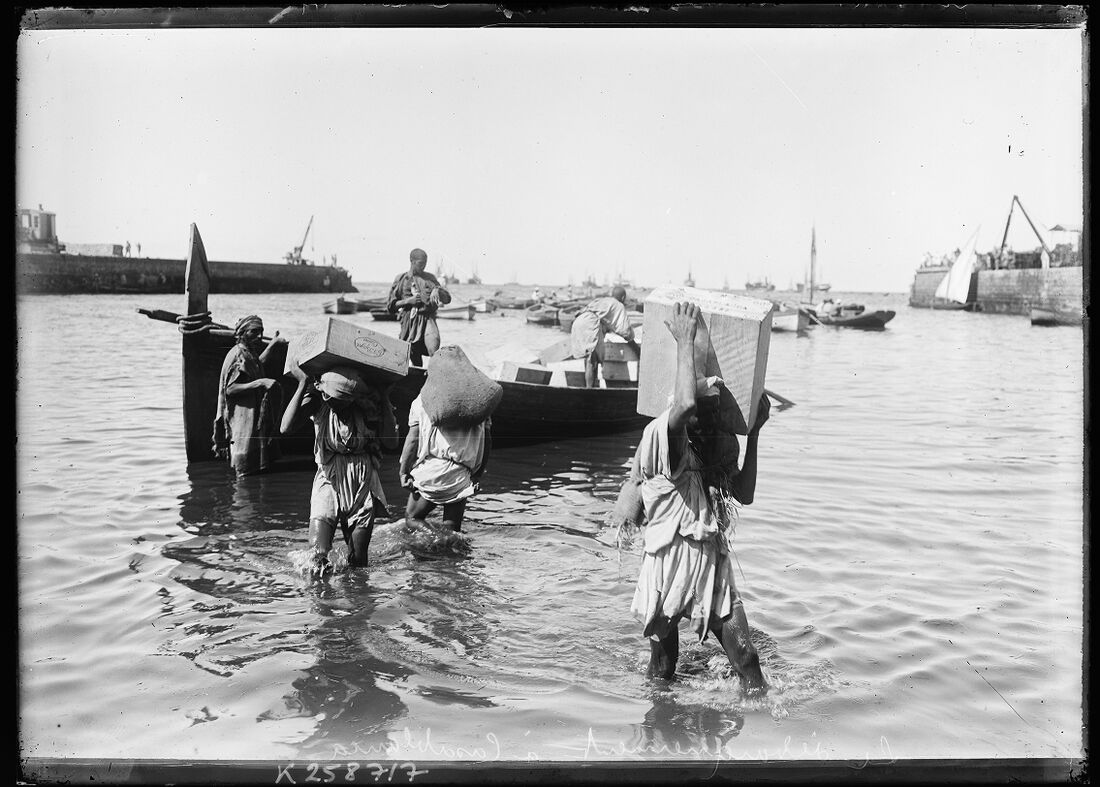
Le débarquement [de caisses contenant de l'absinthe C. F. Berger] à Casablanca
Agence Rol (photographie de presse, Raymond Lavagne ?) · 1913
Agence Rol, Le débarquement [de caisses contenant de l'absinthe C. F. Berger] à Casablanca (Unloading [crates of C. F. Berger absinthe] at Casablanca), press photograph, 1913. The crates are not Pernod's: by this date, absinthe was made by dozens of houses and sold far beyond France.
Source gallica.bnf.fr / BnF, ark:/12148/btv1b53232059g — public domain.
Display case 02 of 08 1805-1912
How did a mountain liqueur become an industry?
In February 1805, a distiller from Couvet, in Switzerland, Henri-Louis Perrenod, founded a house in Pontarlier under his own name, which he now spelled Pernod. His “fabrique d'eau verte” — his green-water works — had two stills and, around 1810, turned out sixteen litres a day.
What came out of his stills was a plant spirit. Grand wormwood, the bitter artemisia grown on the plateaux of the Haut-Doubs, was steeped with green anise and fennel in a mixture of alcohol and water, then went through the copper still; Roman wormwood and hyssop were then infused in it, giving it its pale green tint. When cold water was poured in, the liqueur clouded and turned opaline: it was this milky glass that would be nicknamed the green fairy.
A century later, the same name stood for a factory. In 1896, the Pernod Fils distillery produced 20,000 litres a day, with its great oak vats, its tank wagons and its own railway siding. In 1912, it employed 265 people.
The photograph from Casablanca tells the other half of the story: in 1913, absinthe was unloaded on men's backs on the beaches of the empire. What had been a mountain elixir had become a mass commodity — and it was that mass which would cause alarm.
Fact or legend? « Absinthe was invented around 1792 by a French doctor who had taken refuge in Switzerland, Dr Ordinaire. » Decide before you open it. See the answer
It is more complicated.
It is the most widespread story, and it circulates in several versions — a doctor, two Henriod sisters, a merchant. None of them rests on a published archive. What is documented begins with the Couvet distillery in 1802 and the Pernod house in Pontarlier in 1805.
On 11 August 1901, the Pontarlier factory burned down. And absinthe was about to reappear where no one expected it.
Next display caseHow we know
Degree of certainty
Attested — documented by first-hand sources or by solid historiography.
Sources
- Inventaire général du patrimoine culturel, Région Bourgogne-Franche-Comté, file IA25001599, “Distillerie Pernod”, R. Favereaux, 2016
- Gallica: Agence Rol, Le débarquement à Casablanca, 1913, ark:/12148/btv1b53232059g
Key object
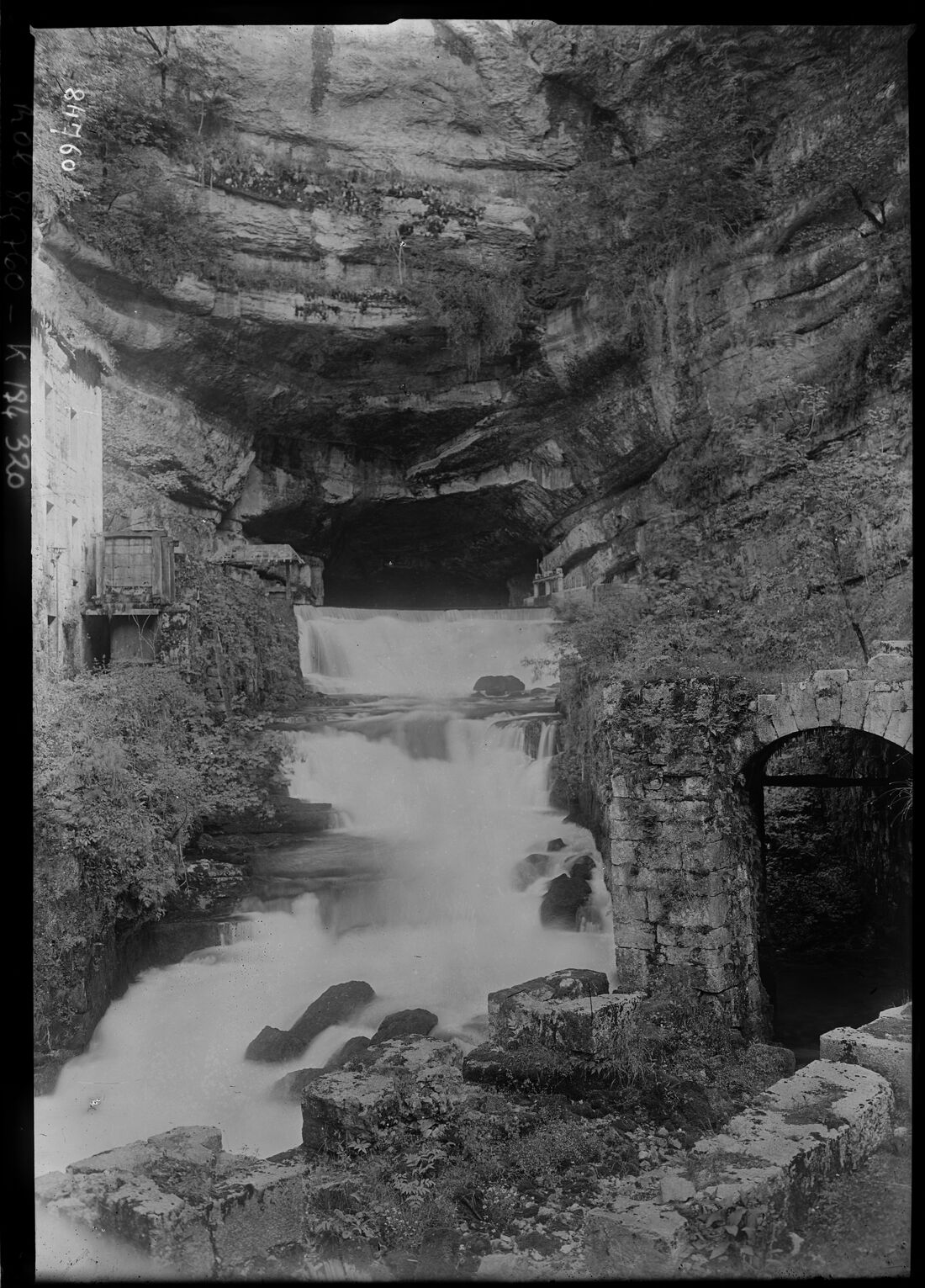
Source de la Loue
Agence Rol (photographie de presse) · 1923
Agence Rol, Source de la Loue (The source of the Loue), press photograph, 1923. The river rises from a cave at the foot of a limestone cliff, at Ouhans (Doubs). The episode of 1901 made it a textbook case in karst hydrology.
Source gallica.bnf.fr / BnF, ark:/12148/btv1b53111197c — public domain.
Display case 03 of 08 1901
Why did a spring in the Jura smell of anise?
On 11 August 1901, lightning set fire to the Pernod distillery on the banks of the Doubs. The buildings were destroyed. During the fire, the vats were emptied, and thousands of litres of absinthe and alcohol ran into the river.
Two days later, at the source of the Loue — another river, on the far side of a plateau, a dozen kilometres away as the crow flies — the water turned cloudy and smelled of anise. The story records the name of André Berthelot, who reported it to the Académie des sciences that same year.
The explanation lies underground: part of the Doubs disappears into the limestone and resurfaces at the Loue. What the fire suggested was later confirmed by dye tracings poured into the Doubs. A drink had served, in spite of itself, as a tracer.
Fact or legend? « The fire of 1901 proved that the Loue is a resurgence of the Doubs. » Decide before you open it. See the answer
It is more complicated.
The smell of anise at the Loue two days after the fire is the founding story, handed down by secondary sources. The proof came from the dye tracings carried out afterwards. The fire put people on the trail; it did not, on its own, prove anything.
The factory was rebuilt from 1902. At the same moment, others were demanding that every last one be shut.
Next display caseHow we know
Degree of certainty
Probable — historians agree, but a date or an attribution is still debated.
Sources
- Inventaire Bourgogne-Franche-Comté, file IA25001599 (fire of 11 August 1901 caused by lightning, rebuilding in 1902-1903)
- Showcaves.com, “Pernod”: account by André Berthelot and dye tracing by E.-A. Martel (secondary source)
- Gallica: Agence Rol, Source de la Loue, 1923, ark:/12148/btv1b53111197c
Key object
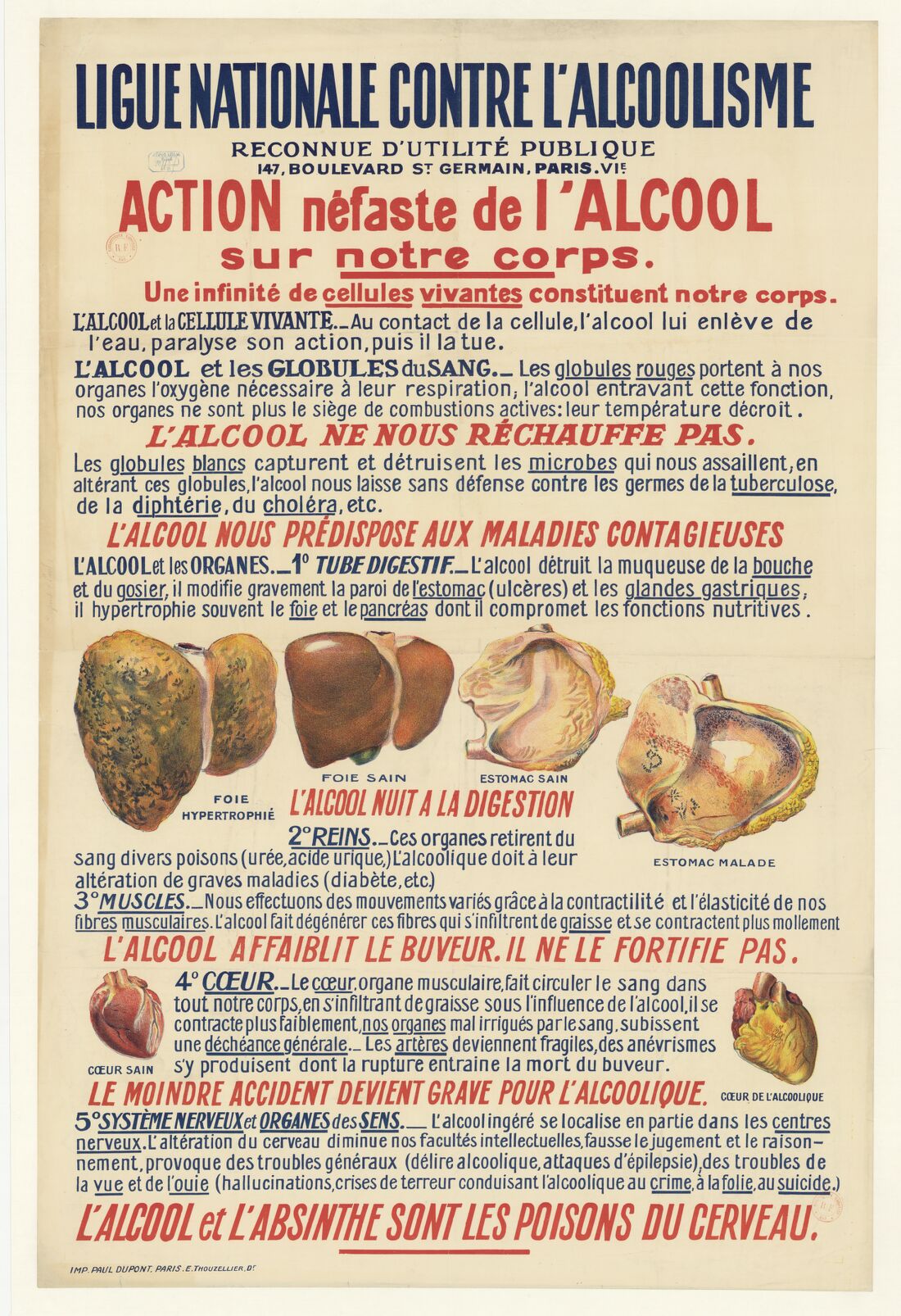
Ligue nationale contre l'alcoolisme. Action néfaste de l'alcool sur notre corps
1911
Ligue nationale contre l'alcoolisme, Action néfaste de l'alcool sur notre corps (The harmful action of alcohol on our body), poster, 1911. To be read as a piece of propaganda: its vocabulary mixes medical observation with dread, and its conclusion points at absinthe.
Source gallica.bnf.fr / BnF, ark:/12148/btv1b53127521p — public domain.
Display case 04 of 08 1905-1914
Who wanted the green fairy dead?
At the turn of the century, absinthe drew the accusations together. Doctors described an “absinthism” distinct from alcoholism, blamed on the plant's essential oil. Temperance leagues made it their target. Winegrowers, hit hard by phylloxera and then by overproduction, saw in it a competitor that could be accused without accusing wine.
The 1911 poster of the Ligue nationale contre l'alcoolisme is a piece of that battle: drawn organs, claims printed in red, and a last line that singles out absinthe among the “poisons du cerveau” — the poisons of the brain.
Europe moved before France. In 1905, in Switzerland, a labourer, Jean Lanfray, killed his wife and his two daughters; the investigation noted that he had drunk absinthe, among a great many other alcoholic drinks that day. The country banned it by popular vote in 1908. Belgium had done so in 1905; the Netherlands followed in 1909, the United States in 1912.
Fact or legend? « Absinthe drove people mad because of thujone, the molecule found in grand wormwood. » Decide before you open it. See the answer
It is a legend.
Thujone is toxic in high doses. But an analysis of pre-ban absinthes, published in 2008, found levels far too low to explain the disorders described. The main danger of these drinks, at close to 70% alcohol, was the alcohol itself.
What was still missing was an occasion to turn campaigns into law. It came in August 1914.
Next display caseHow we know
Degree of certainty
Probable — historians agree, but a date or an attribution is still debated.
Sources
- Gallica: Ligue nationale contre l'alcoolisme, poster, 1911, ark:/12148/btv1b53127521p
- D. W. Lachenmeier et al., “Chemical composition of vintage preban absinthe with special reference to thujone, fenchone, pinocamphone, methanol, copper, and antimony concentrations”, Journal of Agricultural and Food Chemistry, 56 (9), 2008
- Swiss Federal Constitution of 1874, art. 32ter (ban on absinthe adopted by popular vote on 5 July 1908)
Key object
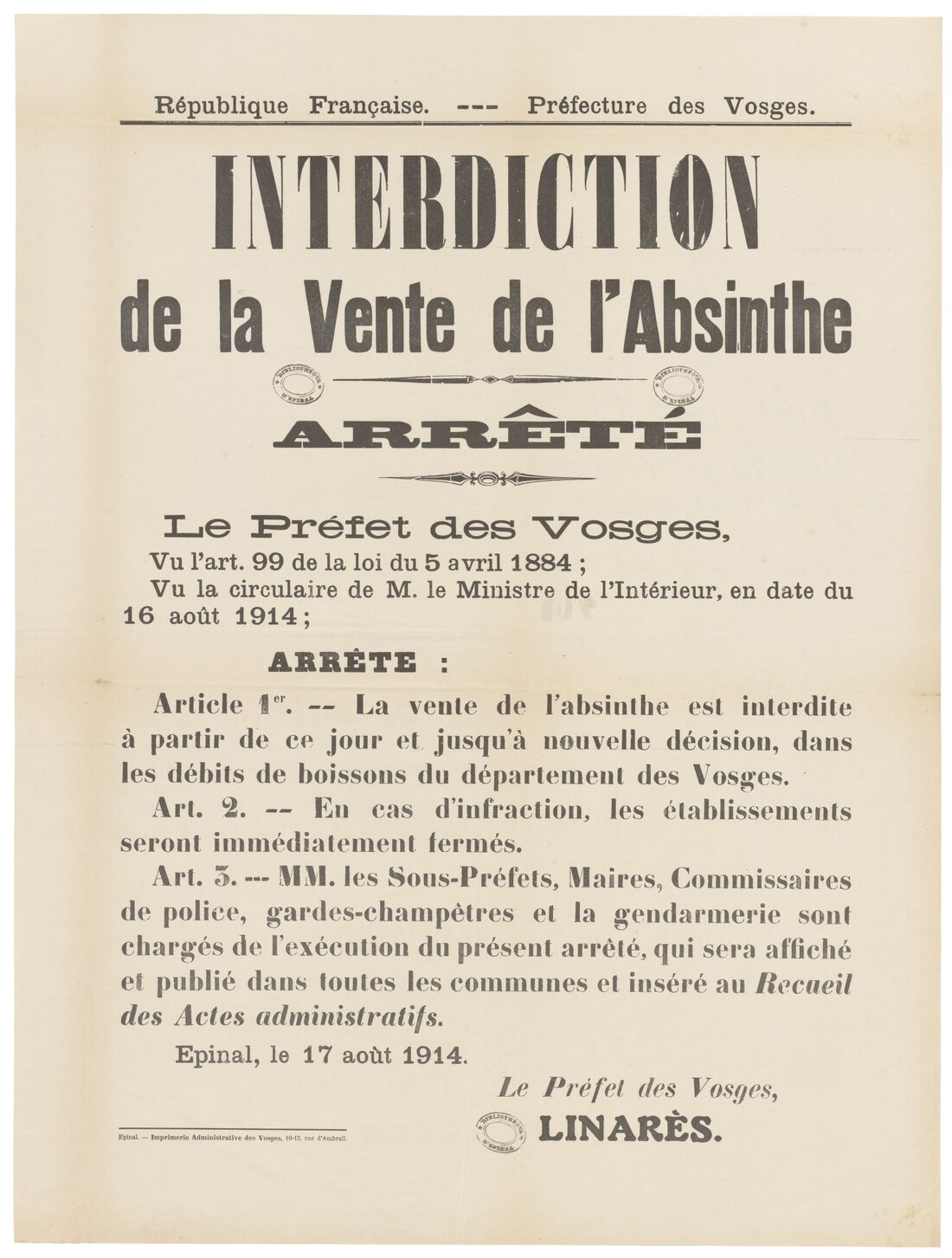
Préfecture des Vosges. Interdiction de la vente de l'absinthe. Arrêté
Pierre Linarès, préfet des Vosges · 1914
Préfecture des Vosges, Interdiction de la vente de l'absinthe (Ban on the sale of absinthe), printed order, Épinal, 17 August 1914, signed by the prefect Pierre Linarès. The text rests on the municipal law of 5 April 1884 and on a circular from the Minister of the Interior dated the day before.
Source gallica.bnf.fr / BnF, ark:/12148/btv1b106734075 — public domain.
Display case 05 of 08 1914-1915
How do you ban a drink in a matter of months?
The war achieved what thirty years of campaigning had not. On 16 August 1914, the Minister of the Interior asked the prefects to ban the sale of absinthe; the next day, in Épinal, the prefect of the Vosges signed the order shown here. Other départements followed, and Paris too.
On 7 January 1915, a decree extended the ban on sale and circulation to the whole of France, but only for the duration of hostilities. The law of 16 March 1915 made the measure permanent: it banned the manufacture, the wholesale and retail sale and the circulation of absinthe and of “similar liqueurs”. Passed in the middle of the war, it was presented as a measure of national defence.
In Pontarlier, the Pernod distillery became a military hospital, then closed. In 1919, it was sold to a firm of chocolate makers, who turned it into a confectionery works.
« La vente de l'absinthe est interdite à partir de ce jour et jusqu'à nouvelle décision, dans les débits de boissons du département des Vosges. (The sale of absinthe is prohibited from this day and until further notice in the drinking establishments of the département of the Vosges.) »
Banning a drink does not abolish the demand it met. What took its place?
Next display caseHow we know
Degree of certainty
Attested — documented by first-hand sources or by solid historiography.
Sources
- Gallica: Préfecture des Vosges, Interdiction de la vente de l'absinthe, order of 17 August 1914, ark:/12148/btv1b106734075
- Loi du 16 mars 1915 relative à l'interdiction de la fabrication, de la vente en gros et au détail, ainsi que de la circulation de l'absinthe et des liqueurs similaires
- Conseil d'État, 29 April 1921, Société Premier et Henry (the decree of 7 January 1915 has effect only for the duration of hostilities and must be ratified by the Chambers)
- Inventaire Bourgogne-Franche-Comté, file IA25001599 (military hospital, closure, sale in 1919 to Peter-Cailler-Kohler)
Key object
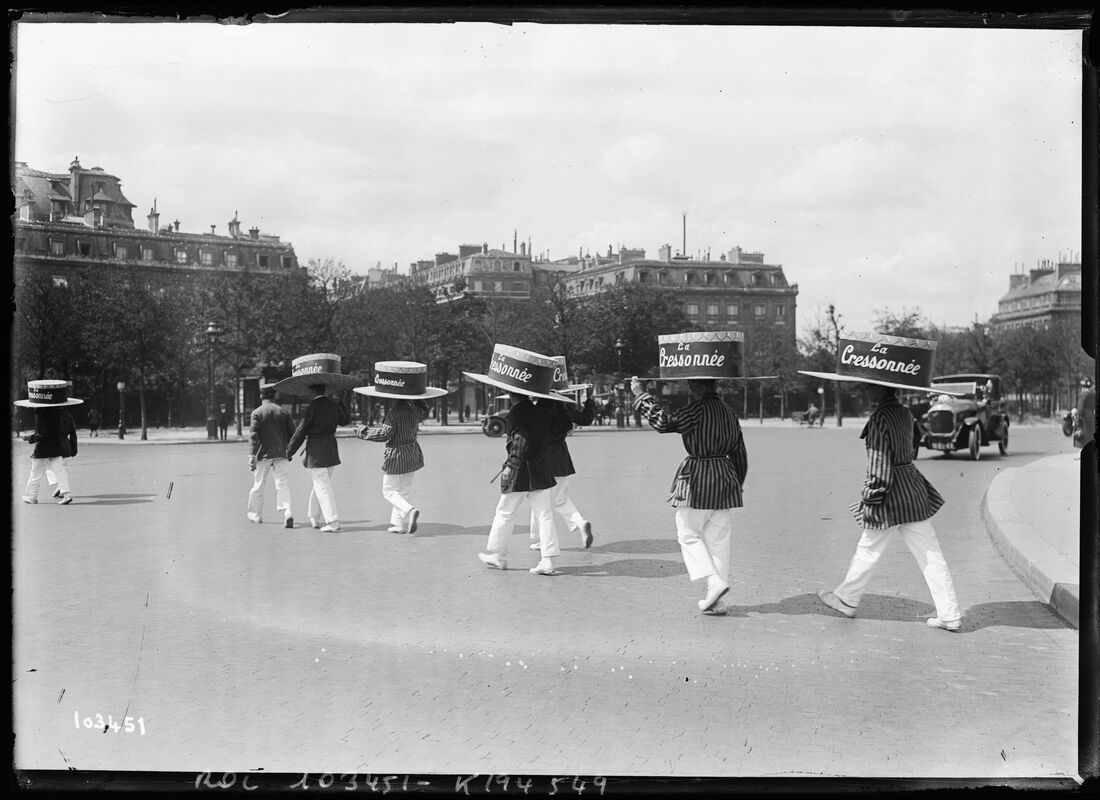
Publicité [la cressonnée, absinthe ?]
Agence Rol (photographie de presse) · 1925
Agence Rol, Publicité [la cressonnée, absinthe ?] (Advertisement [la cressonnée, absinthe?]), press photograph, 1925. The question mark is the BnF catalogue's own: ten years after the ban, no one can tell from the image which drink is meant.
Source gallica.bnf.fr / BnF, ark:/12148/btv1b53152112d — public domain.
Display case 06 of 08 1920-1940
What took the place of absinthe?
The law of 1915 targeted the plant, not anise. In the early 1920s, the State tolerated anise aperitifs without grand wormwood, at a strength first capped, then raised. Distillers converted their stills: the same plants, or nearly, minus one. The Pernod Fils brand, sold in 1926, also went over to anise spirits.
In 1925, in Paris, sandwich-board men paraded the name of one of these replacement drinks; the BnF catalogue is still unsure, in the photograph's caption: “absinthe?”. In 1932, a Marseille merchant, Paul Ricard, launched a “pastis”; the Provençal word meant a mixture. In 1938, the permitted strength rose to 45%.
That did not close the circle: in 1940, the Vichy government banned aperitifs of more than 16%, and anise spirits returned only after the war. A banned drink had given rise to a whole family, which the law regulates degree by degree.
Fact or legend? « Pastis was invented to get round the law of 1915. » Decide before you open it. See the answer
It is more complicated.
Anise was already part of the absinthe recipe, and anise-flavoured drinks existed before 1915. What the ban created was a market and a framework: anise spirits without grand wormwood, whose maximum strength the State set and then raised.
For nearly a century, the very word absinthe stayed banned from French labels. How did it come back?
Next display caseHow we know
Degree of certainty
Probable — historians agree, but a date or an attribution is still debated.
Sources
- Gallica: Agence Rol, Publicité [la cressonnée, absinthe ?], 1925, ark:/12148/btv1b53152112d
- Inventaire Bourgogne-Franche-Comté, file IA25001599 (sale of the Pernod Fils brand to André Hémard, 1926)
- France.fr, “5 petits secrets à connaître sur le pastis” (chronology for 1922, 1932, 1938, 1940; secondary source)
Key object
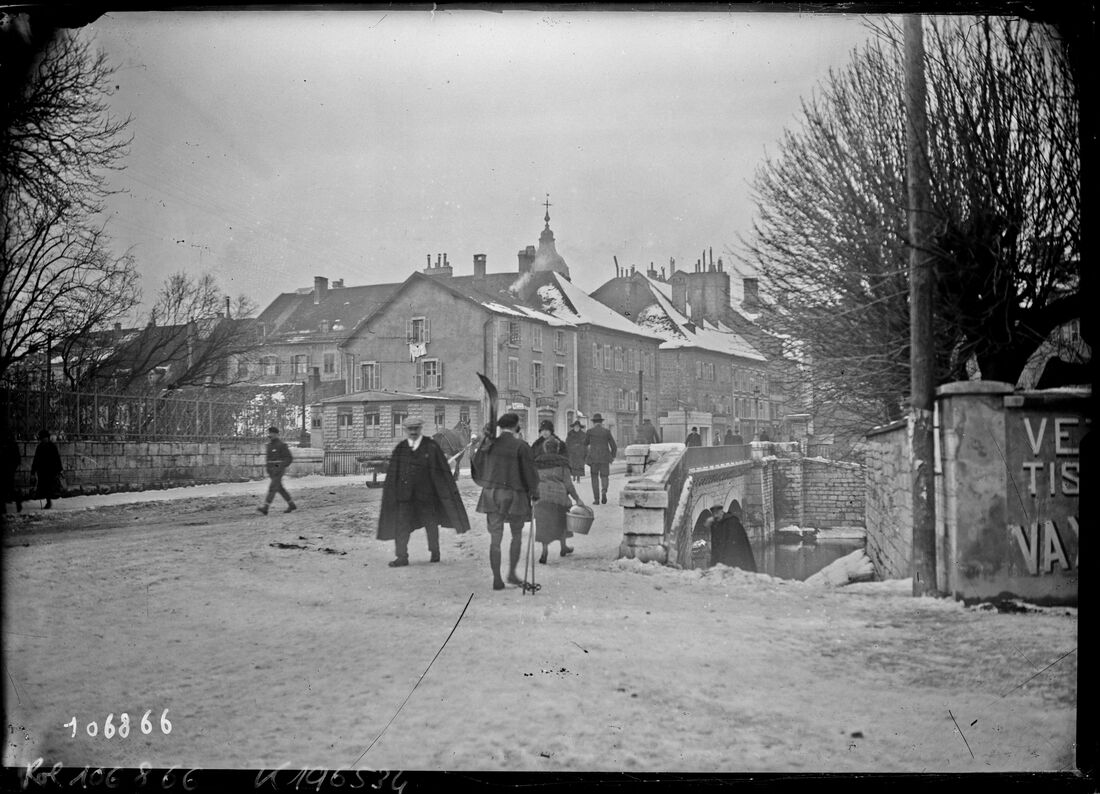
Pontarlier, vue de la grande rue
Agence Rol (photographie de presse) · 1926
Agence Rol, Pontarlier, vue de la grande rue (Pontarlier, view of the main street), press photograph, January 1926. The town was photographed for ski championships; its absinthe distilleries had been closed for ten years.
Source gallica.bnf.fr / BnF, ark:/12148/btv1b53157292t — public domain.
Display case 07 of 08 1988-2019
Why did absinthe come back bearing the name of a town?
For more than seventy years, the plant vanished from French stills. In 1988, a decree once again allowed grand wormwood to be distilled, provided its name did not appear on the label; in Pontarlier, distilleries took up again the practices of before 1915.
There the spirit described by nineteenth-century makers can be found again: grand wormwood grown and dried on the plateau, green anise, maceration and then the copper still, and that pale yellow tint verging on green which turns cloudy on contact with water. The word itself came back in 2011, when the law of 1915 was repealed, partly because Switzerland was seeking to keep it for itself.
Pontarlier then applied for protection of its name, which France granted in 2013 and the European Union in 2019. Banned in the name of public health, absinthe returned in the name of a place.
It remains to gather together what these seven display cases have untangled.
What to take awayHow we know
Degree of certainty
Attested — documented by first-hand sources or by solid historiography.
Sources
- Décret n° 88-1024 du 2 novembre 1988
- Loi n° 2011-525 du 17 mai 2011 de simplification et d'amélioration de la qualité du droit (repeal of the law of 16 March 1915)
- Décret du 12 juillet 2013 approuvant le cahier des charges de l'indication géographique “Absinthe de Pontarlier” (JORF of 19 July 2013)
- Commission Implementing Regulation (EU) 2019/1350 of 12 August 2019 (registration of the geographical indication “Absinthe de Pontarlier”)
Display case 08 of 08 Last display case
What to take away
Why did France ban absinthe?
The answer Absinthe was banned in 1915 less for what it contained than for what it stood for: having become the symbol of alcoholism, it served as the culprit for a country at war — and it returned in 2011, its composition under control and bearing the name of a town.
- Before it was banned, absinthe was an industry: 20,000 litres a day in Pontarlier in 1896.
- The ban was the child of war as much as of hygienism: prefects enforced it from August 1914, and the law followed in March 1915.
- Analyses of old absinthes do not bear out the madness blamed on thujone; the main danger was the alcohol.
- Absinthe is a plant spirit — grand wormwood, green anise and fennel — that turns cloudy on contact with water; it is distilled once more in Pontarlier, and its name came back in 2011.
Room opened on 3 October 2026. The texts are written by the SpiLi team and await review by the scholarly board.
← and → arrow keys: previous or next display case.