House stories · Bénédictine
Did a monk invent Bénédictine in 1510?
On its labels, Bénédictine invokes a Venetian monk of the abbey of Fécamp, Dom Bernardo Vincelli, and the year 1510. Historians have been looking for this monk for a long time. What they found in his place was a wine and spirits merchant of genius, Alexandre Le Grand.
The story
Alexandre Le Grand did not rediscover a monk's recipe: he invented a liqueur, then gave it a monk for an ancestor.
In the heart of Fécamp stands a castle that is nothing like a castle. Turrets, gables, spires, stained glass: the Palais Bénédictine blends Gothic and Renaissance like an opera set. Yet it was built from 1882 onwards, for a distillery. Its architect, Camille Albert, designed it to be taken for an abbey.
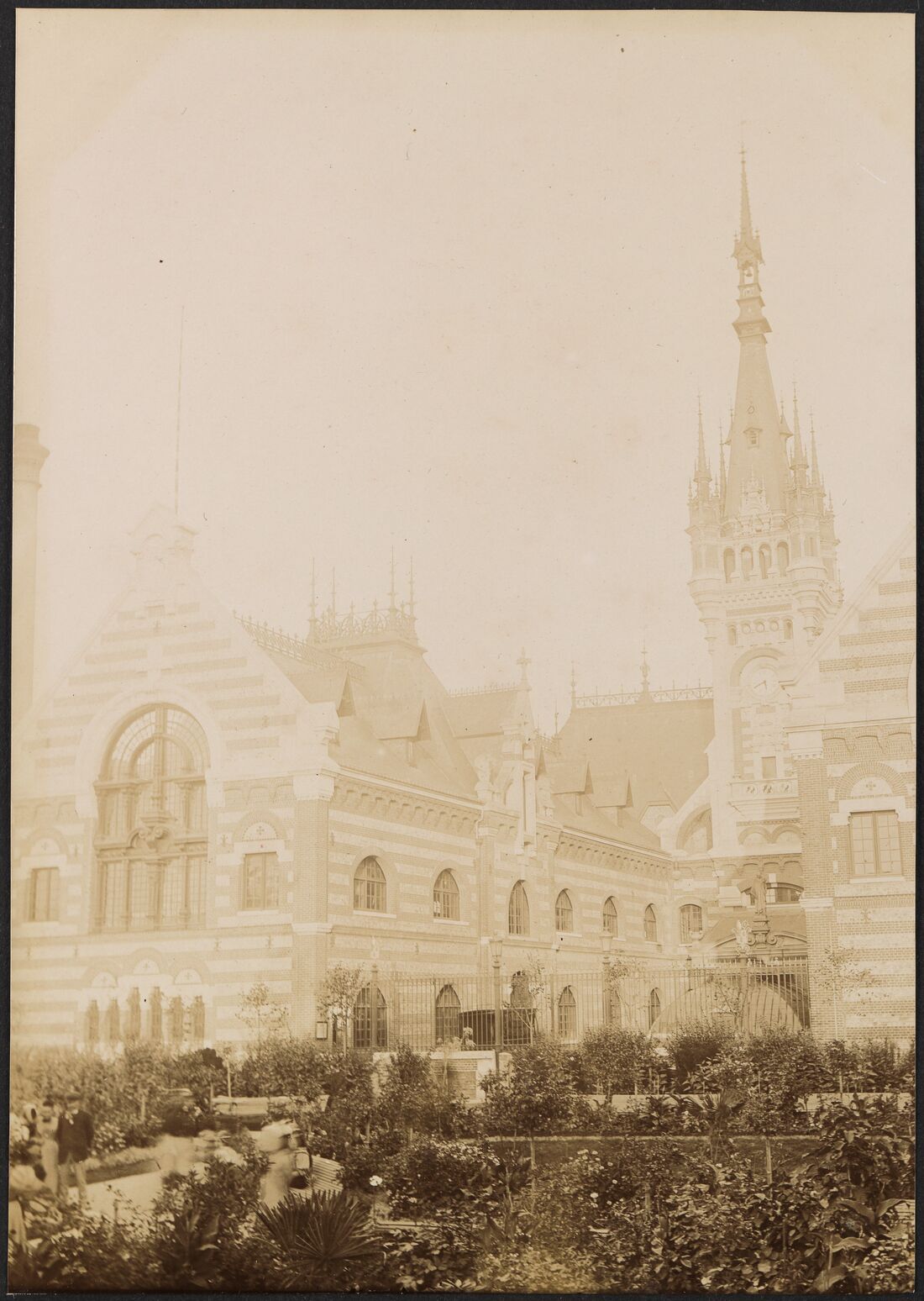
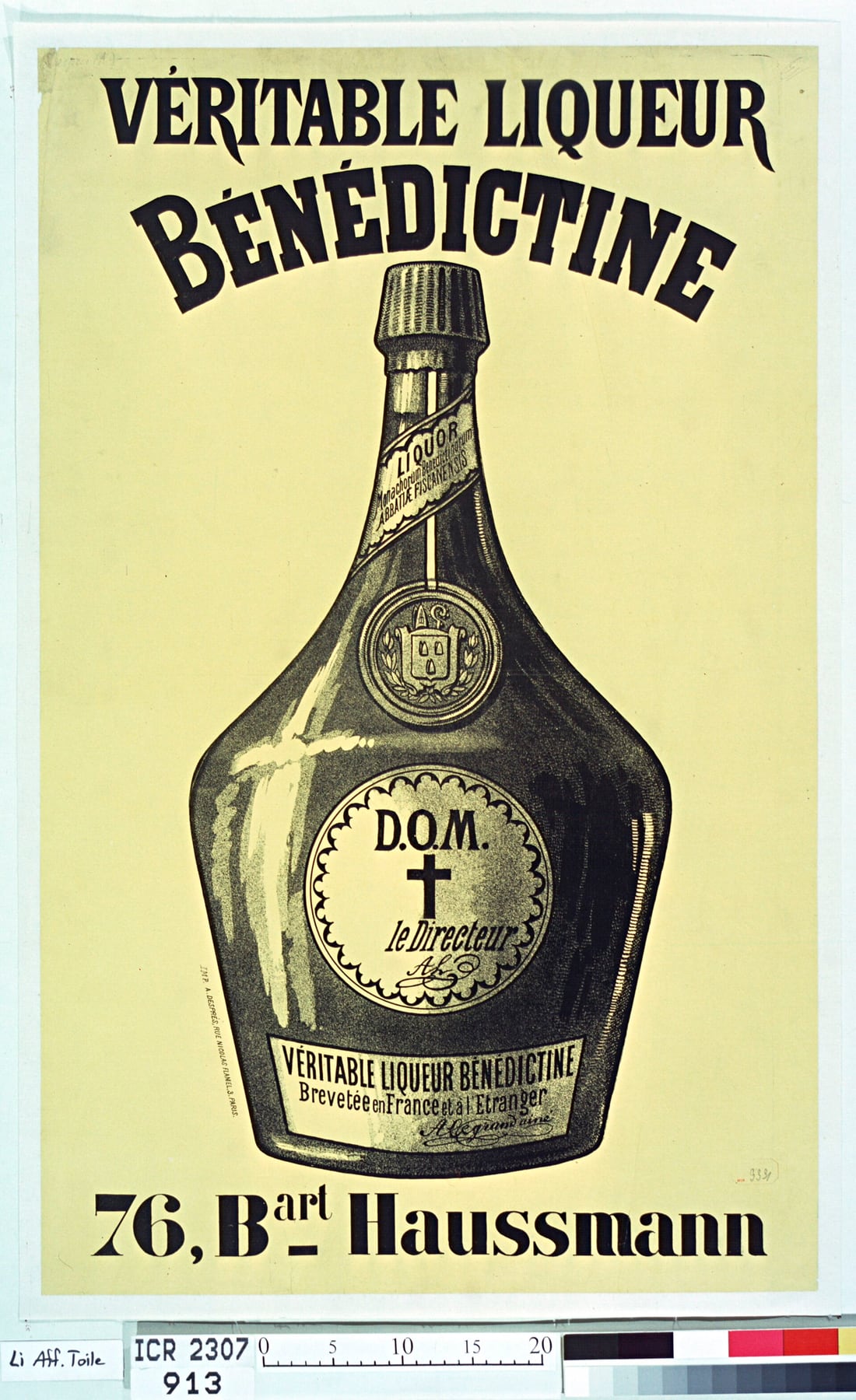
The man who wanted it was called Alexandre Le Grand. Born in Fécamp in 1830, a wine and spirits merchant, he perfected a herbal liqueur in 1863. In 1864 he gave it a bottle and a name: Bénédictine, in tribute to the Benedictines of the abbey of Fécamp, scattered by the Revolution. On the label, three letters: D.O.M., for Deo Optimo Maximo, “to God, most good, most great”. The formula belongs to no order: it is the Latin dedication carved on the pediments of churches.
What Le Grand bottled was a liqueur of plants and spices. The house claims twenty-seven of them, without publishing its formula, and names a few, such as saffron, angelica and lemon balm. Most of the plants are divided among several preparations, macerated and then distilled separately in copper stills that can still be seen at the palace. The distillates, once blended, are aged in oak casks before the honey is added. The liqueur, at 40% vol., is a golden amber; honey and spices mingle in it with the bitterness of the plants.
Success came quickly. Le Grand set up a company in 1876, floated it on the stock exchange in 1882, and turned his story into a heritage. The palace houses a collection of religious art, opened to the public in 1900 (1898 according to other sources), and one unusual room: the counterfeits. Hundreds of imitation bottles from all over the world are displayed there like trophies. The fake monk was defending himself against fake bottles.
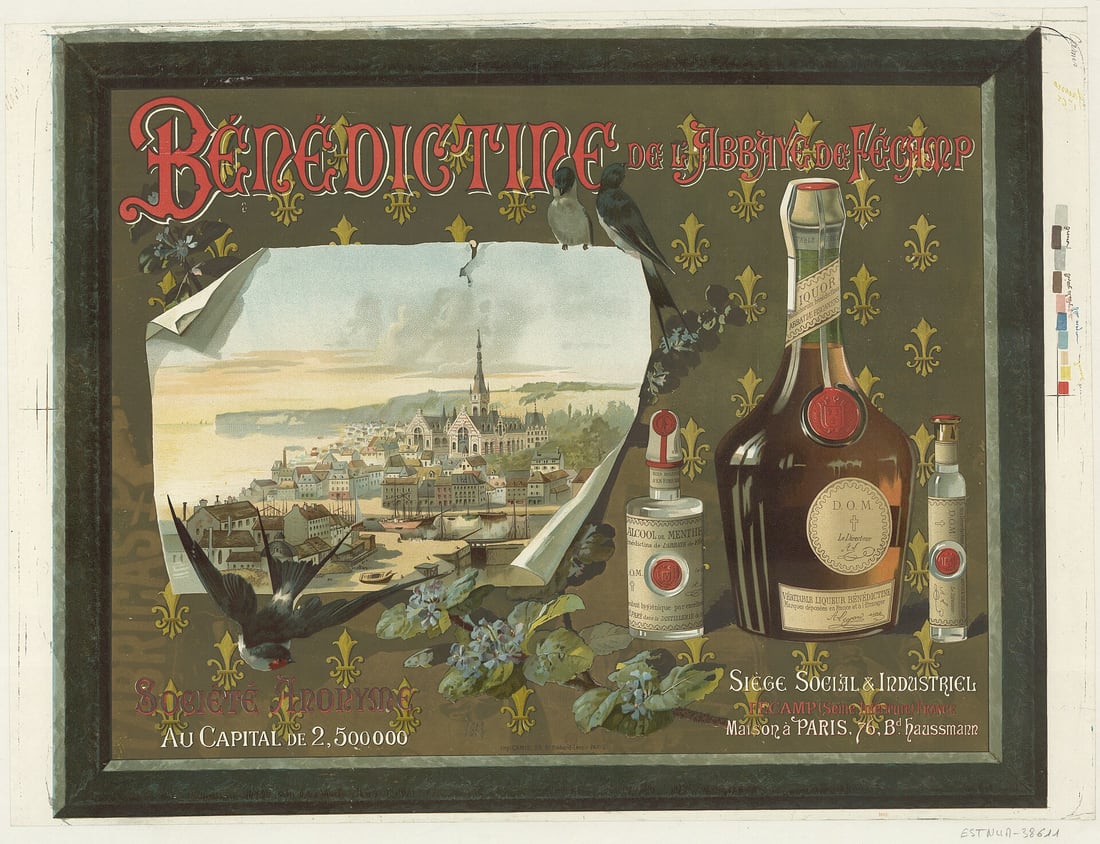
The palace burned down in January 1892 and was rebuilt at once. In 1898, the year Le Grand died, the house commissioned a poster from Alfons Mucha. The painter showed no monk: he showed an abbey at sunset, a mitre, and the D.O.M. bottle between two draped young women. The image says the same thing as the architecture: a sacred antiquity, suggested rather than asserted.
In the 20th century, the Fécamp house became a buyer in its turn: in 1969 it acquired the Get liqueurs of Revel, whose story is told elsewhere in this section. Then it changed hands itself, passing to Martini & Rossi in the 1980s and to the Bacardi group in the early 1990s. The distillery still operates inside the palace, which can be visited like a museum — and it is first and foremost a museum of the way a brand manufactures a memory for itself.
The legend set against the sources
The legend
As told by the brand
In 1510, at the abbey of Fécamp, a Benedictine monk from Venice, Dom Bernardo Vincelli, composed a herbal elixir. Francis I is said to have tasted it during a visit in 1534. The recipe, lost at the Revolution, is said to have been rediscovered by Alexandre Le Grand in an old manuscript acquired along with the abbey's books, then deciphered and reconstructed.
What the sources say
No list of the monks of Fécamp or of Saint-Wandrille knows of any Bernardo Vincelli, no record mentions a visit by Francis I, and the manuscript has never been shown, either to historians or in the house's own museum, which displays everything else.
In the Oxford Companion to Spirits and Cocktails, Jim Meehan notes the absence of any independent evidence for the monk and of any original document. The brand itself has switched to the conditional: Vincelli “is said to have” created the elixir.
The rest is attested: the liqueur dates from 1863, the brand from 1864, the company from 1876, and the palace, inaugurated in 1888, is a monument of 19th-century advertising. Mucha's poster, held by the Bibliothèque nationale de France and the National Art Museum of Catalonia, is dated 1896 or 1898.
So, legend or history?
Before you read the answer, what do you think?
Choose a degree: it is the question a historian asks of every story.
Degree of certainty : Legend
Legend. The monk of 1510 appears in no document.
Dom Vincelli is a brand invention: no archive of the abbey knows of him, and the manuscript that would prove his existence has never been shown. Bénédictine is a creation of 1863. Its real historical interest lies elsewhere: Alexandre Le Grand understood before anyone else that a liqueur could be sold with a past, and he built that past in stone.
How we know
Each date in this story refers to one of the sources below. The degree of certainty can be read from the pattern of the rule: solid for attested, dashed for probable, dotted for tradition, double for legend.
Key dates
-
1510 Dom Vincelli composes the elixir, according to the brand -
1863 Alexandre Le Grand perfects the liqueur -
1864 The name and the bottle are registered -
1876 The Bénédictine company is founded -
1888 The Palais Bénédictine is inaugurated -
1892 The palace burns down and is rebuilt at once -
1898 Alfons Mucha's poster; death of Alexandre Le Grand
Attested- established by documents contemporary with the events.
Probable- plausible and consistent with the sources, without direct proof.
Tradition- handed down by the house or by local memory, with no document to confirm or refute it.
Legend- contradicted by the sources, or invented after the fact.
What remains uncertain
- The trademark registration: 1864 or 1875 depending on the source.
- The opening of the palace museum: 1898 or 1900.
- Mucha's poster: 1896 or 1898 depending on the catalogue entry.
Sources
- Bénédictine, Heritage , 2026.
- Palais Bénédictine, Heritage Bénédictine — le palais , 2026.
- Jim Meehan, « Bénédictine », in The Oxford Companion to Spirits and Cocktails , Oxford University Press , 2021.
- Difford's Guide, Distillerie Bénédictine SA — History .
- Museu Nacional d'Art de Catalunya, Alfons Mucha, Bénédictine .