Room · History · Gin Lane
Did gin really ruin London?
In 1751, an engraving by Hogarth makes a London alley the very image of ruin. Five display cases to trace this image back to its causes: a Flemish remedy, a Dutch king, laws that fail.
6 display cases · about 6 minutes
Start the visitKey object
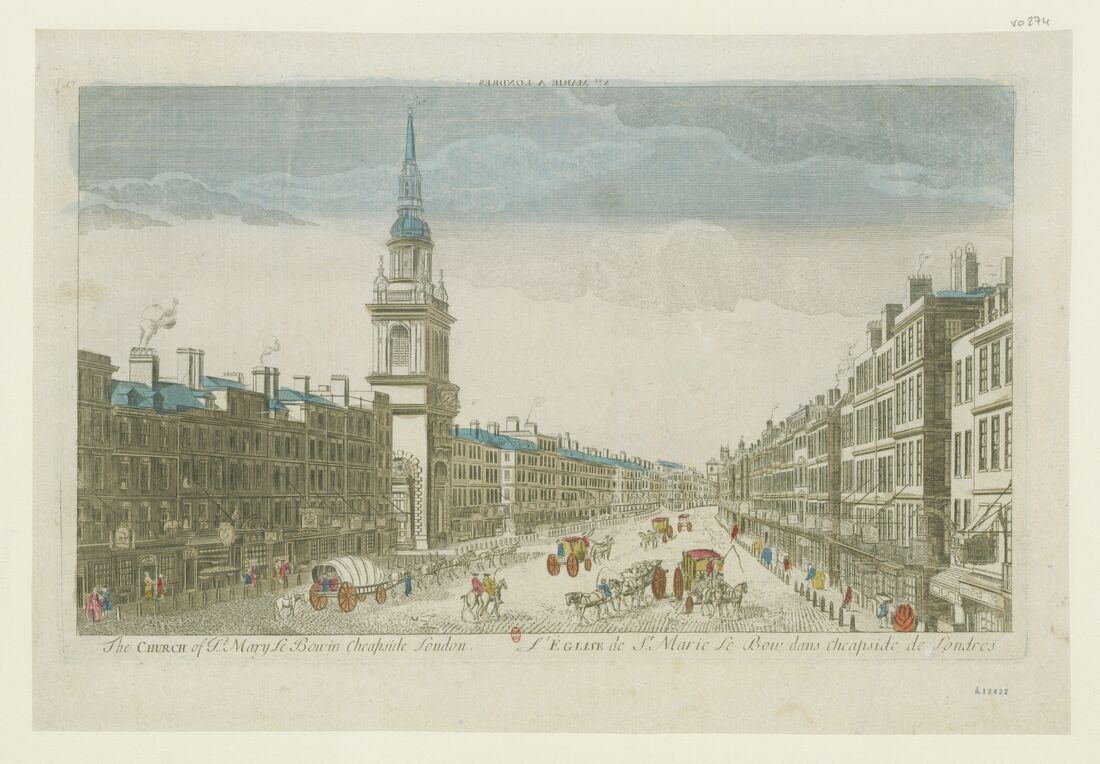
L'Église de Ste Marie le Bow dans Cheapside de Londres
Vue d'optique, éditeur non identifié · 1750
L'Église de Ste Marie le Bow dans Cheapside de Londres (The church of St Mary-le-Bow in Cheapside, London), hand-coloured engraved perspective view, around 1750. These images, made to be looked at through a lens, showed buyers on the Continent an orderly, mercantile London.
Source gallica.bnf.fr / BnF, ark:/12148/btv1b69492540 — public domain.
Display case 01 of 06 1720-1751
Why was London afraid of a drink?
Look at this view of Cheapside, sold around 1750: broad streets, brick façades, carriages. This is the London that was put on show. The London of the same years, in the poor parishes, was a city where a cheap grain spirit was distilled and sold on almost every street corner.
The figures struck contemporaries: around 1743, the English were reckoned to drink on average some ten litres of gin each a year. Magistrates, doctors and pamphleteers spoke of an epidemic. In 1734, the trial of Judith Defour, who had killed her child to sell its clothes and buy gin, became the case everyone quoted.
Historians today speak of the “Gin Craze”, a fever lasting a few decades. It was real; but we know it above all through those who wanted to stop it.
But where did this gin come from? Not from England: from the other side of the North Sea.
Next display caseHow we know
Degree of certainty
Probable — historians agree, but a date or an attribution is still debated.
Sources
- Gallica: perspective view of Cheapside, around 1750, ark:/12148/btv1b69492540
- Proceedings of the Old Bailey, trial of Judith Defour, February 1734
- Wikipedia (en), “Gin Craze”: per capita consumption in 1743 (secondary source)
Key object
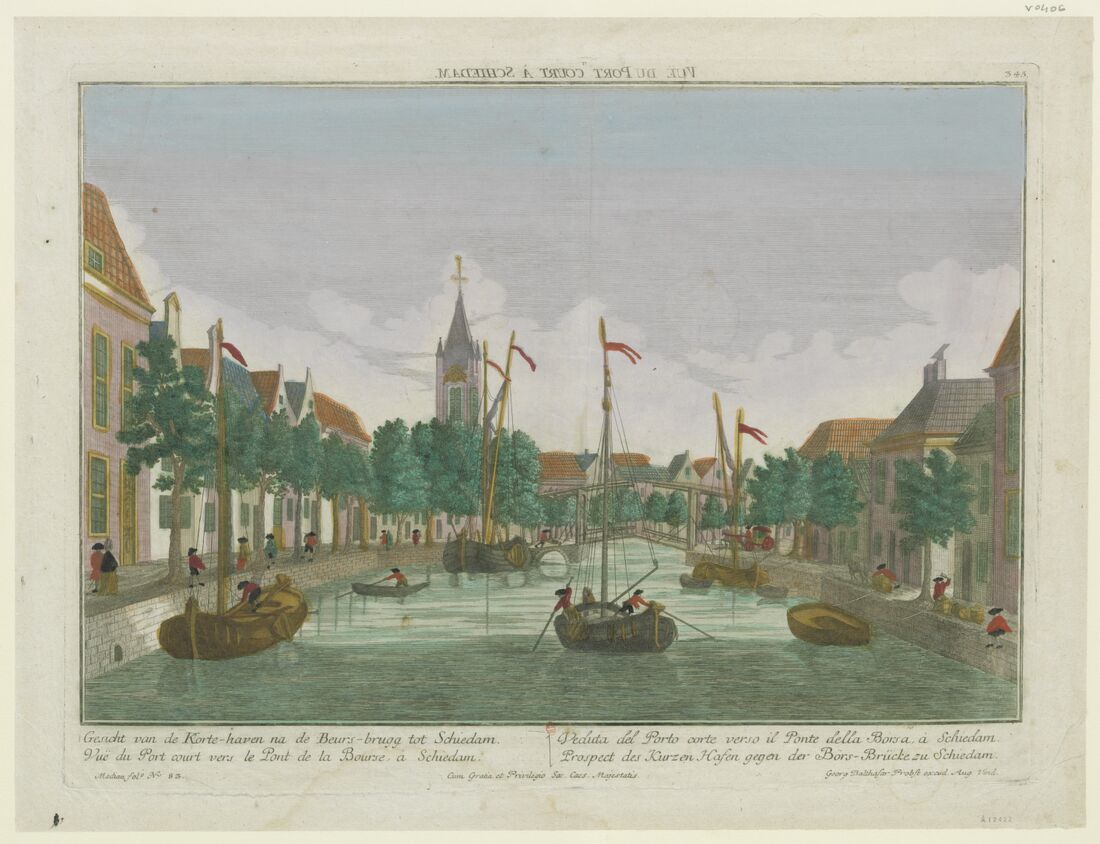
Vuë du Port court vers le Pont de la Bourse à Schiedam
Vue d'optique, éditeur non identifié · 1750
Vuë du Port court vers le Pont de la Bourse à Schiedam (View of the Short Harbour towards the Exchange Bridge at Schiedam), hand-coloured engraved perspective view, around 1750, titled in French and Dutch. Schiedam was then the town of Dutch genever.
Source gallica.bnf.fr / BnF, ark:/12148/btv1b69493869 — public domain.
Display case 02 of 06 13th–17th century
Where does genever come from?
The word gin is short for the English genever, taken from the Dutch word for juniper. Around 1270, the Flemish poet Jacob van Maerlant was already mentioning, in Der Naturen Bloeme, a remedy of juniper berries cooked in wine. It was not yet a distilled spirit: it was a medicine.
In the 16th century, the distilling books of the Low Countries gave recipes for juniper spirit; that of Philippus Hermanni, printed in Antwerp in 1552, contains one. In the 17th century, grain distilling became concentrated in a few towns in Holland, among them Schiedam, near Rotterdam.
Dutch genever was first and foremost a grain spirit. Rye and malted barley were mashed and fermented, then distilled into a “malt wine”, moutwijn, lightly rectified, which kept the taste of bread and cereals. Juniper berries, added during distillation or left to steep, lent it their scent of resin and pine. It was the grain, more than the berry, that would decide its fate: grain was to be found everywhere.
Yet one name recurs in almost every account: that of a Leiden professor who is said to have invented it all.
Next display caseHow we know
Degree of certainty
Probable — historians agree, but a date or an attribution is still debated.
Sources
- Jacob van Maerlant, Der Naturen Bloeme, around 1270
- Philippus Hermanni, Een Constelijck Distileerboec, Antwerp, 1552
- Leiden University, “The dubious Leiden roots of genever and gin”, 2016
Key object
Alambic
1509
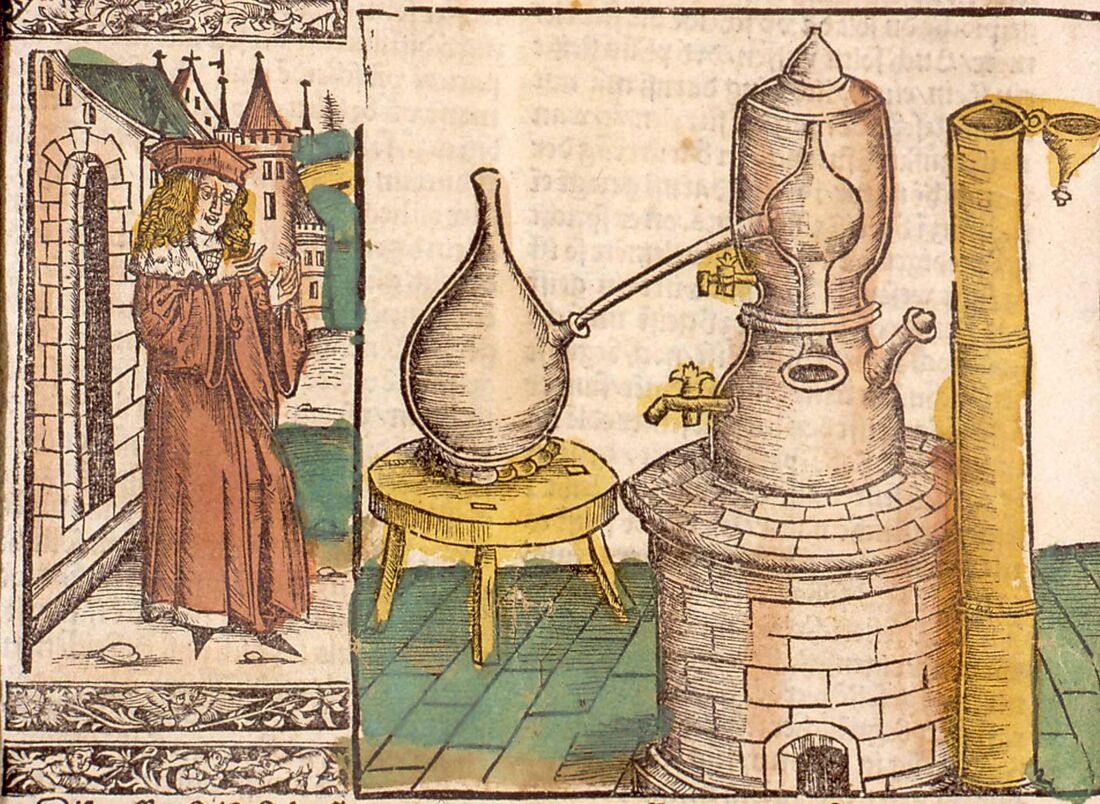
Alambic (Still), hand-coloured woodcut, 1509. A century before Sylvius was born, print was already spreading the shape of the apparatus and recipes for distilled waters, from plants and from berries alike.
Source gallica.bnf.fr / BnF, ark:/12148/btv1b10218821k — public domain.
Display case 03 of 06 1614-1824
Did Sylvius invent gin?
Franciscus Sylvius, born in 1614, professor of medicine at Leiden, has passed for two centuries as the inventor of gin. The story is everywhere, even on labels.
It does not hold up. Recipes for juniper spirit were printed decades before he was born, and genever was on sale in Holland while he was still a child. The attribution first appears in an English book of 1824, by Samuel Morewood, who read as authorship what was probably no more than the mention of a preparation.
This still, engraved in 1509, says what matters: the distilling of aromatic waters was knowledge printed and shared long before Sylvius. Drinks almost never have an inventor; they have origin legends.
Fact or legend? « Gin was invented by the physician Franciscus Sylvius, in Leiden, in the 17th century. » Decide before you open it. See the answer
It is a legend.
A recipe for juniper spirit was printed in 1552, sixty years before Sylvius was born. The attribution appears in 1824 in Samuel Morewood and has been copied ever since; Leiden University itself considers it doubtful.
If not an inventor, what brought genever to London? A change of king.
Next display caseHow we know
Degree of certainty
Attested — documented by first-hand sources or by solid historiography.
Sources
- Leiden University, “The dubious Leiden roots of genever and gin”, 2016
- Samuel Morewood, An Essay on the Inventions and Customs of Both Ancients and Moderns in the Use of Inebriating Liquors, London, 1824
- Gallica: Alambic, woodcut, 1509, ark:/12148/btv1b10218821k
Key object
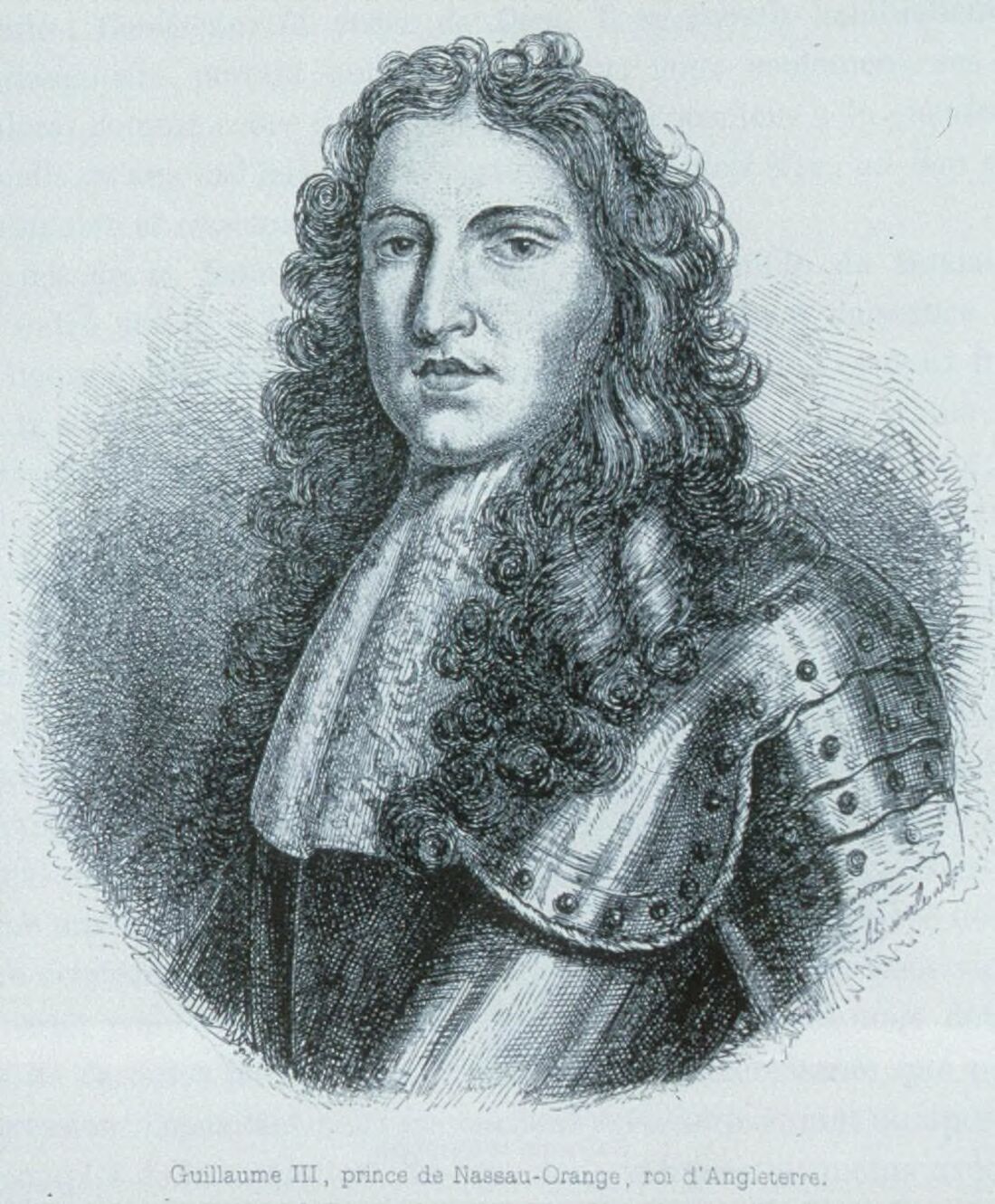
Guillaume III, prince de Nassau-Orange, roi d'Angleterre
Ernest Lehr et A. Demarle (illustrateurs) · 1870
Ernest Lehr and A. Demarle, Guillaume III, prince de Nassau-Orange, roi d'Angleterre (William III, Prince of Nassau-Orange, King of England), engraving, 1870. A history portrait, engraved nearly two centuries after the events for an illustrated book.
Source gallica.bnf.fr / BnF, ark:/12148/btv1b10211076f — public domain.
Display case 04 of 06 1689-1736
How did genever cross the North Sea?
In 1689, William of Orange, stadtholder of Holland, became King of England. His reign was one of almost constant war with France: French spirits were heavily taxed and, in 1690, grain distilling was thrown open to all, breaking the monopoly of the London Company of Distillers.
The consequence was not intended. Distilling became an activity without control or qualification; English grain found an outlet; a spirit imitating Dutch genever, sold cheaply, spread through the poor districts of London.
It is also said that English soldiers had acquired a taste for genever during the wars in the Low Countries — “Dutch courage”. The story is appealing, and it has no reliable source. The documented cause is fiscal and commercial.
Parliament soon understood what it had set off. For twenty years, it would try to undo it.
Next display caseHow we know
Degree of certainty
Probable — historians agree, but a date or an attribution is still debated.
Sources
- Act of 1690 encouraging the distilling of spirits from grain (reign of William and Mary)
- Wikipedia (en), “Gin Craze”: end of the distillers' monopoly, policy of William III (secondary source)
- Gallica: Guillaume III, engraving, 1870, ark:/12148/btv1b10211076f
Key object
Gin Lane
William Hogarth · 1751
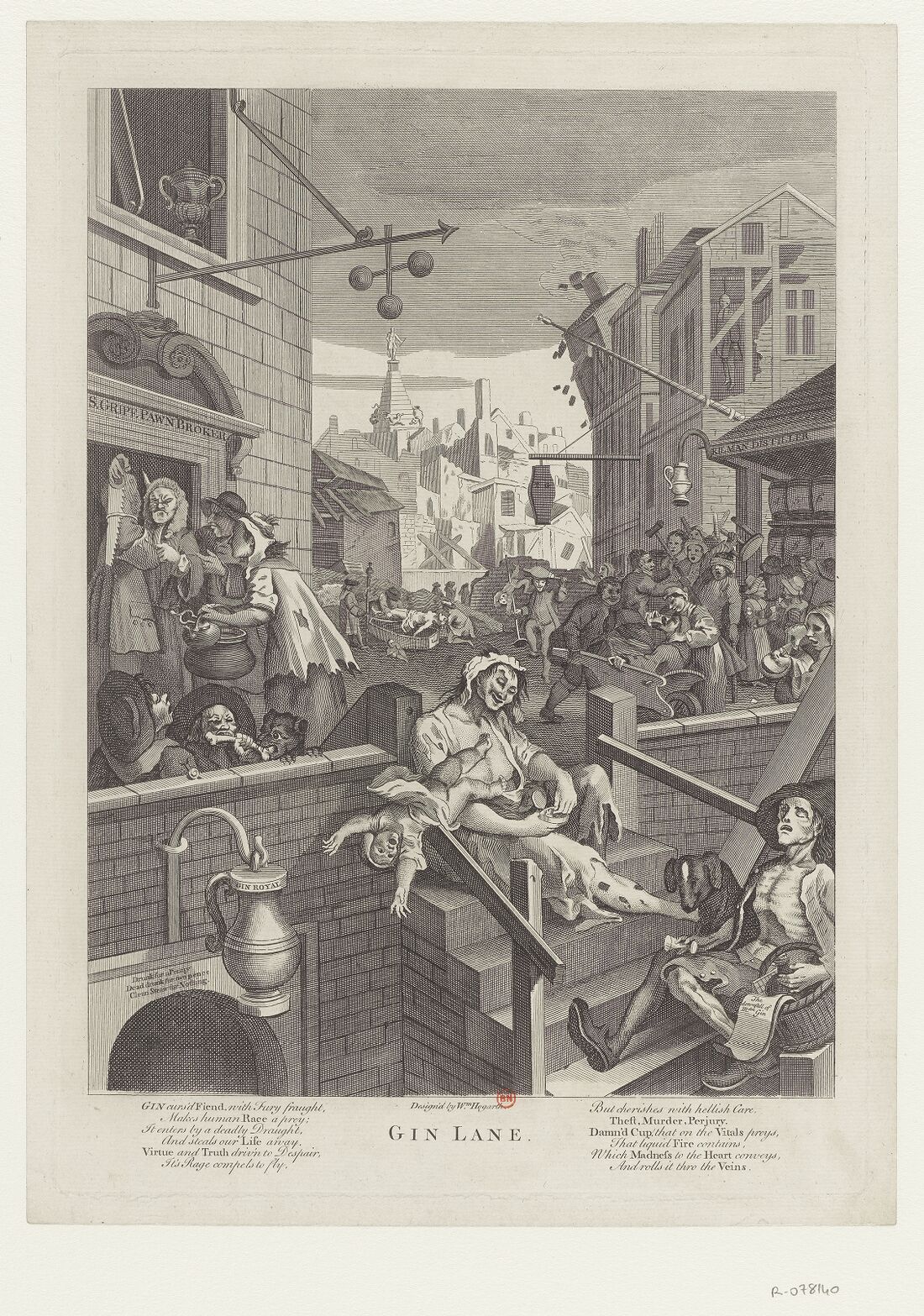
William Hogarth, Gin Lane, engraving, 1751, here in a late edition with the verses at the foot. In the foreground, a mother lets her child fall; in the background, only the pawnbroker prospers. The engraving is an indictment, not a piece of reportage.
Source gallica.bnf.fr / BnF, ark:/12148/btv1b10844098s — public domain.
Display case 05 of 06 1729-1751
What does Hogarth's engraving really show?
What was sold in the alleys of London had little to do with the genever of Schiedam: a grain spirit distilled in haste, of very uneven quality, pepped up with flavourings to mask its harshness. Parliament tried to contain it with five laws between 1729 and 1751; that of 1736, too heavy-handed, drove the trade underground and had to be abandoned in 1743.
In 1751, the campaign changed form. In January, the novelist and magistrate Henry Fielding published an inquiry linking gin to the rise in robberies. In February, his friend William Hogarth published two cheaply sold engravings, Gin Lane and Beer Street: on one side a street falling apart, on the other a prosperous one. Beer, the national drink, is acquitted; gin, come from abroad, is condemned.
The law of 1751 restricted sales to established traders and barred distillers from selling. Production fell. But historians also put the end of the fever, around 1757, down to the rising price of grain. Hogarth's image, for its part, has outlived the crisis it denounced.
« A new kind of drunkenness, unknown to our ancestors, is lately sprung up amongst us. »
The fever subsided; gin remained, and in the following century it would become a respectable spirit. What to take away from it fits in a few lines.
What to take awayHow we know
Degree of certainty
Attested — documented by first-hand sources or by solid historiography.
Sources
- Henry Fielding, An Enquiry into the Causes of the Late Increase of Robbers, London, January 1751
- Gallica: W. Hogarth, Gin Lane, late edition, ark:/12148/btv1b10844098s
- Wikipedia (en), “Gin Craze”: Gin Acts of 1729, 1736, 1743, 1747 and 1751, end of the crisis around 1757 (secondary source)
Display case 06 of 06 Last display case
What to take away
Did gin really ruin London?
The answer Gin was not born in London, and Sylvius did not invent it: it was Dutch genever, transplanted by a trade policy, that became in the 18th century the first mass-market spirit — and the first moral panic that a series of laws tried to put out.
- Gin descends from Dutch genever, a flavoured grain spirit whose recipes were printed as early as the 16th century.
- Sylvius did not invent it: the attribution dates from a book of 1824.
- The “Gin Craze” was born of policy: a trade war with France, and distilling thrown open to all in 1690.
- The laws failed for as long as they could not be enforced; the crisis died out between 1751 and 1757, between reform and the price of grain.
Room opened on 3 October 2026. The texts are written by the SpiLi team and await review by the scholarly board.
← and → arrow keys: previous or next display case.