N2 · terroir / geographical indication
Absinthe de Pontarlier — GI
- Location
- Burgundy-Franche-Comté, France46.89 / 6.24
- Protection
- Geographical indication registered in the European UnionFile PGI-FR-01870 · in the Union since 12 August 2019
- Validation
- First versionawaiting the scholarly board
Colour: Plants, as on the Atlas. Each neighbouring entry leads to its page; the inset, top right, opens the wide view.
A plant spirit in which grand wormwood predominates, grown and dried on the Haut-Doubs plateau, distilled with green anise. The plants are steeped in a mixture of alcohol and water, then go into the copper still; with water, the absinthe turns cloudy.
Before 1915, Pontarlier produced nearly a third of French absinthe. Recognised in France in 2013 and protected in the European Union since 2014, Absinthe de Pontarlier is the only absinthe entered in the European register of geographical indications.
A story
In 1805, the Dubied-Pernod family's production moved from Couvet, in the Swiss Val-de-Travers, to Pontarlier, on the other side of the border, where Henri-Louis Pernod founded his distillery. The town became the centre of French production.
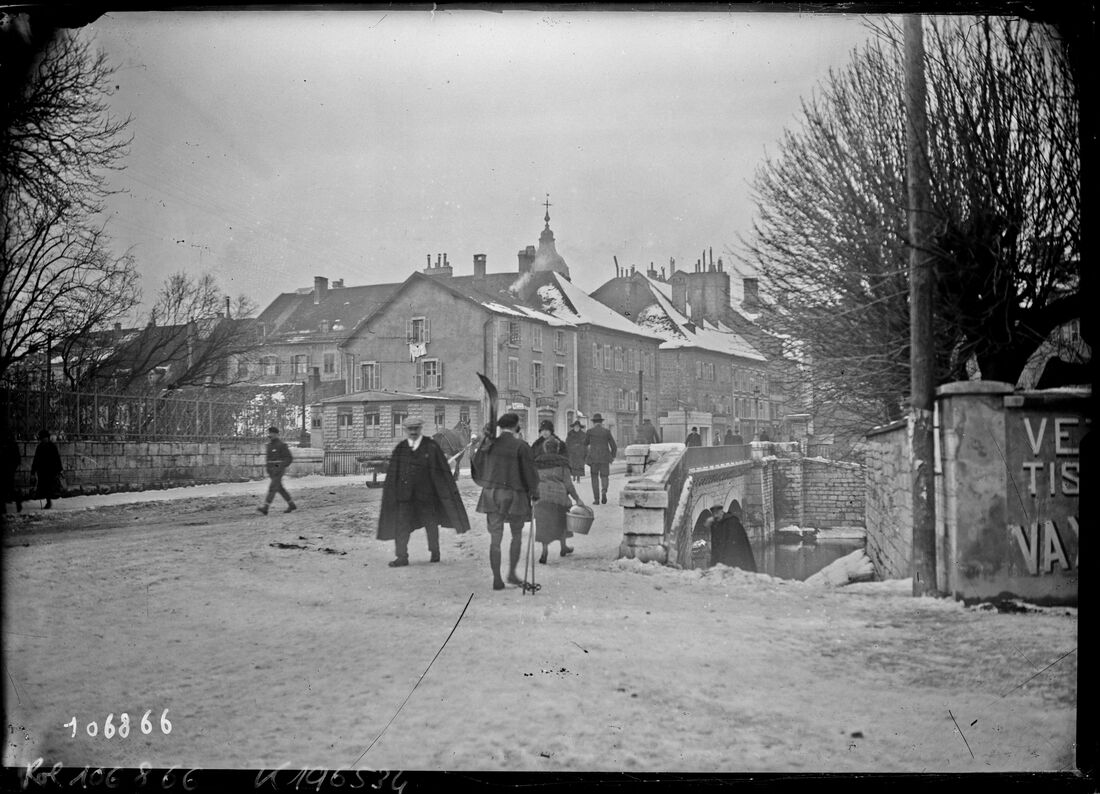
In August 1901, lightning set fire to the Pernod factory. To prevent an explosion, the vats were emptied into the Doubs; less than two days later, the source of the Loue, some fifteen kilometres away, smelt of absinthe. The accident revealed that the Loue is partly a resurgence of the Doubs, which a fluorescein tracing test confirmed in 1910.
In the glass
Its pale yellow tint, verging on green, comes from a compulsory colouring step: after distillation, Roman wormwood and hyssop are infused in it. In the 19th century, iced water was poured in drop by drop, often over a sugar lump, until it turned cloudy.
How we know
A geographical indication or an appellation guarantees an origin and compliance with a controlled product specification. It says nothing about the quality of any particular bottle, nor about how artisanal the producer is: it is a guarantee of provenance and method, not a score.
The outline drawn is the official delimitation of the area, published by INAO (INAO, Délimitation des aires géographiques des SIQO, millésime 2026-08-24, Licence Ouverte v2.0 (Etalab)), reprojected and simplified for the scale of the map. It is not an administrative document : for the area that has legal force, refer to the product specification.
The distilleries of this area
A survey of the producers in this area is under way. This level of the corpus — the distillery, its history, its equipment, its archives — is the Atlas's next documentary undertaking. You can help with it.
Sources and validation
- Sources of the corpus
- Names and statuses: eAmbrosia, the official register of geographical indications of the European Union. Geometries: INAO, Délimitation des aires géographiques des SIQO (27/07/2026), Licence Ouverte v2.0, reprojected to WGS84.
- File reference
- PGI-FR-01870 eAmbrosia register of the European Union
- Protection in the Union
- Since 12 August 2019 Official Journal L215 19.08.2019 — eAmbrosia record of 17 November 2026
- Corpus updated on
- 1 August 2026
- Validation
- First version Corpus under construction. Each entry is checked and sourced before validation by the future scholarly board. Protection status and mode of location are carried by each entry: an area delimited by a product specification and a reference-town point do not carry the same weight.
Distilleries recorded within this area
6 establishments fall inside the delimited outline, according to OpenStreetMap, Wikidata and the official registers. This is not an inventory: these sources record what their contributors have entered or what businesses have declared, and nothing guarantees that they are complete or up to date. See the worldwide survey.
None of these entries carries a founding date backed by a reference: the corpus therefore displays none. Survey of 2026-11-15. © OpenStreetMap contributors (ODbL).