House stories · Pernod
Did absinthe from the Pernod factory really flow all the way to the Loue?
In August 1901, lightning struck the great Pernod Fils distillery in Pontarlier. Absinthe from the burst vats poured into the Doubs; two days later, the source of the Loue, a dozen kilometres away, smelled of anise. The story sounds like a barroom tall tale. It was published by a chemist in a scholarly journal.
The story
The 1901 fire proved, through the smell of absinthe, that the Loue is a resurgence of the Doubs — it is one of the rare house anecdotes that is attested.
On 11 August 1901, a storm passed over Pontarlier. Lightning struck the Pernod Fils factory, one of the largest absinthe distilleries of its day, on the banks of the Doubs. Fire broke out. The vats burst in the heat and in the fight against the blaze. The absinthe, laden with essences of anise and herbs, poured into the river. Witnesses spoke of an enormous quantity; some put it at a million litres.
On 13 and 14 August, a dozen kilometres away, on the other side of a mountain, the source of the Loue began to smell of anise. The water emerging from the cliff, at the head of its steep blind valley, had the scent of the aperitif. It had long been suspected that the Loue was merely an underground branch of the Doubs, lost in the fissures of the limestone. The fire proved it.
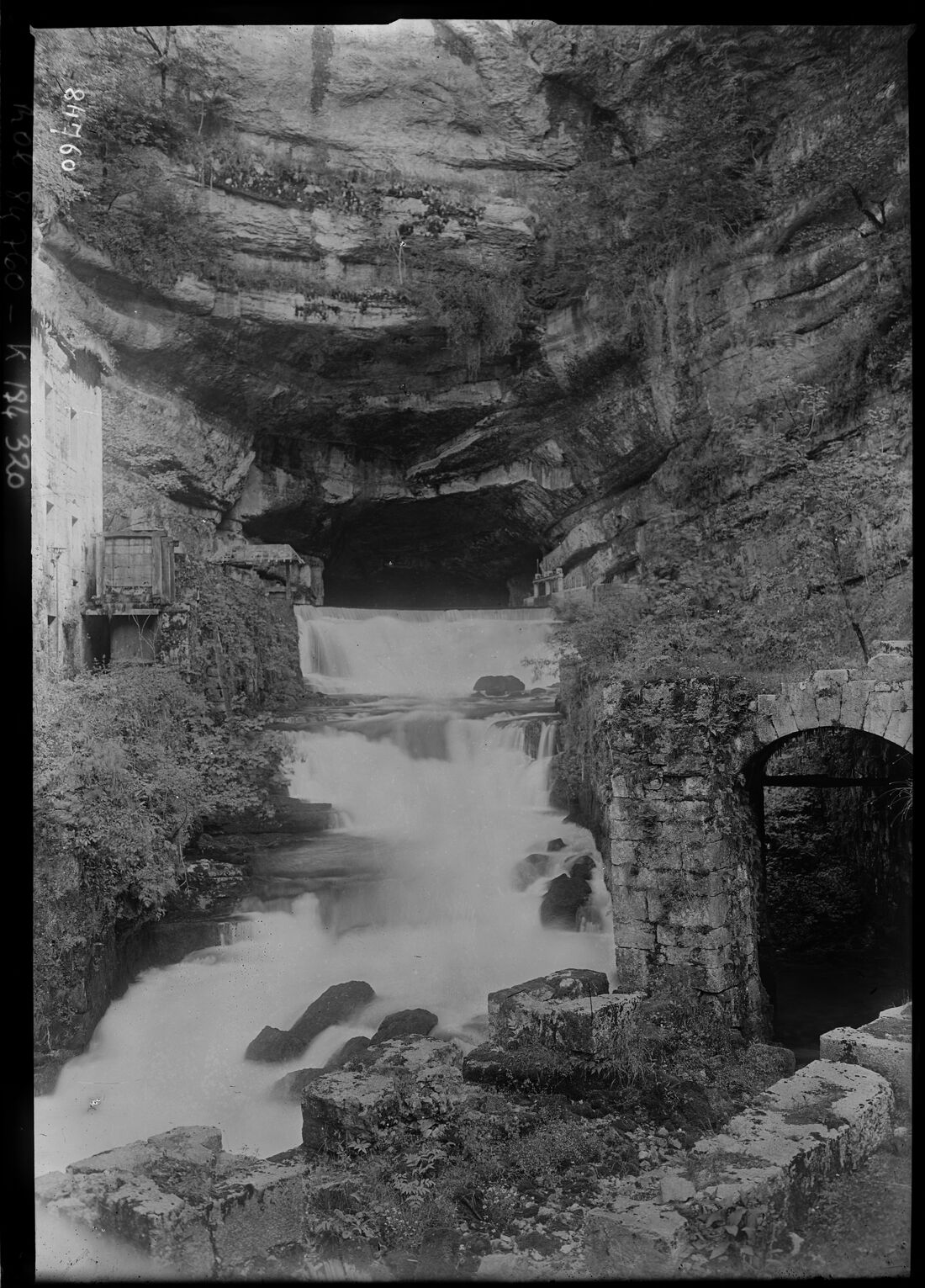
What was flowing from the vats was absinthe as it was distilled in Pontarlier. Grand wormwood, green anise and fennel are macerated in alcohol, then pass through the copper still. The distillate that comes out is colourless; a second infusion of plants, Roman wormwood and hyssop, gives it its pale green tint. It is high in strength, and turns cloudy as soon as water is added: the anethole from the anise, dissolved in the alcohol, then forms fine droplets. It was this scent of anise, more than the colour, that gave away the river's course.
The factory that burned had a century of history behind it. At Couvet, in the Swiss Val-de-Travers, Daniel-Henri Dubied opened an absinthe distillery around 1797 with his son Marcelin and his son-in-law Henri-Louis Pernod. In 1805, Pernod crossed the border and settled in Pontarlier. The house grew with the fashion for the “green fairy”. After the fire of 1901, it was rebuilt in 1902 and 1903.
It did not enjoy its new walls for long. The law of 16 March 1915 banned absinthe in France. The factory became a military hospital during the war, and was then sold in 1919 to the chocolate maker Peter-Cailler-Kohler. The name, however, survived. In 1926, Paul Hémard set up the Établissements Pernod, which sold an anise liqueur containing no wormwood. It is this drink that the 1933 poster presents under the old name, with the places of origin, Couvet and Pontarlier, and the familiar bottle.
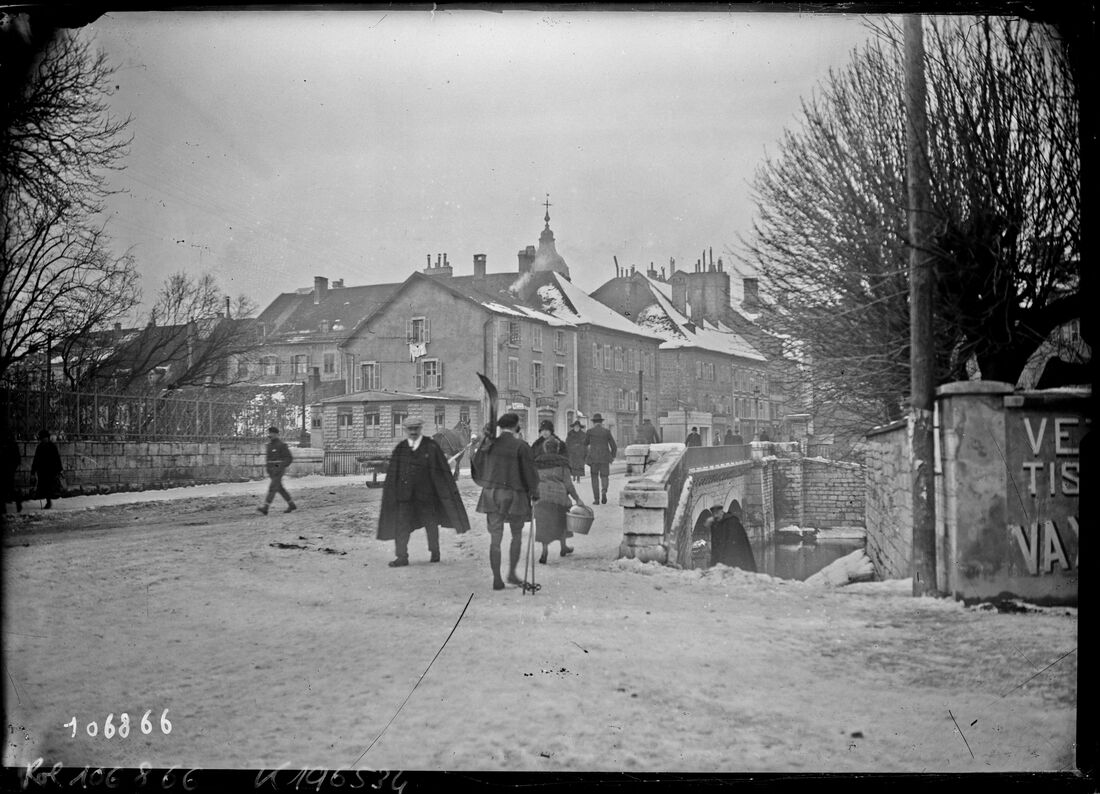
Today the brand presents itself as “the oldest of the anise spirits”, founded in 1805. The date is right for the house; but the product of 1805 was an absinthe, and the anise drink that bears the name dates from the 1920s. In between came a ban, a factory sold off, and a river that smelled of anise.
The legend set against the sources
The legend
As told by local memory and the popular science press
On the day of the fire, a million litres of absinthe poured into the Doubs. The river vanished underground and, a few days later, the Loue ran green and fragrant with absinthe: that is how it was discovered that the two rivers were one and the same.
What the sources say
The heart of the story is attested. In the Annales de chimie et de physique of 1902, Marcellin Berthelot published André Berthelot's letter on the smell of absinthe at the source of the Loue on 13 and 14 August 1901. The journal Cosmos, in September 1901, and Louis Figuier's L'Année scientifique saw it as confirmation of an old hypothesis: “la Loue représente un bras souterrain du Doubs” (the Loue is an underground branch of the Doubs).
Two details do not hold. The million litres was given at the time with a question mark; no one measured it. And the river did not turn green: it was the smell that raised the alarm, and the 1901 letter reports, on the following day, nothing more than a greenish foam below the waterfall at Mouthier. In 1910, a fluorescein tracing confirmed the connection.
The invention of absinthe by Dr Pierre Ordinaire, readily repeated in brand stories, is judged “probably” false by the Dictionnaire historique de la Suisse; the trail leading to Henriette Henriod, at Couvet, remains a tradition.
So, legend or history?
Before you read the answer, what do you think?
Choose a degree: it is the question a historian asks of every story.
Degree of certainty : Attested
Attested. The smell of absinthe at the source of the Loue was described as early as 1901.
The absinthe from the fire did reach the Loue, and a chemist recorded it: the fact is attested by scientific publications of 1901 and 1902. The legend merely embellishes, with a million litres that no one counted and a green river that no one saw. For once, the most extraordinary house story is also the best documented.
How we know
Each date in this story refers to one of the sources below. The degree of certainty can be read from the pattern of the rule: solid for attested, dashed for probable, dotted for tradition, double for legend.
Key dates
-
1797 The Dubied distillery at Couvet, with Henri-Louis Pernod -
1805 Henri-Louis Pernod settles in Pontarlier -
1901 Lightning sets the factory on fire; the absinthe reaches the source of the Loue -
1915 Absinthe banned in France -
1919 The factory sold to Peter-Cailler-Kohler -
1926 Paul Hémard sets up the Établissements Pernod
Attested- established by documents contemporary with the events.
Probable- plausible and consistent with the sources, without direct proof.
Tradition- handed down by the house or by local memory, with no document to confirm or refute it.
Legend- contradicted by the sources, or invented after the fact.
What remains uncertain
- The quantity of absinthe spilled in 1901: no measured figure.
- The opening date of the Couvet distillery: 1797 or 1802 depending on the source.
- The role of Henriette Henriod in the invention of absinthe.
Sources
- Inventaire général du patrimoine culturel, Bourgogne-Franche-Comté, Distillerie Pernod Fils, puis usine Nestlé, dossier IA25001599 .
- Dictionnaire historique de la Suisse, Absinthe .
- Marcellin Berthelot, Annales de chimie et de physique , 1902.
- Cosmos, 14 septembre 1901 , 1901.
- Louis Figuier (fondateur), L'Année scientifique et industrielle , 1901.