Why does pastis turn cloudy in water?
A clear liquid, clear water, and yet a cloud. The gesture is two centuries old, the word “pastis” itself means “a muddle”, and physics only gave it a scholarly name in 2003.
In 1611, the lexicographer Randle Cotgrave recorded in his dictionary an unusual use of the adjective louche: the word no longer described only a squinting gaze, but a cloudy wine. Three centuries later, when an aniseed drink took the place of absinthe, Marseille slang gave it a name meaning “a jumble, a muddled situation”: pastis.
The cloudiness was in the words before it was in the textbooks. And the question is stranger than it looks: how can two perfectly clear liquids, once mixed, produce a third that is no longer clear?
A nineteenth-century gesture
The story passes through the Jura. Henri-Louis Pernod began producing absinthe at Couvet, in Switzerland, in 1797, then settled in Pontarlier in 1805 to win the French market; his distillery then had only one still, producing sixteen litres a day. A century later, the house of Pernod Fils and its competitors had made Pontarlier the capital of a drink that had become the emblem of French cafés.
The gesture that went with it was codified. A slotted spoon holding a lump of sugar was laid across the glass; water poured drop by drop dissolved it to soften the bitterness of the plant. Absinthe, green and transparent, then clouded over to an opaline white. The sugar answered the bitterness. The cloud came from somewhere else.
1914: anise outlives absinthe
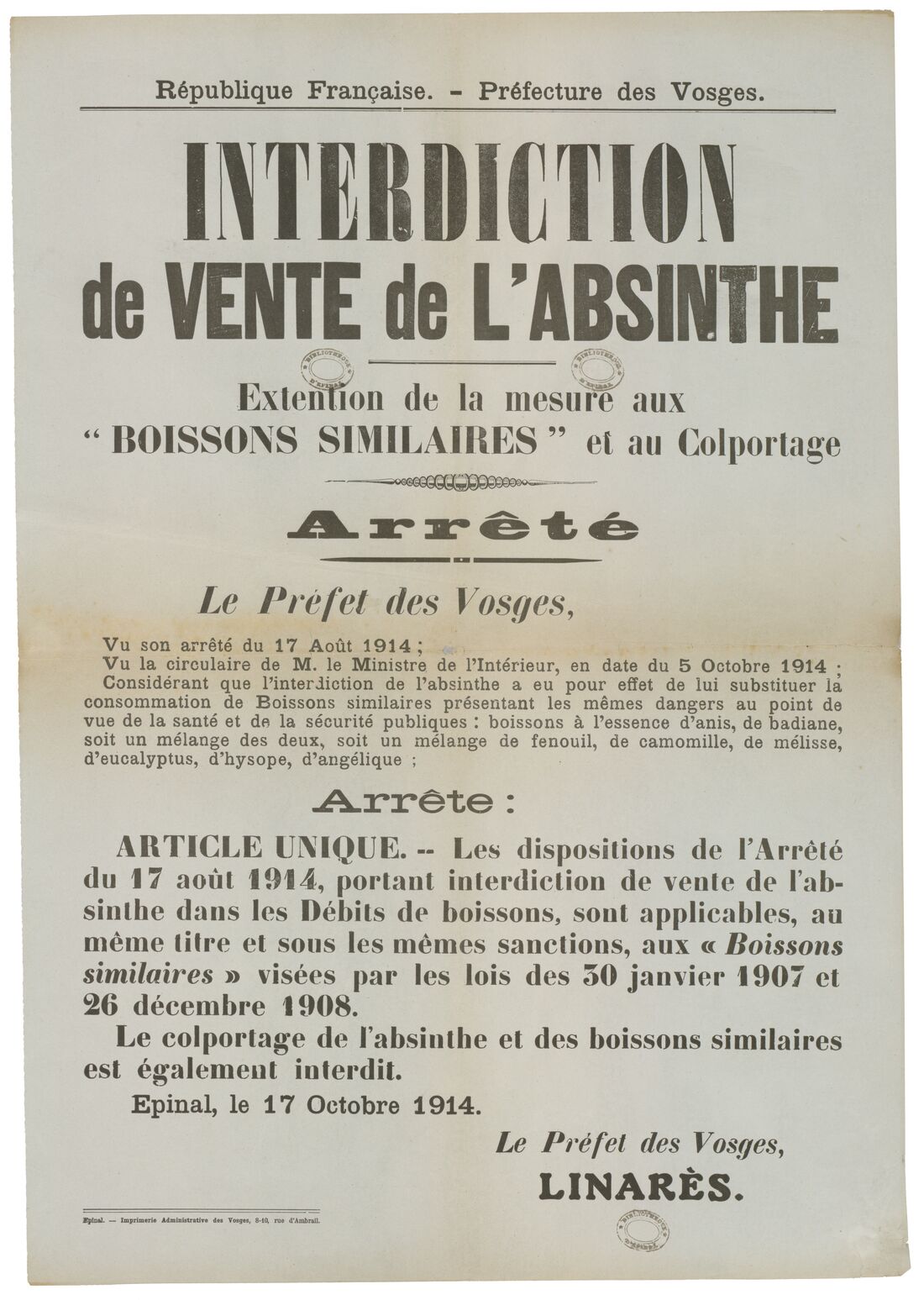
The poster reproduced here is dated Épinal, 17 October 1914. The prefect of the Vosges had banned the sale of absinthe in drinking establishments as early as 17 August. Two months later, he noted that the ban “a eu pour effet de lui substituer” (had the effect of putting in its place) other drinks: made with essence of anise, star anise, fennel. He banned them in turn. The law of 16 March 1915 extended the measure: the manufacture, sale and circulation of absinthe and of “liqueurs similaires” (similar liqueurs) were prohibited throughout the country. The story of this fall is that of the exhibition The Green Fairy.
The prefect had seen one thing clearly. What turns white in the glass is not absinthe, the plant, but anise. After the war, aniseed aperitifs free of absinthe returned legally to the market, and the cloudiness with them. The Trésor de la langue française dates to 1928 the use of pastisse for the drink, in the slang of the Marseille underworld, and to 1931 the form pastis. Paul Ricard launched his own in Marseille in 1932; brand legend credits him with inventing the word, which the dictionaries attest before him. The TLFi specifies that the name of the drink comes from the sense of “muddled situation”, in allusion to the cloudiness caused by water.
A molecule that changes sides
The culprit is called anethole. It is the main aromatic molecule of green anise, star anise and fennel, and European law sets its content in a pastis at between 1.5 and 2 grams per litre. Anethole is an oil: it dissolves readily in ethanol, and barely in water — about 0.1 gram per litre at 25 °C.
In the bottle, at 40 or 45% alcohol, it stays dissolved and invisible. When the water arrives, the proportion of ethanol collapses, and the anethole finds itself in excess in a solvent that can no longer hold it. It does not settle at the bottom or form an oily layer on the surface: it gathers instantly into a multitude of droplets on the scale of a micrometre, a thousandth of a millimetre. At that size, close to the wavelength of visible light, the droplets scatter light in every direction. The liquid turns milky for the same reason as milk: it is an emulsion.
The most surprising thing is what is missing. A mayonnaise needs an emulsifier, egg yolk, and a whisk. Here there is nothing of the kind: the droplets form on their own, without stirring, and the cloud remains visually stable for several hours.
2003: physics gives it a name
Generations had watched this cloud form without its having a scholarly name. In 2003, Stephen Vitale and Joseph Katz published in the journal Langmuir a study of droplet dispersions formed by “homogeneous liquid-liquid nucleation”, which they dubbed “the ouzo effect”, after the Greek aniseed spirit. In 2008, chemists in Bordeaux gave the reason with a touch of irony: in the United States, ouzo is better known than pastis.
The researchers' interest had nothing to do with taste. They were showing that very fine, long-lasting droplets could be obtained without machinery or surfactant. In 2005, François Ganachaud and Joseph Katz described the making of nanoparticles and nanocapsules “using the ouzo effect”, as an alternative to ultrasonic and high-shear devices. The cloud of the cafés had become a laboratory process.
Others looked more closely. In Bordeaux, the team of Dario Bassani and Isabelle Pianet followed anethole by nuclear magnetic resonance: the molecules first gather into small aggregates, which then merge into droplets a micrometre across. In 2016, a team at the University of Twente filmed an evaporating drop of ouzo: clear, then milky as the ethanol leaves first from the edge, then clear again — a drop of water sitting on a ring of oil — and finally reduced to a tiny drop of anethole. Chemists are still debating the detail of what stabilises these emulsions.
What the cloud says
Pastis turns cloudy because water drives the anethole out of solution: deprived of the alcohol that dissolved it, the anise oil disperses into droplets too small to be seen one by one, yet numerous enough to stop the light. The cloudiness is therefore not a failed mixture. It is a spontaneous emulsion, one of the few that form entirely by themselves, and physics only named it in 2003.
Anise survived the law of 1915 because the cloud had never depended on absinthe. The whole family of anise spirits, from ouzo to raki, shares this cloudiness — and the same molecule. As for the ethanol that held the oil in the bottle, its name too has an unexpected history: it first referred to a powder for the eyes.