Where does the word “alcohol” come from?
Before it ever ran from a still, alcohol was laid on the eyelids. The word took more than three centuries to pass from powder to liquid, and that journey says something chemistry has never contradicted.
In the Egypt of the pharaohs, people darkened the rims of their eyes with a greasy, dark powder, ground very fine. When, in 1999, chemists from the Laboratoire de recherche des musées de France analysed Egyptian cosmetics still in their original pots, they found galena, a lead ore, and two lead compounds that nature supplies only in tiny quantities: the Egyptians made them. Eye make-up was already a matter for the laboratory.
Arabic calls this cosmetic kuḥl. In English we write kohl. And from it, by a detour of several centuries, came the word that today denotes ethanol, distilled wine and everything that intoxicates. How did a powder for the eyelids become the name of a liquid?
A black powder, an Arabic article
Al-kuḥl means “the kohl”: al is the definite article, as in alembic, alchemy or algebra. The word denotes an extremely fine mineral powder, based on antimony sulphide (stibnite) or on lead (galena), applied along the rims of the eyelids. The corresponding Arabic verb means “to paint the eyes”.
Muslim Spain passed the word on to Castilian: alcohol is attested there as early as 1278 in the sense of “antimony”, according to the Trésor de la langue française. From there it passed into the Latin of the alchemists, who used it for something precise: a substance reduced to an impalpable powder.
In French, the word appears in the fourteenth century in a medical treatise, the Jardin de santé. Surgeons at the end of the Middle Ages used it as a measure of fineness: in 1492, a recipe prescribes grinding ingredients on a marble slab “en pouldre subtile comme alcohol” (into a powder as fine as alcohol). In the sixteenth century, Ambroise Paré still defines a collyrium as a remedy for the eyes “fait de medicamens bien subtilement pulverises, que les Arabes disent comme alcohol” (made of medicines very finely powdered, like what the Arabs call alcohol). Alcohol was then a standard of extreme fineness. It did not flow.
The apparatus before the word
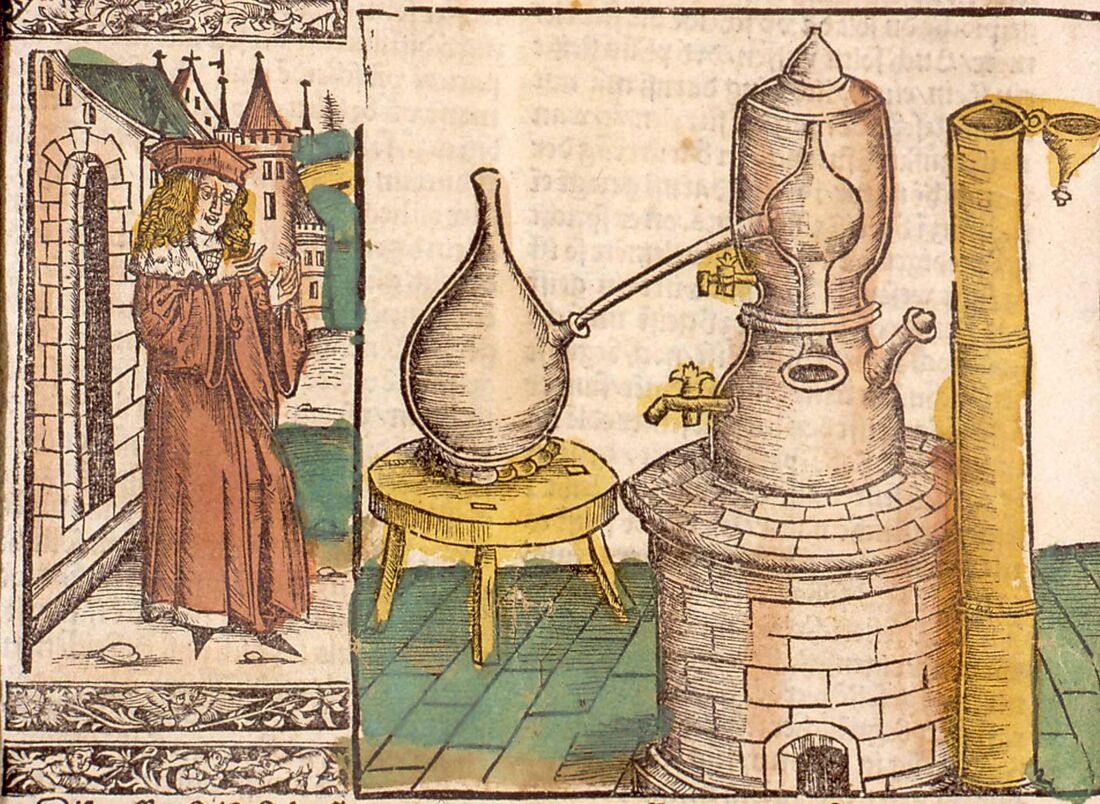
The oddest thing is this time lag: the instrument had long been part of French when its product still did not bear that name. The word alambic — alembic — also Arabic (al-anbīq, itself taken from the Greek), appears as early as the 1270s in the Roman de la Rose. For centuries, what came out of the still was called aqua ardens, “burning water”, because it burns, or aqua vitae, “water of life”, because it was credited with the power to prolong life. People also said “spirit of wine”. The history of those names is told in another article: why do we say “eau-de-vie”?
The alchemists' shift
The passage from solid to liquid took place among the alchemists of the Renaissance. For them, alcohol no longer meant only a powder, but whatever is purest and subtlest in a substance, whatever its form. Etymologists attribute this leap to the Swiss physician Paracelsus (1493-1541), who is said to have spoken of alcohol vini, “the alcohol of wine”, to mean the finest part of wine, the part that distillation draws out. The Trésor de la langue française cautiously gives this attribution in the conditional: it is an old scholarly hypothesis, handed down from dictionary to dictionary, rather than a fact established by a dated text.
What is dated, on the other hand, is the first unambiguous definition. In 1612, Martin Ruland's Lexicon alchemiae, published in Frankfurt, sets it down in Latin: alkol is the purest substance of a thing, “thus alkhol vini is rectified burning water”. The word had changed state. In 1694, Thomas Corneille confirms it in his dictionary: it is “un mot arabe connu dans la Pharmacie pour signifier un esprit de vin bien rectifié et séparé de son phlegme” (an Arabic word known in pharmacy to signify a spirit of wine well rectified and separated from its phlegm), that is to say, from its water.
From spirit of wine to chemistry
The rest of the journey is a series of widenings. By 1834, the French word denotes the product of the fermentation of beer, cider or any other drink, and no longer only that of wine. In 1863, Littré records the chemists' sense: a whole family of compounds with the same structure, of which the alcohol of wine is only one member. Around 1852, a Swedish physician, Magnus Huss, coined alcoholism to name the effects of abuse. Along the way, the Académie française dropped the h from alcohol, which Spanish and English have kept.
Littré was already struck by the route. He noted that one does not see at first “comment le sens a passé d'une poudre très fine à l'esprit-de-vin” (how the meaning passed from a very fine powder to spirit of wine), then concluded that the two senses meet in that both express “des objets d'une très grande ténuité” (objects of very great fineness).
A legend to set aside
Another etymology circulates widely online: alcohol is supposed to come from the Arabic al-ghūl, a “spirit” or “demon”, and to mean “the spirit that devours the body”. It has a moral on its side, and the echo of spirits. It has no text on its side: no historical dictionary accepts it, and the fact-checkers who have examined it have rated it false. Kuḥl, by contrast, is attested at every step.
What the word has kept
Alcohol bears the name of a cosmetic because the alchemists were looking for the same thing in the powder and in the liquid: the finest, purest part of a substance. Grinding antimony until it could no longer be felt and distilling wine until the water was driven off were, in their eyes, one and the same operation. The word followed the idea, from the eyelid to the worm of the still.
Chemistry ended up proving it right in its own way: alcohol is indeed what distillation separates from wine, and the exhibition The still shows how the apparatus achieves it. The story of its beginnings is in The origins of distilling. And ethanol can be found at work elsewhere, where it holds an oil of anise in solution until water drives it out: that is the clouding of pastis.