Who banned absinthe, when, and what exactly was banned?
A drink banned in the middle of a war, a contested decree, a law passed in the spring. Read the documents in the file, then fill in the notebook: who, what, when.
The file
Six archive documents, from 1911 to 1915. Read them, then fill in the notebook. The notebook never says which answer is wrong: it confirms your correct answers in batches of three.
-
Exhibit A
A poster by the Ligue nationale contre l'alcoolisme (National League against Alcoholism), 1911
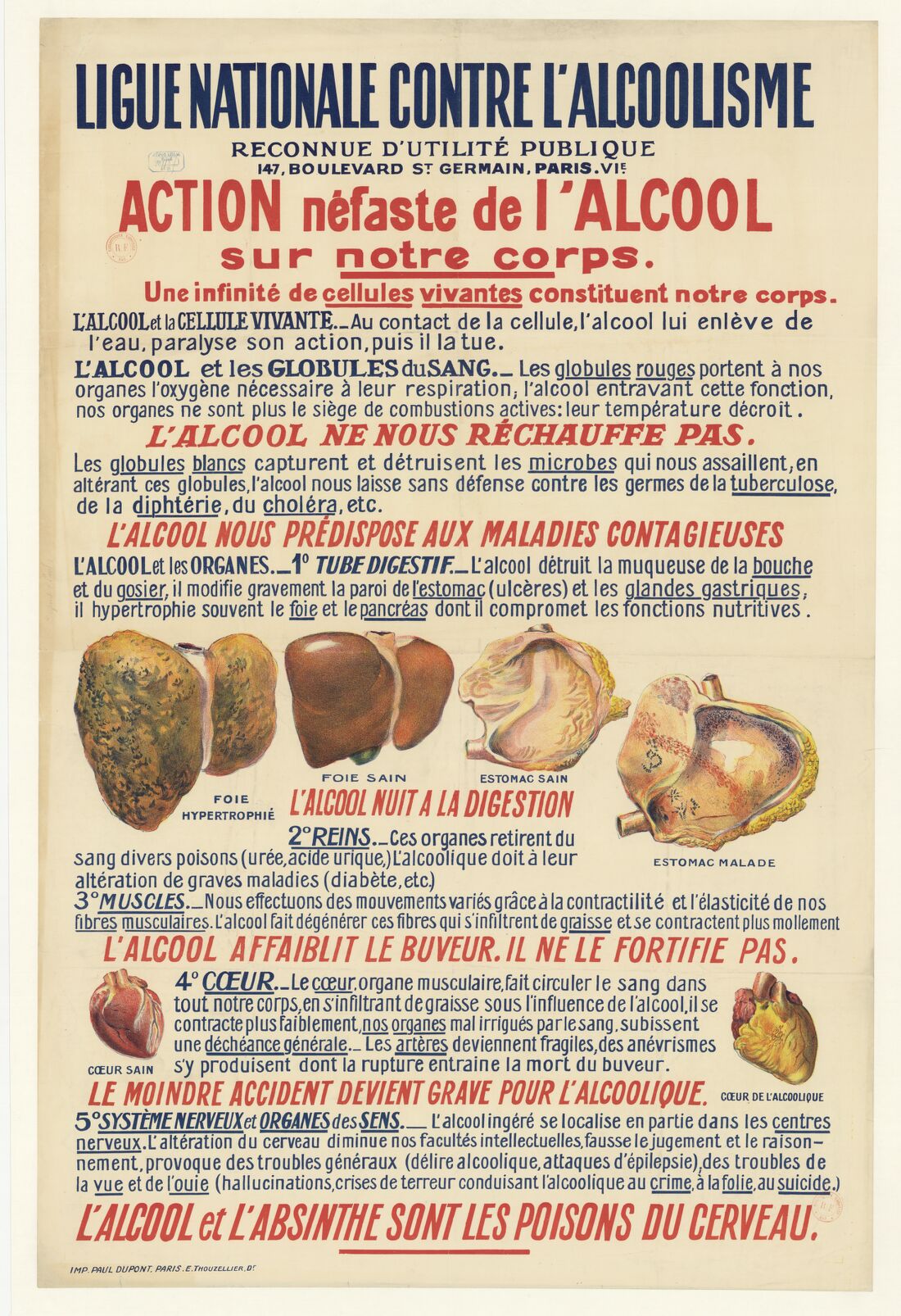
Ligue nationale contre l'alcoolisme. Action néfaste de l'alcool sur notre corps, 1911. Source gallica.bnf.fr / BnF, ark:/12148/btv1b53127521p — public domain. An educational poster intended for schools and public places. Its last line singles out absinthe: “l'alcool et l'absinthe sont les poisons du cerveau” (alcohol and absinthe are the poisons of the brain).
Source: Ligue nationale contre l'alcoolisme, poster, 1911, BnF, Gallica ark:/12148/btv1b53127521p.
-
Exhibit B
A wall in Paris, 1914
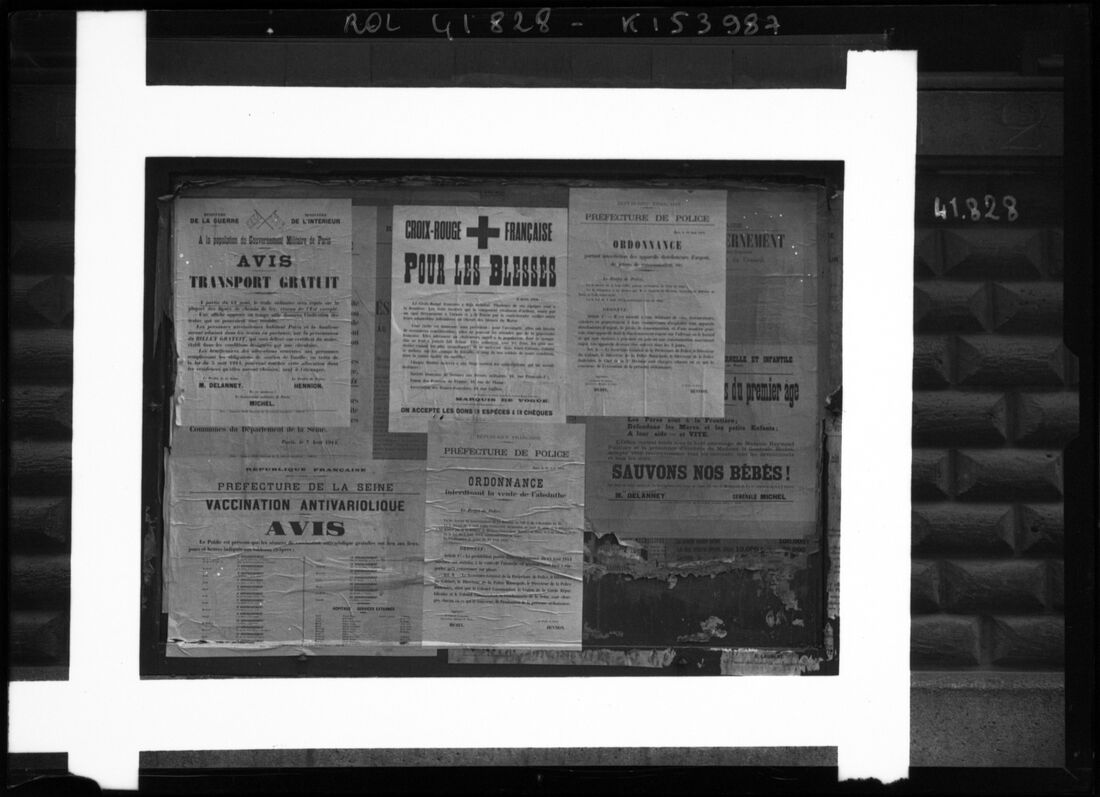
Ordonnances d'interdiction des distributeurs d'argent, de jetons et de vente d'absinthe, avis divers, Agence Rol (photographie de presse), 1914. Source gallica.bnf.fr / BnF, ark:/12148/btv1b6931264m — public domain. Press photograph: among the official notices posted at the start of the war, an ordinance of the Préfecture de police bans the sale of absinthe.
Source: Agence Rol, “Ordonnances d'interdiction des distributeurs d'argent, de jetons et de vente d'absinthe, avis divers”, 1914, BnF, Gallica ark:/12148/btv1b6931264m.
-
Exhibit C
Le Petit Parisien, 8 January 1915
“L'interdiction définitive de l'absinthe. Sur la proposition des ministres de l'Intérieur, des Finances et de la Justice, le Président de la République a signé, hier en conseil des ministres, deux importants décrets. […] Le second décret a pour but de rendre définitive l'interdiction de la vente de l'absinthe et des boissons similaires, interdiction qui n'était jusqu'ici que temporaire et limitée à la durée de la guerre. Ces deux décrets seront soumis à l'approbation des Chambres dès l'ouverture de la session ordinaire du Parlement.” (“The permanent ban on absinthe. On the proposal of the Ministers of the Interior, of Finance and of Justice, the President of the Republic yesterday signed two important decrees in the Council of Ministers. […] The purpose of the second decree is to make permanent the ban on the sale of absinthe and similar drinks, a ban which until now was only temporary and limited to the duration of the war. These two decrees will be submitted to the Chambers for approval as soon as the ordinary session of Parliament opens.”)
One of the most widely read dailies in France announces the decision the day after the Council of Ministers. The first of the two decrees limits the opening of new drinking establishments. “Définitive” (permanent): that is the government's intention. But is a decree enough, and what will become of it if the Chambers do not approve it?
Source: Le Petit Parisien, 8 January 1915, p. 2, BnF, Gallica ark:/12148/bpt6k5653095.
-
Exhibit D
The decree, in the Journal officiel, January 1915
“Le Président de la République française, sur le rapport des ministres de l'intérieur, des finances et de la justice, le conseil des ministres entendu ; décrète : Art. 1er. — Sont interdites la vente en gros et au détail ainsi que la circulation de l'absinthe et des liqueurs similaires visées par l'article 15 de la loi du 30 janvier 1907 et l'article 17 de la loi du 26 décembre 1908. Toutefois, la présente interdiction n'est pas applicable aux expéditions faites à destination soit de l'étranger […].” (“The President of the French Republic, on the report of the Ministers of the Interior, of Finance and of Justice, the Council of Ministers having been heard, decrees: Art. 1. — The wholesale and retail sale, as well as the circulation, of absinthe and of the similar liqueurs referred to in Article 15 of the Law of 30 January 1907 and Article 17 of the Law of 26 December 1908 are prohibited. However, the present prohibition does not apply to consignments sent to destinations either abroad […].”)
Read carefully the list of what is banned — and of what is not.
Source: Journal officiel de la République française, 8 January 1915, BnF, Gallica ark:/12148/bpt6k2023701p.
-
Exhibit E
Le Petit Parisien, 12 January 1915
“M. Adolphe Girod, député du Doubs, vient d'adresser à M. Paul Deschanel, président de la Chambre, la lettre suivante : Monsieur le président, j'ai l'honneur de vous informer que je désire interpeller le gouvernement, à la plus prochaine séance, ‘sur la légalité du décret visant l'interdiction de l'absinthe et le respect des droits du Parlement en matière législative’.” (“Mr Adolphe Girod, deputy for the Doubs, has just sent the following letter to Mr Paul Deschanel, President of the Chamber: Mr President, I have the honour to inform you that I wish to interpellate the government, at the very next sitting, ‘on the legality of the decree concerning the ban on absinthe and respect for the rights of Parliament in legislative matters’.”)
The Doubs is the département of Pontarlier, the foremost absinthe town in France. The deputy does not challenge the ban itself, but the route chosen: a decree rather than a law.
Source: Le Petit Parisien, 12 January 1915, p. 2, BnF, Gallica ark:/12148/bpt6k5653137.
-
Exhibit F
The law, in the Journal officiel, 17 March 1915
“Loi relative à l'interdiction de la fabrication, de la vente en gros et au détail, ainsi que de la circulation de l'absinthe et des liqueurs similaires. Le Sénat et la Chambre des députés ont adopté, le Président de la République promulgue la loi dont la teneur suit : Art. 1er. — Sont interdites la fabrication, la vente en gros et au détail, ainsi que la circulation de l'absinthe et des liqueurs similaires […]. Art. 2. — La présente loi est applicable à l'Algérie et aux colonies.” (“Law on the prohibition of the manufacture, the wholesale and retail sale, and the circulation of absinthe and similar liqueurs. The Senate and the Chamber of Deputies have adopted, the President of the Republic promulgates the law whose content follows: Art. 1. — The manufacture, the wholesale and retail sale, and the circulation of absinthe and similar liqueurs […] are prohibited. Art. 2. — The present law applies to Algeria and the colonies.”)
The law, dated 16 March 1915, appears in the Journal officiel the following day. Compare its first article with that of the decree.
Source: Journal officiel de la République française, 17 March 1915, p. 1, BnF, Gallica ark:/12148/bpt6k20237698.
The notebook
Choose an answer for each box, then have the notebook checked. It only confirms correct answers in batches of three, without saying which ones are wrong.
The affair, pieced together
Absinthe fell in three stages. In August 1914, a wartime measure suspended its sale. In January 1915, a decree extended the ban, on sale and circulation, to the whole of France; absinthe could still be distilled, and shipped abroad. In March 1915, a law banned its manufacture as well, as far afield as Algeria and the colonies: in Pontarlier, the stills of the Green Fairy came to a halt. Years of anti-alcohol campaigning had prepared the ground. The ban targets one drink and those that resemble it, not alcohol in general: wine and wine-based aperitifs remained on sale. The 1915 law would not be repealed until 2011.
How we know
Journal officiel de la République française, 8 January and 17 March 1915; Le Petit Parisien, 8 and 12 January 1915; posters of 1911 and 1914; all available on Gallica (BnF). Scope of the decree: Conseil d'État, 29 April 1921, Société Premier et Henry.
How this inquiry is built
The six documents are authentic: posters, a press photograph, articles from Le Petit Parisien and texts from the Journal officiel, all held by the Bibliothèque nationale de France and available on Gallica. Quotations are copied from the digitised pages, with a few cuts marked […].
Confirming in batches is borrowed from deduction games: you cannot find a box by trying every answer; you have to have understood enough of the affair to be sure of three at once. Without JavaScript, each box shows its answer and its evidence directly.
The other games
-
Quiz · common misconceptions
Legend or history?
A monk of 1510, an absinthe that drives people mad, a doctor who invents gin: it is up to you to decide, evidence in hand.
10 statements · 10 minutes
-
Observation · posters
Reading a label
Medals, monks, health promises: five old posters and labels to decipher, area by area.
5 documents · 15 minutes
-
Riddles · botany
Guess the plant
Ten plants from liqueurs and bitters, three clues each: history, botany, use.
10 riddles · 10 minutes
-
Quiz · three levels
Learn about spirits
From cane to rum, from grain to whisky: three levels of questions on the raw materials, the gestures and the history of spirits.
10 questions per level