Skip to content

This page was machine-translated from French. It has not been reviewed by a native speaker: the French version prevails. Read the French version

Play · reading images

Reading a label

A 19th-century liqueur poster is a document: it tells us what people believed they could promise, and to whom. Tap each numbered area to decipher it — label wording, health promises, symbols.

On each image, the numbered areas refer to the list that follows. Once every area of a document has been read, the document reveals what it says.

  • Wording
  • Health promise
  • Symbol

Document 1 of 5

Bitter Sécrestat, Bordeaux

An 1898 poster that shows nothing but a bottle. But the label on that bottle has a great deal to say: about medals, about doctors, and even about absinthe.
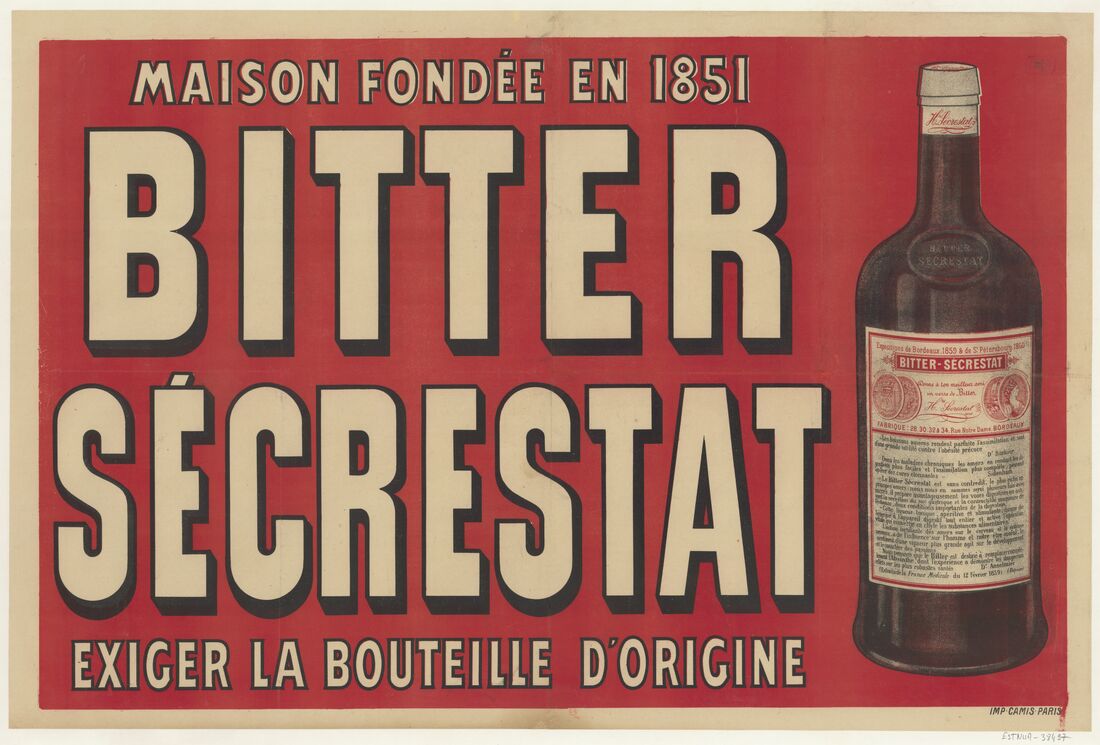
Affiche horizontale rouge : « Bitter Sécrestat » en très grandes lettres crème, « Maison fondée en 1851 » au-dessus, « Exiger la bouteille d'origine » en bas ; à droite, une bouteille sombre dont l'étiquette porte des médailles et un texte serré de citations médicales.
Bitter Sécrestat, Maison fondée en 1851, exiger la bouteille d'origine, Affiches Camis, Paris, 1898. Source gallica.bnf.fr / BnF, ark:/12148/btv1b53205500c — public domain.
  1. Wording , “Maison fondée en 1851” (House founded in 1851) : Why does a poster begin with a date?

    Age is an argument: it suggests that a product has proved itself. The date is the one the house claims; it appears on hundreds of posters of the period, in the same formula. It says nothing about what was being made in 1851, or by whom.

  2. Wording , The exhibition medals : What are the medals printed on the label worth?

    The label cites the exhibitions of Bordeaux (1859) and Saint Petersburg (1860). The industrial exhibitions of the 19th century handed out large numbers of awards, category by category; a medal says that a jury rewarded the product in a given year, not that it is better than the others. On the label, it becomes a permanent seal of quality.

  3. Health promise , The doctors' quotations : What do the small, tightly packed texts beneath the label promise?

    Extracts attributed to doctors, dated “la France médicale du 12 février 1859” (La France médicale, 12 February 1859): the bitters is said to be “tonique, apéritif et stimulant” (tonic, appetising and stimulating), useful “contre l'obésité précoce” (against early obesity), and even “destiné à remplacer complètement l'absinthe, dont l'expérience a démontré les dangereux effets” (intended to replace completely absinthe, the dangerous effects of which experience has demonstrated). Since 2006, EU law has prohibited any health claim on a drink of more than 1.2% vol.

  4. Wording , “Exiger la bouteille d'origine” (Insist on the original bottle) : Against whom is this instruction written?

    Against imitations. Successful brands were copied, and the law of 23 June 1857 on trademarks gave manufacturers a means of taking action. The instruction is addressed to the customer: it is up to them to check the bottle, its shape, its label.

  5. Symbol , The signature on the neck : Why a handwritten signature on the bottle?

    The signature “H. Sécrestat”, reproduced on the capsule, acts as a seal: it personalises the product and makes it harder to counterfeit. It is the same device as the wax seals and monograms of liqueurs from the same period.

What this document says

This poster argues like a prescription. Age, exhibition awards, quotations from doctors: everything is meant to turn a bitter aperitif into a serious product, almost a remedy. The most striking argument is absinthe, branded as dangerous as early as 1859, in order to sell another alcoholic drink in its place. Today, none of these health promises would be allowed.

How we know

Bitter Sécrestat, poster, Affiches Camis, 1898, BnF, Department of Prints and Photography, Gallica ark:/12148/btv1b53205500c.
Document 2 of 5

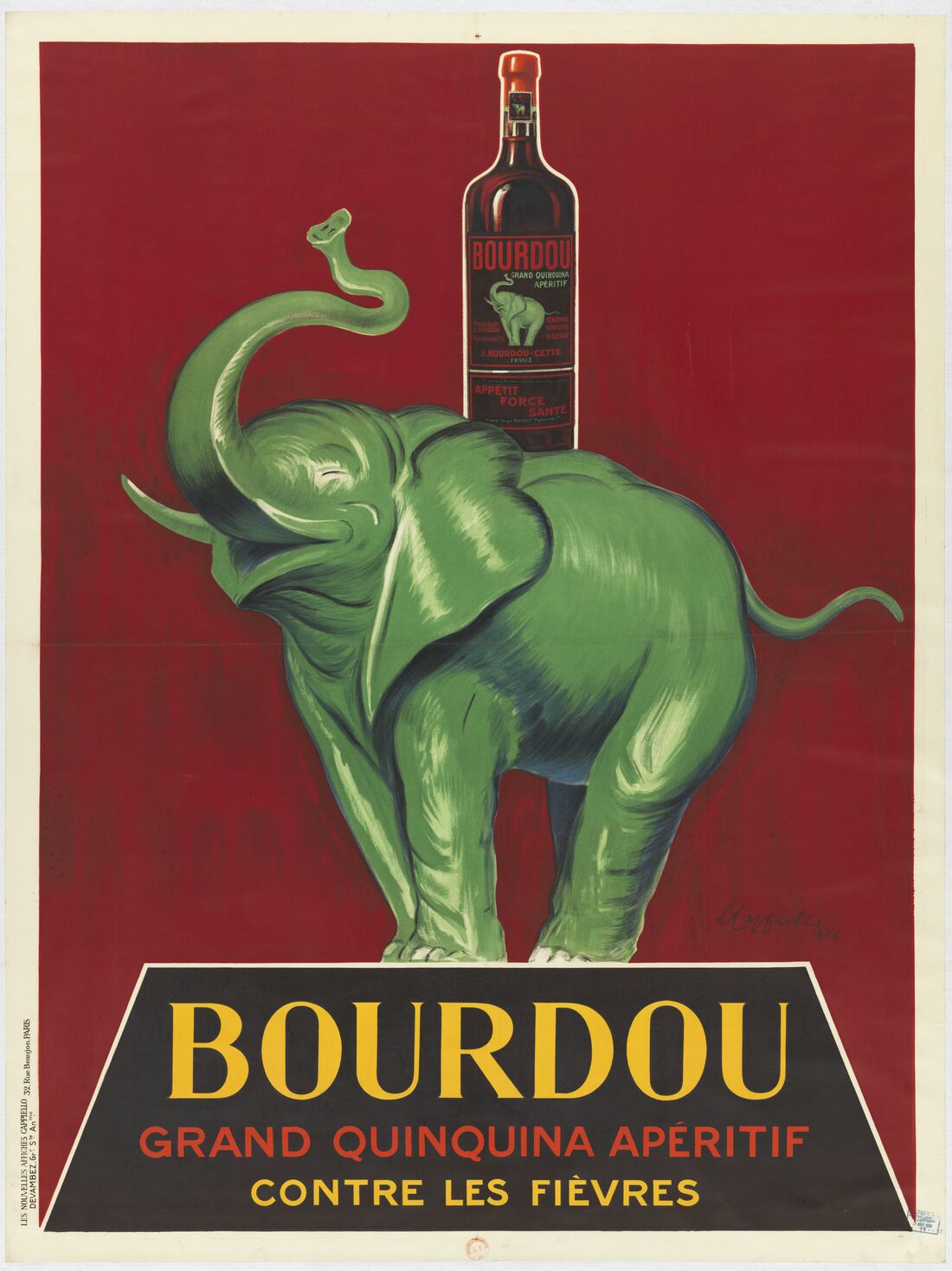
Bourdou, grand quinquina, Cette

A green elephant, a balancing bottle, and a promise in capital letters: “contre les fièvres” (against fevers). Leonetto Cappiello signed the poster in 1926.

Affiche de Cappiello sur fond rouge : un éléphant vert, trompe levée, porte sur son dos une bouteille de quinquina Bourdou ; en bas, sur un socle noir, « Bourdou, grand quinquina apéritif, contre les fièvres ».
Bourdou grand quinquina apéritif contre les fièvres, Leonetto Cappiello (1875-1942), 1926. Source gallica.bnf.fr / BnF, ark:/12148/btv1b52510715z — public domain.
  1. Health promise , “Grand quinquina apéritif contre les fièvres” (Grand cinchona aperitif against fevers) : An aperitif against fevers: what is the promise based on?

    On cinchona bark, from which Pelletier and Caventou isolated quinine in 1820, a medicine genuinely effective against malaria. “Vins de quinquina” (cinchona wines) sold on that reputation. That does not make an alcoholic drink a remedy, and this sentence would be banned today: Regulation (EC) No 1924/2006 prohibits any health claim on drinks of more than 1.2% vol.

  2. Health promise , The pharmacist on the label : What does the bottle's small label say?

    “Préparé par J. Bourdou, pharmacien de 1re classe” (Prepared by J. Bourdou, first-class pharmacist), “fébrifuge, tonique, digestif” (febrifuge, tonic, digestive), “Cette, France”. The maker's diploma serves as a medical guarantee. Cette is the old spelling of Sète, abandoned at the end of the 1920s: the wording dates the label as much as it locates it.

  3. Health promise , “Appétit, force, santé” (Appetite, strength, health) : Three words, three promises: which ones?

    To whet the appetite, to give strength, to preserve health. This is the vocabulary of the “tonics” of the time, halfway between the pharmacy and the café. None of these three claims has been demonstrated for an alcoholic drink; none could appear on a label today.

  4. Symbol , The green elephant : Why an elephant?

    It is the brand's emblem — the label asks buyers to “exiger la marque Bourdou ‘Éléphant vert’” (insist on the Bourdou ‘Green Elephant’ brand). The animal stands for strength and can be recognised from afar. Cappiello built his style on this principle: a single, vivid figure on a plain background, which passers-by remember without reading.

  5. Wording , The signature “Cappiello 1926” : What does the signature tell us?

    The artist's name and the year. Leonetto Cappiello (1875-1942), born in Livorno, drew hundreds of commercial posters in Paris. As he died in 1942, his work entered the public domain in 2013: that is what allows us to show it here.

What this document says

Cappiello's poster sells an image, the elephant, and a medical promise. Cinchona does contain quinine, a genuine antimalarial; but an aperitif is not a treatment, and the pharmacist, the “febrifuge” and the “health” on the label serve above all to reassure. This register has disappeared: it is now banned for any alcoholic drink.

How we know

Bourdou, grand quinquina apéritif, poster by Leonetto Cappiello, printed by Devambez, 1926, BnF, Gallica ark:/12148/btv1b52510715z.

Document 3 of 5

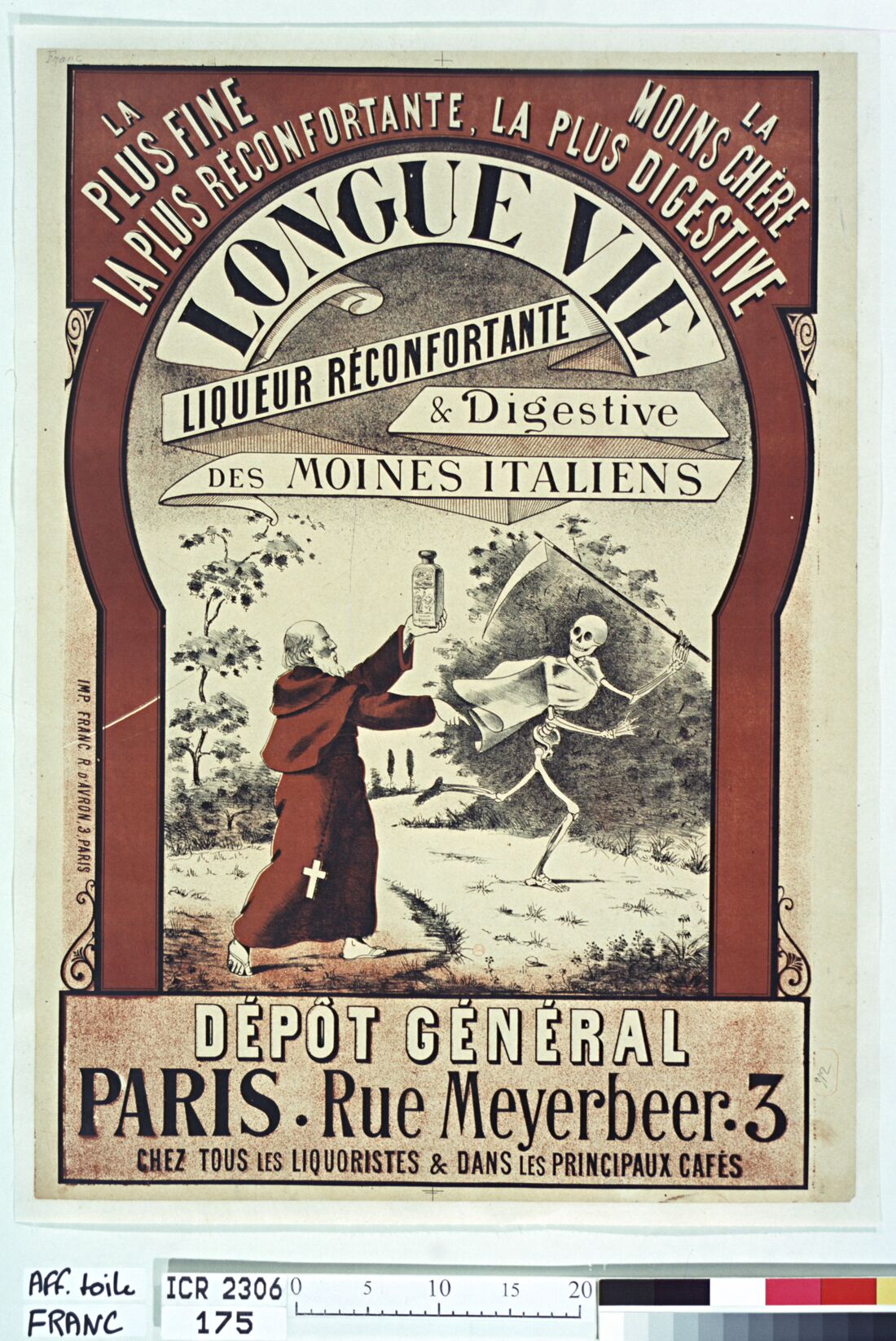
Longue Vie, “liqueur des moines italiens”

A monk holds out a bottle to Death, who flees. The poster, printed in Paris in 1882, promises what its name says: Longue Vie, long life.

Affiche lithographiée : sous le titre « Longue Vie, liqueur réconfortante & digestive des moines italiens », un moine en robe brune brandit une bouteille devant un squelette armé d'une faux qui s'enfuit ; en bas, « Dépôt général, Paris, rue Meyerbeer, 3 ».
La plus fine, la plus réconfortante, la moins chère, la plus digestive, Longue Vie, liqueur réconfortante & digestive des moines italiens, Imprimerie Franc, Paris, 1882. Source gallica.bnf.fr / BnF, ark:/12148/btv1b90088046 — public domain.
  1. Wording , “La plus fine, la plus réconfortante, la plus digestive” (The finest, the most comforting, the most digestive) : How many superlatives does the poster line up?

    Four, arching above the name: three about quality, one about price. None can be checked: “la plus” (the most) refers to no comparison. These are advertising formulas, like the “supérieure à toutes les liqueurs” (superior to all liqueurs) of other posters. Today, advertising for alcohol in France is restricted to objective information about the product.

  2. Health promise , “Liqueur réconfortante & digestive” (Comforting & digestive liqueur) : What is a “réconfortante”, or comforting, liqueur?

    A pharmacy word applied to a drink: the “cordial”, the liqueur that revives the heart. “Digestive” completes the promise. Both words have remained in everyday use, but they describe an intention to sell, not an established effect.

  3. Wording , “Des moines italiens” (Of the Italian monks) : Which monks?

    We do not know: the poster names neither abbey nor order, and the liqueur is sold from Paris. A monastic origin is a selling point, widespread after the success of Chartreuse and Bénédictine. The monk vouches for age and for a knowledge of plants, without anyone being able to check.

  4. Symbol , The monk with the bottle : What is the monk doing?

    He brandishes the bottle like a crucifix before Death. The cross on his habit makes the link: the liqueur takes the place of the sacred object. The image turns a drink into a form of protection.

  5. Symbol , Death in flight : Why a skeleton on a liqueur poster?

    To illustrate the name: “Longue vie” (long life). Death with his scythe, borrowed from the danse macabre, recoils before the bottle. As early as 1845, the chemist Raspail published a “liqueur hygiénique” (hygienic liqueur) meant to ensure a long life: the promise of longevity is a commonplace of 19th-century liqueurs.

  6. Wording , “Dépôt général, Paris, rue Meyerbeer, 3” (General depot, Paris, 3 rue Meyerbeer) : Where is the liqueur sold?

    At a Paris depot, then “chez tous les liquoristes et dans les principaux cafés” (at all liqueur merchants and in the principal cafés). These Italian monks, then, have an address in the Opéra district. The general depot is the warehouse that supplies retailers: it is the most concrete line on the poster.

What this document says

Everything on this poster is a promise: superlatives, a “réconfortante et digestive” (comforting and digestive) drink, monks who cannot be identified, and Death put to flight. It is the model of the 19th-century monastic liqueur, in which the habit vouches for the recipe and the recipe vouches for health. The Paris depot, for its part, is real: it is the only line that could be checked.

How we know

Longue Vie, liqueur réconfortante et digestive des moines italiens, poster, printed by Franc, 1882, BnF, Gallica ark:/12148/btv1b90088046.

Document 4 of 5

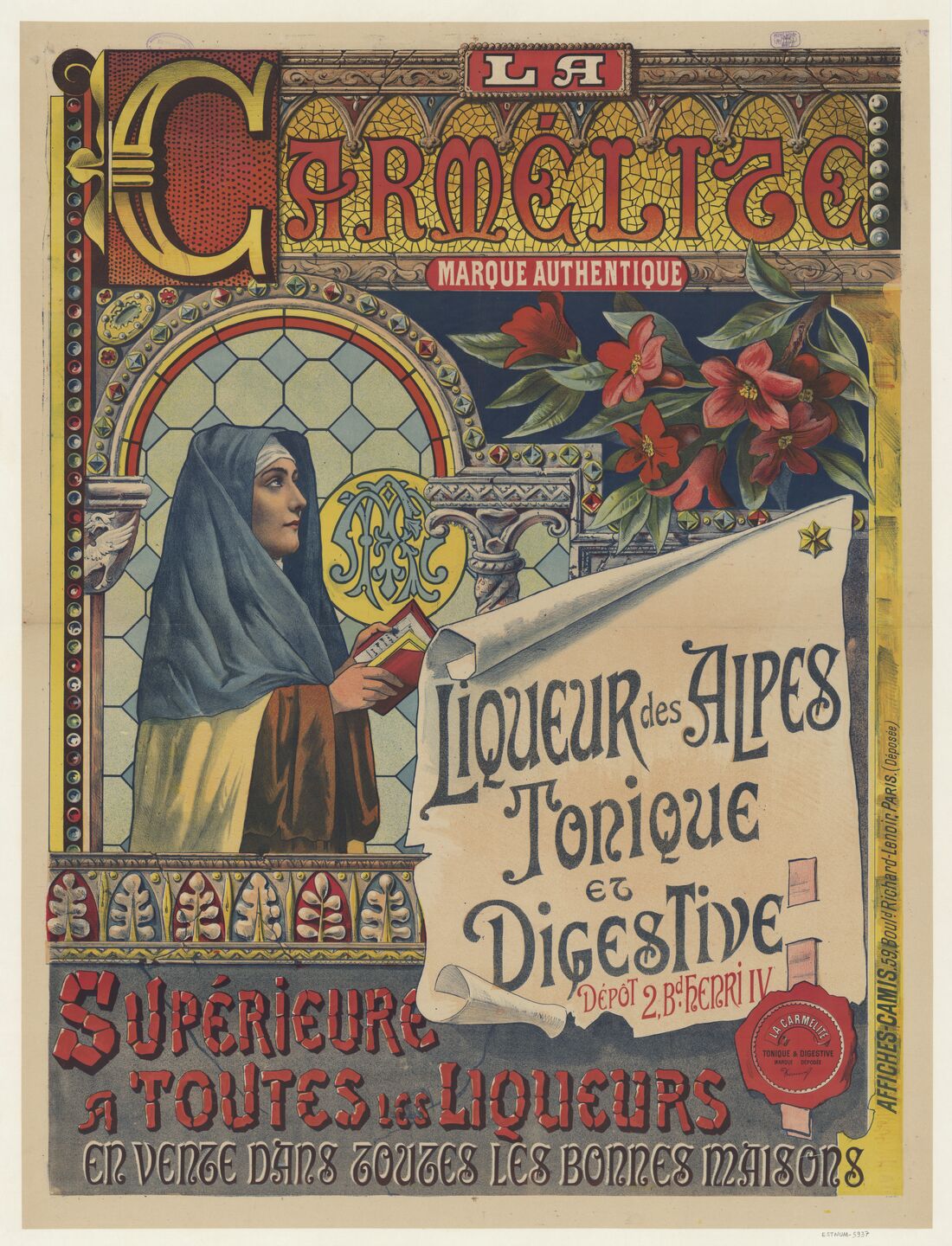
La Carmélite, “liqueur des Alpes”

A nun before a stained-glass window, Gothic lettering, a wax seal. The 1891 poster borrows everything from the cloister.

Affiche chromolithographiée de style néo-gothique : une religieuse au voile bleu, un livre à la main, devant un vitrail ; un parchemin déroulé annonce « Liqueur des Alpes, tonique et digestive », un sceau de cire rouge porte « La Carmélite, marque déposée » ; en bas, « Supérieure à toutes les liqueurs ».
La carmélite, marque authentique. Liqueur des Alpes tonique et digestive, dépôt 2 Bd Henri IV, Affiches Camis, Paris, 1891. Source gallica.bnf.fr / BnF, ark:/12148/btv1b53185287w — public domain.
  1. Wording , “Marque authentique” (Authentic brand) : Authentic compared with what?

    Compared with imitations. Since the law of 23 June 1857 on trademarks, a registered name can be defended in court. To proclaim one's brand “authentique” is to cast the others as copies — and to recall that the name, more than the recipe, is what sells.

  2. Symbol , The Carmelite nun : Why a nun?

    For monastic prestige, as on the posters for Chartreuse or Bénédictine. The Carmelite friars had their “eau de mélisse” (balm water), famous in Paris since the 17th century according to tradition; the female order of Carmel, by contrast, is associated with no known liqueur. The book, the veil and the stained glass make up a setting: they do not say who makes the liqueur.

  3. Wording , “Liqueur des Alpes” (Liqueur of the Alps) : Why the Alps?

    Because the mountains evoke wild plants and pure air — and the Grande Chartreuse, in the neighbouring massif, which then dominated the market for herbal liqueurs. The poster gives no Alpine address: the depot is in Paris, on the boulevard Henri-IV.

  4. Health promise , “Tonique et digestive” (Tonic and digestive) : What do these two words promise?

    The two usual promises of herbal liqueurs: to restore strength and to aid digestion. They reappear on the wax seal, as if they were part of the registered name. They are health claims, now banned for an alcoholic drink.

  5. Symbol , The wax seal : What is the red seal for?

    It imitates the seal that closes an official document or a costly bottle. It reads “La Carmélite, tonique & digestive, marque déposée” (registered trademark), with a signature: the brand presents itself as sealed, and therefore inviolable. The seal reassures about the origin more than it proves it.

  6. Wording , “Supérieure à toutes les liqueurs” (Superior to all liqueurs) : Can this sentence be checked?

    No: it compares itself with nothing specific. It is the most common advertising formula of the period, along with “la plus fine” (the finest) or “la meilleure” (the best). In 1891, no law regulated advertising for alcohol.

What this document says

La Carmélite sells an atmosphere: the cloister, the Alps, authenticity. Each statement answers another brand — Chartreuse is Alpine and monastic, Bénédictine has its monk — and the legal protection of the trademark, still recent, becomes an argument. The nun, for her part, says nothing about how the liqueur is made: nothing on the poster points to a convent.

How we know

La Carmélite, liqueur des Alpes, tonique et digestive, poster, Affiches Camis, 1891, BnF, Gallica ark:/12148/btv1b53185287w.

Document 5 of 5

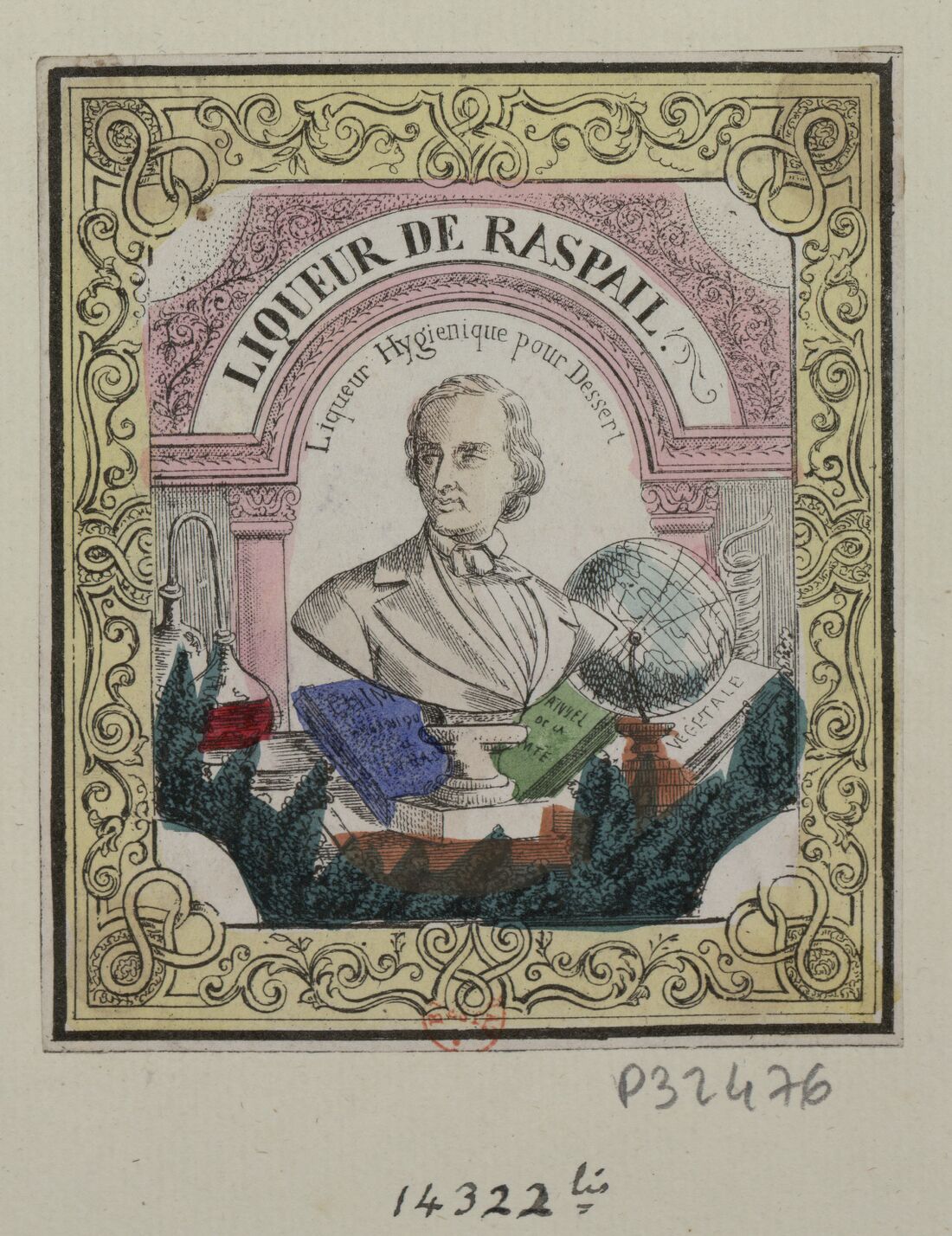
Liqueur de Raspail, “hygiénique pour dessert”

It is not a monk but a scientist who vouches for this liqueur: his bust sits enthroned between a still, a globe and books.

Étiquette gravée et coloriée dans un cadre d'arabesques : le buste du chimiste Raspail sous une arcade portant « Liqueur de Raspail, liqueur hygiénique pour dessert », entouré d'une cornue, d'un globe terrestre et de livres, dont un « Manuel de la santé ».
Liqueur de Raspail. Liqueur hygiénique pour dessert, s. d. (XIXe siècle). Source gallica.bnf.fr / BnF, ark:/12148/btv1b530152843 — public domain.
  1. Wording , “Liqueur de Raspail” : Who is Raspail?

    François-Vincent Raspail (1794-1878), chemist, republican, imprisoned several times. Often presented as a doctor, he never was one. His Manuel annuaire de la santé, published from 1845 onwards, ran to dozens of editions and popularised a domestic medicine based on camphor. His name was a guarantee for a wide public.

  2. Health promise , “Liqueur hygiénique pour dessert” (Hygienic liqueur for dessert) : What does “hygiénique” mean here?

    In the 19th century, “hygiene” meant the art of preserving health. A “hygienic” liqueur therefore presents itself as good for the body. Raspail published its recipe in 1845; his son Émile made it in Arcueil from 1870. Today the word would turn the label into a prohibited health claim.

  3. Symbol , The bust : Why a bust rather than a portrait?

    The bust is the image of great men, the kind placed in town halls and academies. It makes the chemist an official figure and his liqueur a learned product: the authority of the name passes to the bottle.

  4. Symbol , The retort and the flask : What is this laboratory equipment doing on a label?

    It recalls that the liqueur is distilled, and above all that it comes from a laboratory rather than a cellar. It is the secular counterpart of the monk-apothecary: chemistry replaces the cloister as the guarantee.

  5. Wording , The book “Manuel de la santé” (Health manual) : Which book is propped against the bust?

    Raspail's Manuel annuaire de la santé, his most widely circulated work, reissued every year for decades. The liqueur leans on the book: one buys the bottle as one would follow a prescription.

What this document says

The label replaces the monk with science: a famous chemist, his books, his laboratory equipment. François-Vincent Raspail (1794-1878) really did publish, in 1845, the recipe for a “liqueur hygiénique de dessert” (hygienic dessert liqueur) meant to ensure a long life, and his son Émile turned it into a product from 1870. The health promise changes its costume; it remains a promise.

How we know

Liqueur de Raspail. Liqueur hygiénique pour dessert, print, undated (19th century), BnF, De Vinck collection, Gallica ark:/12148/btv1b530152843; on Raspail: “François-Vincent Raspail” article, Wikipédia, to be cross-checked against his Manuel annuaire de la santé (1845).

Why these images

All the documents come from the collections of the Bibliothèque nationale de France, can be consulted on Gallica, and are in the public domain. Dates and titles are those of the catalogue records.

None of these promises, least of all the health promises, would be allowed on an alcoholic drink today. To show these images is to write their history, not to advertise.

The other games

  • Quiz · common misconceptions

    Legend or history?

    A monk of 1510, an absinthe that drives people mad, a doctor who invents gin: it is up to you to decide, evidence in hand.

    10 statements · 10 minutes

  • Inquiry · archives

    The absinthe affair

    Six archive documents from 1911 to 1915. Who banned absinthe, when, and what exactly was banned?

    9 boxes to confirm · 15 minutes

  • Riddles · botany

    Guess the plant

    Ten plants from liqueurs and bitters, three clues each: history, botany, use.

    10 riddles · 10 minutes

  • Quiz · three levels

    Learn about spirits

    From cane to rum, from grain to whisky: three levels of questions on the raw materials, the gestures and the history of spirits.

    10 questions per level