Why do we say “eau-de-vie”?
A water that burns, and yet is called “of life”. The name comes neither from poets nor from drinkers: it comes out of medical treatises, and in a dozen languages it has kept the trace of a promise that nobody makes any more.
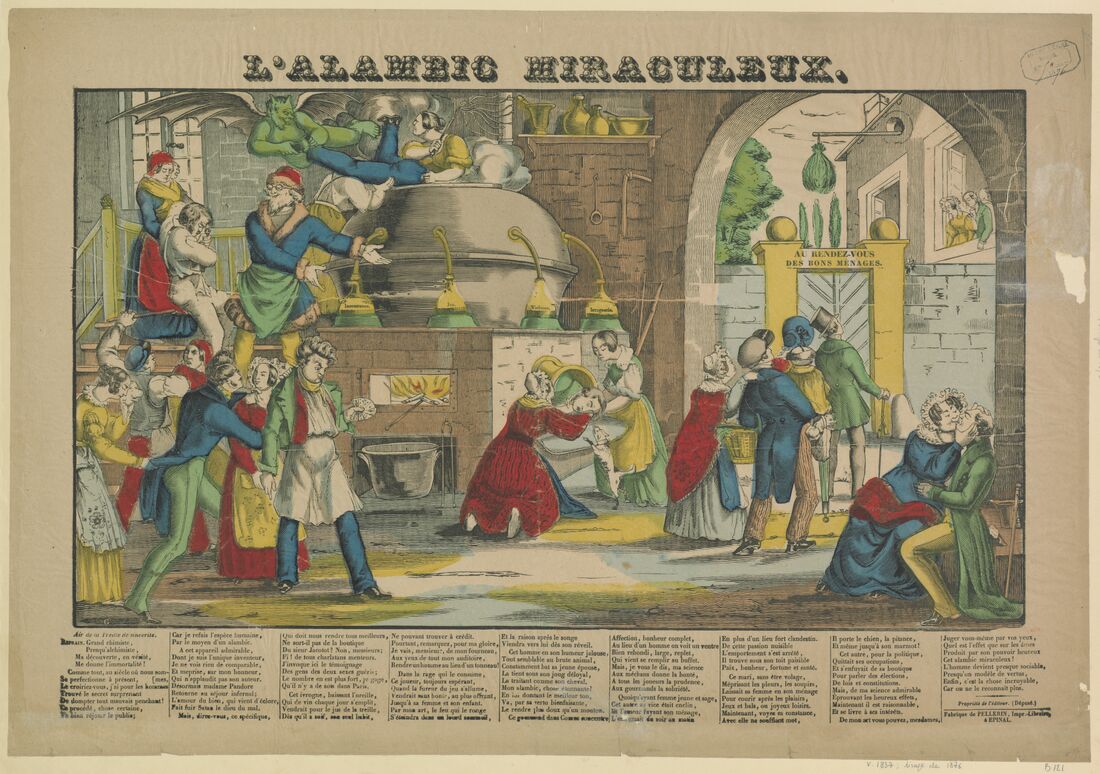
In 1837, the Pellerin print works in Épinal issued a coloured print entitled L'alambic miraculeux (The miraculous still). Stooped old men, leaning on their sticks, are fed into an enormous still; out of the other side come young men. The picture is funny because it takes a word literally. That word now appears, in French, in the legal names of dozens of spirits: eau-de-vie, “water of life”.
It is a strange name for a liquid that burns the throat and that medicine today counts among toxic substances. Why was it ever called “of life”?
First, a water that burns
The first name for distilled alcohol in the West speaks not of life but of fire. In the twelfth century, in the orbit of the medical school of Salerno, in southern Italy, come the first clear mentions of a distillate of wine that catches fire: aqua ardens, “burning water”. It was named for what it does: it burns without ceasing to be a water. The story of the apparatus that produces it is told in The origins of distilling.
Bologna, the 1270s: the remedy gets a name
The name aqua vitae appeared a century later, among physicians. According to the historian David Wondrich, its first documented use is in a series of treatises on distilling written in Bologna in the 1270s and attributed, variably and rather loosely, to two of the city's practitioners: Teodorico Borgognoni, a surgeon, and Taddeo Alderotti, a professor of medicine whom Dante mentions in the Paradiso. Alderotti is credited with describing repeated distillations that concentrate the spirit of wine far beyond what a single heating allows.
The change of name signals a change of outlook. Burning water was a curiosity; water of life is a medicine. It was credited with the power to preserve whatever was steeped in it, to warm chilled bodies, to dissolve and draw out the virtues of plants. Since it kept flesh from corrupting, why should it not delay the corruption of the living body?
Arnaud de Villeneuve, the great borrowed name
In most accounts, one figure dominates this story: Arnaud de Villeneuve (Arnau de Vilanova in Catalan, Arnold of Villanova in English), who died in 1311, a Catalan physician trained at Montpellier, in the service of the kings of Aragon and of the popes. Since the Middle Ages he has been credited with the most widely read treatises on aqua vitae, and his is still the name cited to place the birth of eau-de-vie in France.
The specialists in his work gathered at the Autonomous University of Barcelona see it differently. The treatise De aqua vitae simplici et composita, on the medical uses of alcohol, simple or compounded, belongs to the “pseudo-Arnaldian” alchemical corpus: texts written by others and placed under his authority. The De vinis, a book of recipes for medicinal wines, is classed among the “probably apocryphal” writings. That did not stop it from enjoying immense success: its German adaptation ran to thirty-four editions in the early years of printing.
What is attested, then, is the attribution, not the author. Arnaud's name served as a guarantee for the water of life, just as other prestigious names would later serve as guarantees for liqueurs — the exhibition True and false monks follows the trail.
Roquetaillade: a piece of heaven in a flask
The real churchman of the story is a Franciscan from Auvergne, Jean de Roquetaillade, known to English-language historians as John of Rupescissa. Regarded as a dangerous prophet, he was locked up in the papal prison at Avignon in 1349. It was there, in 1351-1352, that he wrote the De consideratione quintae essentiae, “On the consideration of the fifth essence”.
His reasoning, studied by the historian Leah DeVun, is relentlessly logical for a man of his time. The four earthly elements decay. Yet eau-de-vie distilled several times does not decay, does not rot, and rises at the slightest heat. It is therefore not of this world: it is the fifth essence, the very matter of the heavens, which the alchemist brings down into a flask. Roquetaillade saw in it the universal remedy that Christians would need to come through the persecutions of the Antichrist, which he believed to be imminent. In his hands, aqua vitae became a panacea, and a spiritual weapon.
A calque across Europe
The Latin name then passed into the spoken languages, almost always translated word for word. French has eau-de-vie in fifteenth-century manuscripts, a direct calque of the alchemists' Latin. In 1494, the accounts of the Scottish Exchequer record eight bolls of malt delivered to Friar John Cor “to make aquavite”. On 13 April 1531, the Danish governor of Bergen, Eske Bille, sent the archbishop of Nidaros, in Norway, a letter accompanied by “some water which is called aqua vite” and which “helps against all kinds of illness”: this is the earliest known mention of Norwegian akevitt, and it is still a prescription.
Gaelic, for its part, translates: uisce, “water”, and beatha, “life”. Uisce beatha becomes wiskie in English in 1715, whisky in 1746, and enters French in 1770. The name of one of the most widespread spirits in the world is thus a Gaelic translation of a Latin pharmacy term.
One should beware of extending the family. Russian vodka, often placed among these “waters of life”, is not one of them, at least not by its name: the word derives from voda, “water”, and means “little water”. Life does not come into it.
The name of a promise
We say eau-de-vie because physicians at the end of the thirteenth century believed they held, in this liquid that burns without decaying, a remedy able to prolong existence. The name is a fossilised medical thesis. The thesis has fallen; the word has stayed, in the French name of wine spirits, eaux-de-vie de vin, as in whisky and akevitt.
It is not the only fossil of its kind. Quintessence took on, with Rabelais in 1534, its everyday French sense of “the very best of something”; and the word alcohol itself, before it named this liquid, named a powder for the eyes. The exhibition The still shows the instrument that produced all these words.