N1 · category
Fruit spirits
- Family
- Single-distillate spirit
- Raw materials
- Fruit
- Place of origin
- Alsace & Central Europe
Colour: Other fruit, as on the Atlas. Each neighbouring entry leads to its page; the inset, top right, opens the wide view.
Clear spirits drawn from ripe fruit: cherry, mirabelle, quetsch, pear, which is fermented without added sugar before being distilled. Berries too low in sugar, such as raspberry, are steeped in alcohol and then distilled; in both cases the aim is to keep the scent of the fruit intact.
A bottle requires four to eight kilos of fruit. In Alsace, 100 kilos of cherries, mirabelles or quetsches yield only 4 to 8 litres of pure alcohol depending on the fruit: enough to fill thirteen to twenty-five 70 cl bottles at 45% vol.
How it is made
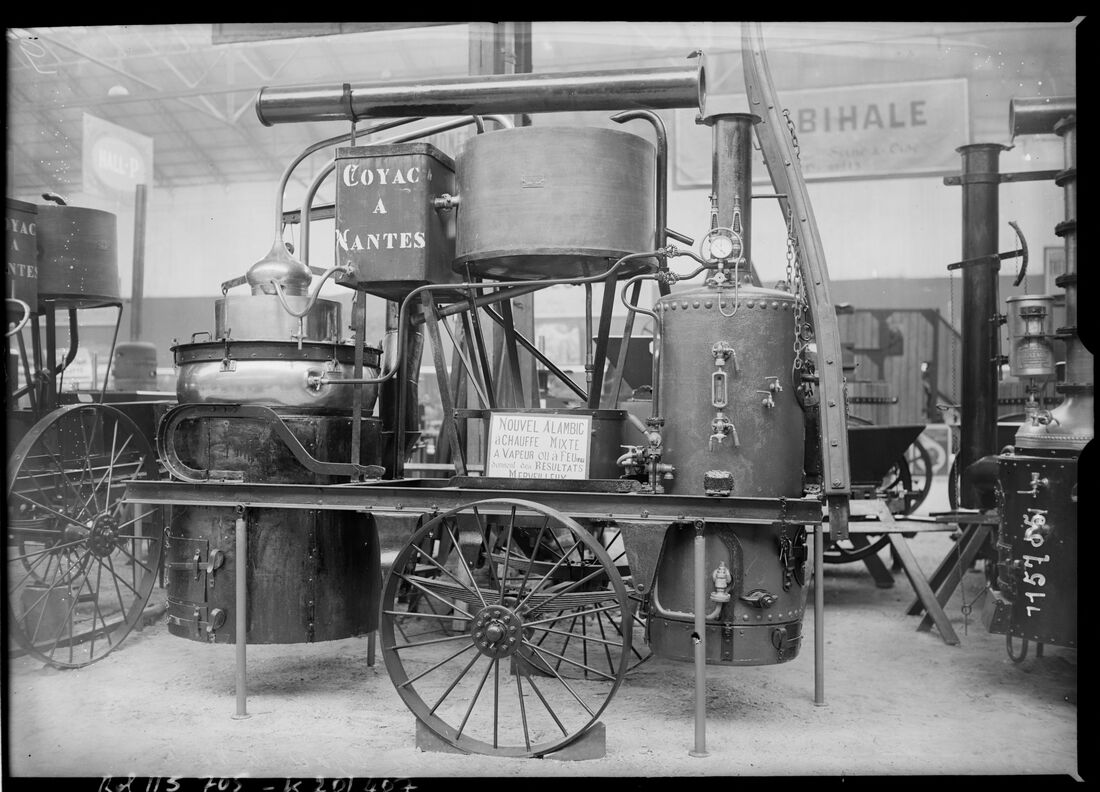
For stone fruit, the whole fruit is left to ferment in vats, without heating, and stirred gently so as not to break the stones. The stone gives kirsch its almond note, but the broken kernel releases hydrocyanic acid, which turns into ethyl carbamate in the spirit, an undesirable substance whose presence is limited by regulation. The fermented mash is then distilled in small copper stills, in two passes or in a short column with a few plates, and the first and last fractions are set aside.
For raspberry and other berries, fermentation would give too little alcohol: the fruit is steeped in alcohol, then the whole is distilled. In both cases the spirit then rests for months in vats, in demijohns or in old casks, taking on no colour, or barely any: a few yellow glints may appear over time.
A story
In Colmar, as early as 1506, the town's register of receipts and expenditure mentions the supervision of the Wynnbrenner, the “wine burners”, by the magistrate: at that time it was mostly wine that was distilled. Cherry and plum spirits later took hold on the farms of Alsace, Lorraine and Franche-Comté.
This spirit was no luxury. In 1838, the sub-prefect of Sélestat wrote that in the Val de Villé “kirsch is in habitual consumption”, and that even children's bread was dipped in it. Annexed to the German Empire from 1871 to 1918, Alsace kept the right to distil at home, which a special regime then maintained; hence the large number of farm stills still found there.
In the glass
Clear and colourless, these spirits smell of the fruit they come from: cherry and its stone for kirsch, yellow fruit and honey for mirabelle, cooked plum for quetsch. In Alsace they were traditionally served at the end of a meal, very cold or, in the old way, at the temperature of the coffee cup.
They are also used in cooking: kirsch flavours Black Forest gâteau and fondue.
Amber that must be earned — a year in wood before any adjustment. See the six ways of making colour
Terroirs and geographical indications
The recognised production areas attached to this category in the Atlas.
- Framboise d'Alsace Geographical indication registered in the European Union · France
- Kirsch d'Alsace Geographical indication registered in the European Union · France
- Kirsch de Fougerolles Geographical indication registered in the European Union · France
- Mirabelle d'Alsace Geographical indication registered in the European Union · France
- Mirabelle de Lorraine Geographical indication registered in the European Union · France
- Quetsch d'Alsace Geographical indication registered in the European Union · France
- Medronho do Algarve Geographical indication registered in the European Union · Portugal
- Pálinka Geographical indication registered in the European Union · Hungary and Austria
- Schwarzwälder Kirschwasser Geographical indication registered in the European Union · Germany
- Slavonska šljivovica Geographical indication registered in the European Union · Croatia
- Troyanska slivova rakya Geographical indication registered in the European Union · Bulgaria
- Wachauer Marillenbrand Geographical indication registered in the European Union · Austria
- Damassine National designation of origin, outside the Union register · Switzerland
- Feni National designation of origin, outside the Union register · India
- Mampoer Regulated sales denomination, with no link to origin · South Africa
Sources and validation
- Sources of the corpus
- Names and statuses: eAmbrosia, the official register of geographical indications of the European Union. Geometries: INAO, Délimitation des aires géographiques des SIQO (27/07/2026), Licence Ouverte v2.0, reprojected to WGS84.
- Corpus updated on
- 1 August 2026
- Validation
- First version Corpus under construction. Each entry is checked and sourced before validation by the future scholarly board. Protection status and mode of location are carried by each entry: an area delimited by a product specification and a reference-town point do not carry the same weight.