House stories · Suze
Does Suze owe its name to a sister-in-law?
For years, the brand's owner explained that Suze took its name from Suzanne, its creator's sister-in-law. In Switzerland, in the Bernese Jura, a quite different story is told, of a river and a herbalist. Neither has yet found its document.
The story
The name of Suze remains a puzzle: two traditions clash, and the brand itself has stopped telling either of them.
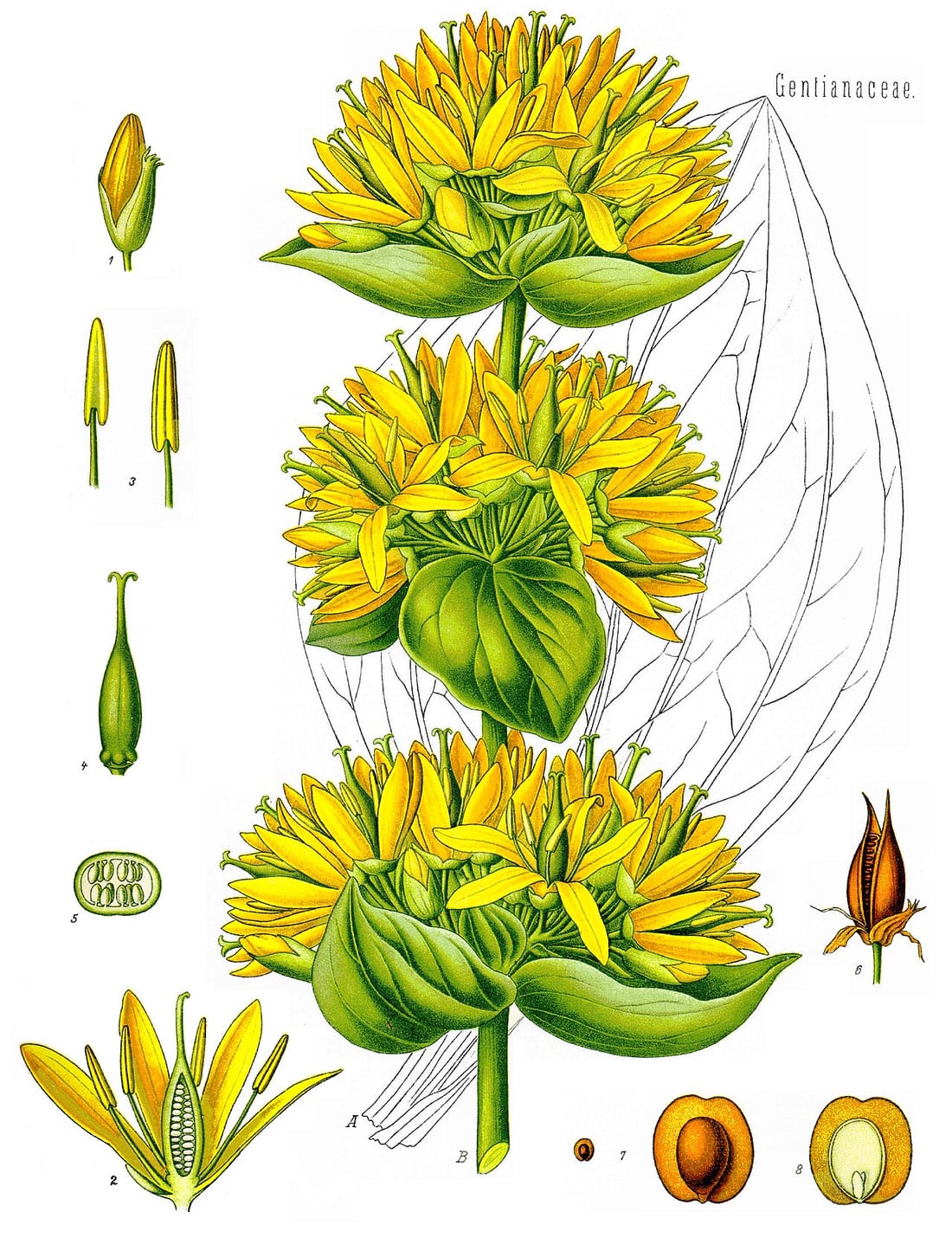
It all begins with a root. Great yellow gentian grows in high meadows, from the Jura to the Pyrenees by way of the Massif Central. It takes seven to ten years before its root is ready to be dug up. Specialist workers, the gentianaires, extract it with the “fourche du diable” (devil's fork), a heavy two-pronged tool, from late spring to autumn. The root is bitter, so much so that it has long been used in pharmacy.
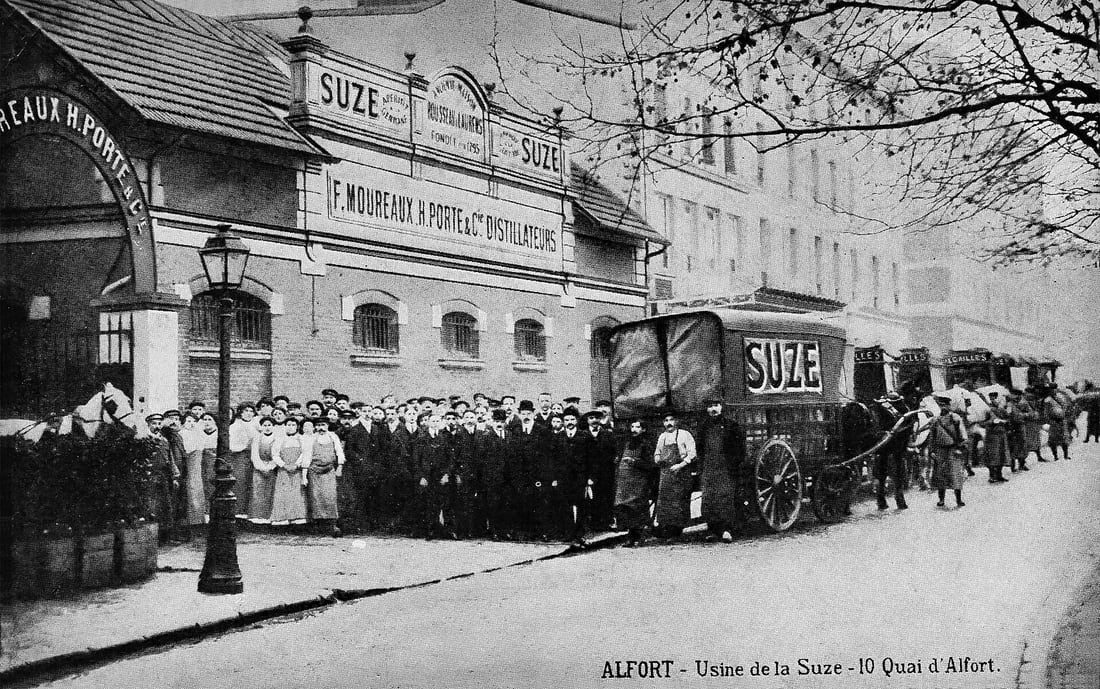
At the end of the 19th century, at Maisons-Alfort, on the outskirts of Paris, the distiller Fernand Moureaux went into partnership with Henri Porte to make an aperitif from it without wine, unlike so many aperitifs of the time. The brand dates the partnership to 1885 and claims a birth in 1889. The aperitif was first called “Picotin”, then “Gentiane Suze”, before becoming simply Suze. The bottle, tall and narrow, is said to have been designed by Porte in 1896.
Suze is a gentian bitter. The roots, washed and cut, are macerated in alcohol; the extract is sweetened, and the drink, a vivid yellow, is today 15% vol. The taste lies almost entirely in the root: a frank, earthy bitterness, tempered by the sugar.
In 1912, Suze entered the museum by an unexpected door. In Paris, at the end of that year, Pablo Picasso composed a papier collé: a glass and a bottle, made of cut paper, gouache and charcoal, with a label on which the aperitif's name can be read, amid newspaper cuttings. The work belongs to the Mildred Lane Kemper Art Museum, in St. Louis, in the United States. It is protected by copyright until 2043: we do not reproduce it, and refer readers to the museum's catalogue entry.
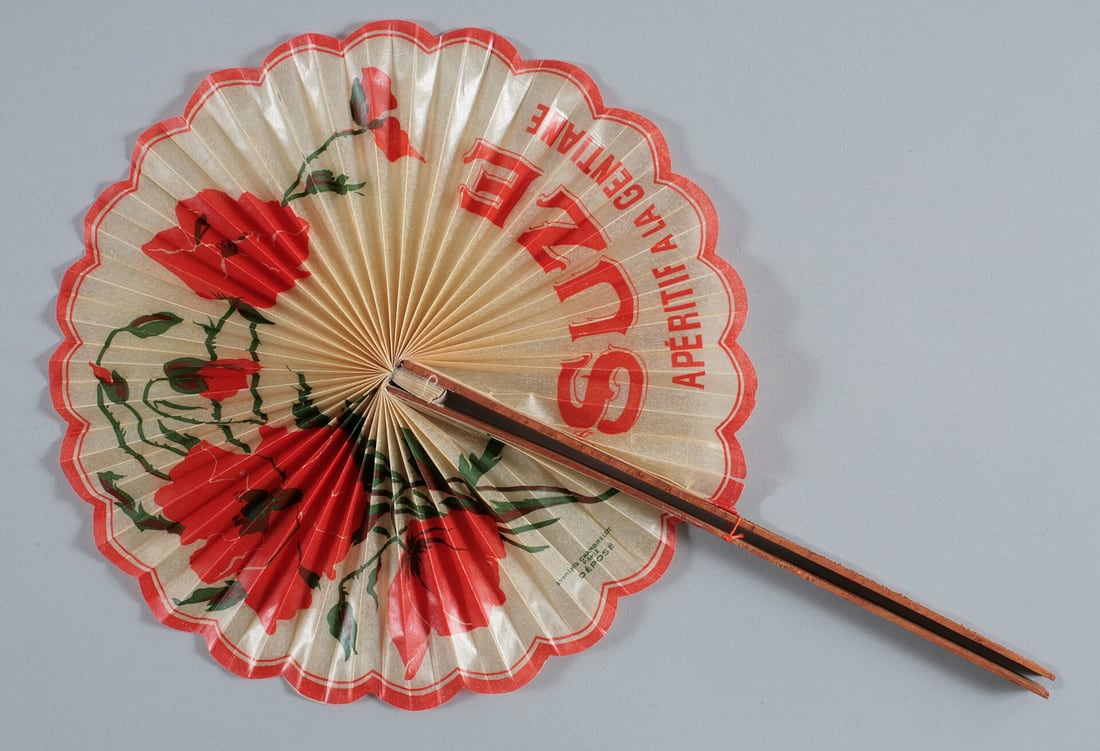
In 1922 the company took the name Distillerie de la Suze. The brand was bought by Pernod in 1965 and now belongs to Pernod Ricard. It is produced at Thuir, in the Pyrénées-Orientales.
The legend set against the sources
The legend
As told by Pernod Ricard, in 2005, and the Sonvilier tradition
First version: Fernand Moureaux is said to have given his aperitif the first name of his sister-in-law, Suzanne Jaspart, who was particularly fond of it. Some accounts add that she played tennis, at Saint-Maur.
Second version, Swiss: the herbalist Hans Kappeler, of Sonvilier, is said to have created a gentian aperitif, the “Or des Alpes” (Gold of the Alps), and to have sold the recipe to a Frenchman, predicting that he would see it flow in France as the Suze flowed at their feet. The Suze is the river that runs through the Saint-Imier valley.
What the sources say
Swissinfo set out the two versions side by side in 2005. Suzanne's, then defended by the brand's owner, rests on no published document. The tennis anecdote appears neither in that article nor in any serious source found, and the surname wavers between Jaspart and Jaspert.
The Swiss version runs up against the calendar: Kappeler's daughter, interviewed at the age of ninety-five in 1998, placed the sale of the recipe around 1914, a quarter of a century after Suze's claimed birth. A local historian, Raymond Bruckert, nevertheless considered it plausible that Kappeler had created a blend of this kind.
The brand's current website no longer says anything about the origin of the name. It announces a gold medal at the “Exposition universelle de Paris” in 1890; there was no such exhibition that year, and it is no doubt the one of 1889 that is meant.
So, legend or history?
Before you read the answer, what do you think?
Choose a degree: it is the question a historian asks of every story.
Degree of certainty : Tradition
Tradition. Neither Suzanne nor the river has a document to support it.
That Suze owes its name to Suzanne Jaspart is a brand tradition, unverifiable as things stand; the river version is a local tradition, weakened by its chronology. Both say something true about the product: it has a well-documented French origin, and a root that also grows in the Swiss Jura. The archives of the Val-de-Marne and the historical trademark database may one day settle the matter.
How we know
Each date in this story refers to one of the sources below. The degree of certainty can be read from the pattern of the rule: solid for attested, dashed for probable, dotted for tradition, double for legend.
Key dates
-
1885 Fernand Moureaux and Henri Porte go into partnership, according to the brand -
1889 The claimed birth of Suze -
1896 The bottle, attributed to Henri Porte -
1912 Picasso, La Bouteille de Suze -
1922 The company becomes the Distillerie de la Suze -
1965 Bought by Pernod -
2005 The Franco-Swiss dispute over the origin of the name goes public
Attested- established by documents contemporary with the events.
Probable- plausible and consistent with the sources, without direct proof.
Tradition- handed down by the house or by local memory, with no document to confirm or refute it.
Legend- contradicted by the sources, or invented after the fact.
What remains uncertain
- The origin of the name: Suzanne Jaspart, the river Suze, or something else.
- The date of creation: 1885, 1889 or 1898, depending on what is meant by creation.
- The creator's first name: Fernand or Ferdinand Moureaux.
- The trademark registration, which cannot be found in the registers.
Sources
- swissinfo.ch, La Suze hésite sur son ascendance , 2005.
- Suze, L'histoire de Suze , 2026.
- Pernod Ricard, Suze , 2026.
- Mildred Lane Kemper Art Museum, Pablo Picasso, La bouteille de Suze (Bottle of Suze), 1912 .