House stories · Smirnoff
Does Smirnoff vodka owe its survival to an execution averted?
The name is spelled the Western way, but it comes from Moscow. Pyotr Smirnov, born a serf, had made his vodka one of the great fortunes of Russia; the revolution nationalised everything. According to the family account, his son Vladimir saved the brand only by narrowly escaping the firing squad. The archives, for their part, follow an exile from Constantinople to Lwów and then to France, up to the sale of his name.
The story
Smirnoff is a brand of exile: its name survived nationalisation thanks to an émigré son who sold it to America, but the execution he is said to have escaped is known only through family tradition.
Pyotr Arsenyevich Smirnov was born in 1831 in a village in Yaroslavl province, into a family of serfs. As a young man, he joined an uncle in Moscow who had bought his freedom by making vodka. Alcohol was then a source of state revenue, farmed out to great tax farmers; in 1863, the farm was abolished and replaced by an excise duty. The market opened up to private individuals. In the 1860s — in 1864, according to the house — Smirnov opened his own business in the centre of Moscow.
He prospered. His vodkas won medals at exhibitions, and in 1886 he obtained the title of purveyor to the Imperial Court, which the tsar had at first refused him. He was soon among the richest men in Russia. But the state wanted to take alcohol back. In 1894, the Minister of Finance Sergei Witte decreed a state monopoly on vodka, which spread across European Russia province by province until 1902 and made the state the sole buyer of alcohol and the sole seller of ordinary vodka, at 40 degrees. Pyotr died in 1898. When the monopoly reached Moscow, at the turn of the century, his sons' profits collapsed.
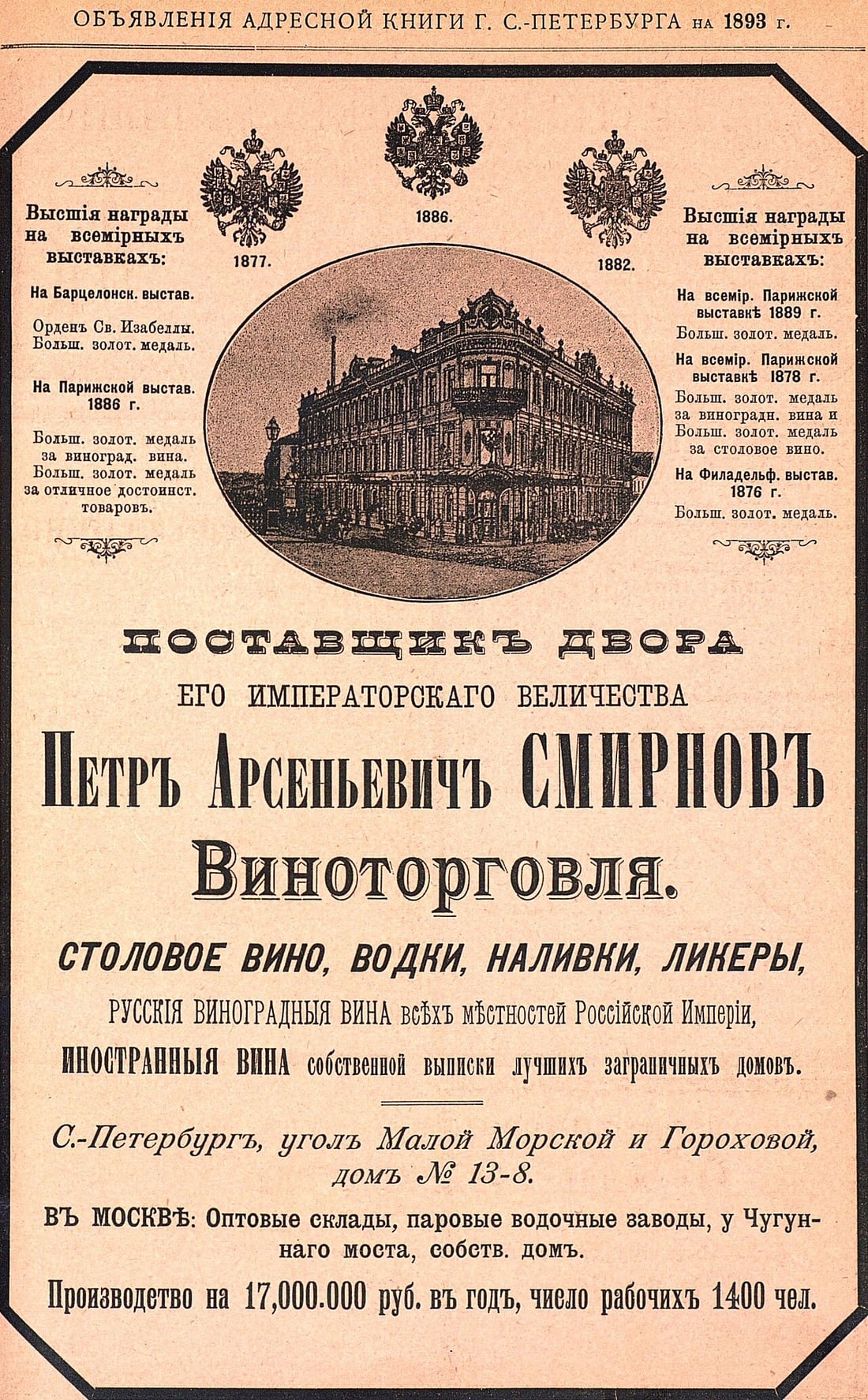
War finished the job. In 1914, Nicholas II banned vodka for the duration of the conflict; by 1918, the Bolshevik government had nationalised all the distilleries, and the house of P. A. Smirnov ceased to exist. In 1924, a Soviet decree even prohibited the use of the brands of nationalised companies, deemed counter-revolutionary. Pyotr's third son, Vladimir, born in 1875, had left Russia. He settled first in Constantinople, where he opened a distillery under the sign of “purveyor to the Russian Imperial Court”.
On 21 December 1923, Vladimir Smirnov arrived in Lwów, then Polish, with a son who was still a minor. The police archives keep his applications for residence, granted six months at a time, on condition of irreproachable conduct. There he set up a company, “Pierre Smirnoff Fls”, which opened offices in Paris and Prague: the name was now spelled the Western way. Around 1928, he left for France. It was there, in August 1933, a year before his death, that he sold to Rudolph Kunett, a Russian émigré settled in the United States, for 54,000 francs, the recipes and the exclusive right to use the name in North America.
What he sold was a vodka: a rectified spirit, distilled to a high degree of purity, then reduced with water and filtered. Already in Lwów, the factory's documents describe a high-quality rectified spirit, filters and water from an artesian well. Kunett produced it in the United States, but the business was not profitable. At the end of the 1930s, he sold it to John G. Martin, of the Heublein company, who presented vodka as a spirit neutral in smell and taste, a “white whisky”. It was in America, under a Frenchified name, that the vodka of a Muscovite born a serf found its future.
The legend set against the sources
The legend
As told by family tradition, taken up by the press and by the biographer Linda Himelstein
In 1919, in the midst of the civil war, Vladimir Smirnov fell into the hands of the Bolsheviks. The son of the vodka king, heir to a fortune, he was imprisoned, mistreated and sentenced to be shot. He was awaiting his execution when the Whites took the town and freed him. He fled Russia, taking his father's recipe with him: without that escape, Smirnov vodka would not have survived the revolution.
What the sources say
The episode is plausible: in 1919, the civil war made whole towns change hands. But no document concerning it has been published. The versions we have read name neither the town, nor the court, nor the exact date. The story has only one possible witness, Vladimir himself, and it reaches us through his family; the presentation of the book by his biographer, Linda Himelstein, speaks of a “bizarre” escape from a prison in 1919, and the brand, in its own history, says nothing about it.
The rest of the exile, on the other hand, is documented. The arrival in Lwów appears in the regional archives, published by the Ukrainian weekly Zerkalo Nedeli in 2000. The companies in Constantinople, Poland and France, and the 1933 contract with Kunett, are described in a 1996 ruling by a US federal court: the family's Russian descendants were contesting the transfer of the name to Heublein.
Other dates shift. The 1864 date displayed by the house is a claim: depending on the source, Pyotr Smirnov's business began in 1860, 1864 or 1867, and Kommersant traces the family firm back to 1818. And the purchase by Heublein is dated 1938 by the Oxford Companion to Spirits and Cocktails, 1939 by Kommersant.
So, legend or history?
Before you read the answer, what do you think?
Choose a degree: it is the question a historian asks of every story.
Degree of certainty : Tradition
Tradition: the exile is attested; the averted execution rests on the family account alone.
Smirnoff is indeed a brand born of exile: an heir dispossessed by the revolution carried the name from Constantinople to Lwów, then to France, and sold it to another émigré for America. The archives follow him step by step. The execution he is said to have escaped in 1919 is plausible in the Russia of the civil war, but no document confirms it: it is the account of a survivor, handed down by his family and turned into the brand's romance.
How we know
Each date in this story refers to one of the sources below. The degree of certainty can be read from the pattern of the rule: solid for attested, dashed for probable, dotted for tradition, double for legend.
Key dates
-
1831 Birth of Pyotr Smirnov, a serf from Yaroslavl province -
1864 The business begins in Moscow, according to the house -
1886 Pyotr Smirnov becomes purveyor to the Imperial Court -
1894 State monopoly on vodka, extended to European Russia by 1902 -
1918 The distilleries nationalised; the house of Smirnov ceases to exist -
1919 Vladimir sentenced to death and freed, according to the family account -
21 December 1923 Vladimir Smirnov arrives in Lwów -
1933 Name and recipes sold to Rudolph Kunett for North America -
1938 Heublein buys Kunett's business
Attested- established by documents contemporary with the events.
Probable- plausible and consistent with the sources, without direct proof.
Tradition- handed down by the house or by local memory, with no document to confirm or refute it.
Legend- contradicted by the sources, or invented after the fact.
What remains uncertain
- The arrest and death sentence of Vladimir in 1919: no place, no date, no document; Linda Himelstein's book could be consulted only through its presentation and its reviews, and we do not know what testimony she bases the account on.
- The date on which Pyotr Smirnov's business began: 1860, 1864 or 1867 depending on the source; Kommersant dates to 1818 the family firm in which he started out.
- The year the monopoly reached Moscow (1901 according to the review in the Moscow Times) and its exact effect on the business.
- The place and date of the first spelling “Smirnoff”: Constantinople, Lwów or Paris.
- The date of the purchase by Heublein: 1938 according to the Oxford Companion, 1939 according to Kommersant; the full transfer of the worldwide rights did not take place until the 1950s.
- David Christian's work on the liquor farm, consulted through the article by Patricia Herlihy that draws on it.
Sources
- Linda Himelstein, The King of Vodka: The Story of Pyotr Smirnov and the Upheaval of an Empire , HarperCollins , 2009.
- The Moscow Times, How Pyotr Smirnov Became the King of Vodka (recension de L. Himelstein) , 2009.
- Patricia Herlihy, « Alcohol Monopoly », in Encyclopedia of Russian History , Macmillan Reference USA , 2004.
- David Christian, « Living Water » : Vodka and Russian Society on the Eve of Emancipation , Clarendon Press , 1990.
- Sergueï Mouraviev et Fiodor Pogodine, Бориса — на царство , Kommersant Vlast, n° 2 , 1996.
- Lioudmila Nossareva et Myron Pavlioust, Львовская «Смирновка» розлива 24-го , Zerkalo Nedeli , 2000.
- Tribunal fédéral du district du Delaware, Joint Stock Society v. Heublein, Inc., 936 F. Supp. 177 , 1996.
- Jason Horn, « Smirnoff », in The Oxford Companion to Spirits and Cocktails , Oxford University Press , 2021.
- International Directory of Company Histories, Heublein, Inc. .
- Publishers Weekly, Recension de L. Himelstein, The King of Vodka , 2009.
- Diageo, Smirnoff, About us , 2026.