House stories · Fernet-Branca
Does Fernet-Branca come from a Swedish doctor called Fernet?
An almost black bitter, low in sugar, made from twenty-seven herbs, roots and spices whose full list remains secret. The Milanese house long told how its founder had developed the formula with a Swedish doctor, Dr Fernet, whose longevity proved its virtues. Historians have never found this doctor. What they have found is the name of a remedy much older than the house.
The story
Dr Fernet is an advertising character: his name was used to sell elixirs of long life a century before Branca, who, poster after poster, made it the name of his bitter.
Milan, in the mid-19th century. The city still belonged to the Austrian Empire, and cholera was sweeping across Europe in waves. Bernardino Branca, born in 1802, was not a doctor: he was a self-taught apothecary who prepared remedies. In 1845, according to the house, he developed a bitter that he sold as a tonic — perhaps, suggests the Oxford Companion to Spirits and Cocktails, as a remedy for cholera.
The house does not publish its recipe. It speaks of twenty-seven herbs, roots and spices, names ten of them — cinchona bark, rhubarb, chamomile, cinnamon, linden, iris, saffron, zedoary, galangal, myrrh — and gives the origin of some, from China to the Arabian Peninsula. Traditional fernets, the Oxford Companion points out, start from a grape spirit and are not sweetened; their dark colour comes from burnt sugar. Branca's has become the model for a family of very bitter herbal bitters, low in sugar and of fairly high alcoholic strength.
The product was first sold as a remedy. The house dates its first advertisement to 1865, in the Milanese daily La Perseveranza: a square ten centimetres a side, in which it bore only one name, “Fernet”. In 1876, another advertisement appeared in the first issue of the Corriere della Sera. Bernardino's three sons, Luigi, Giuseppe and Stefano, joined the business, which took the name Fratelli Branca, the “Branca brothers”.
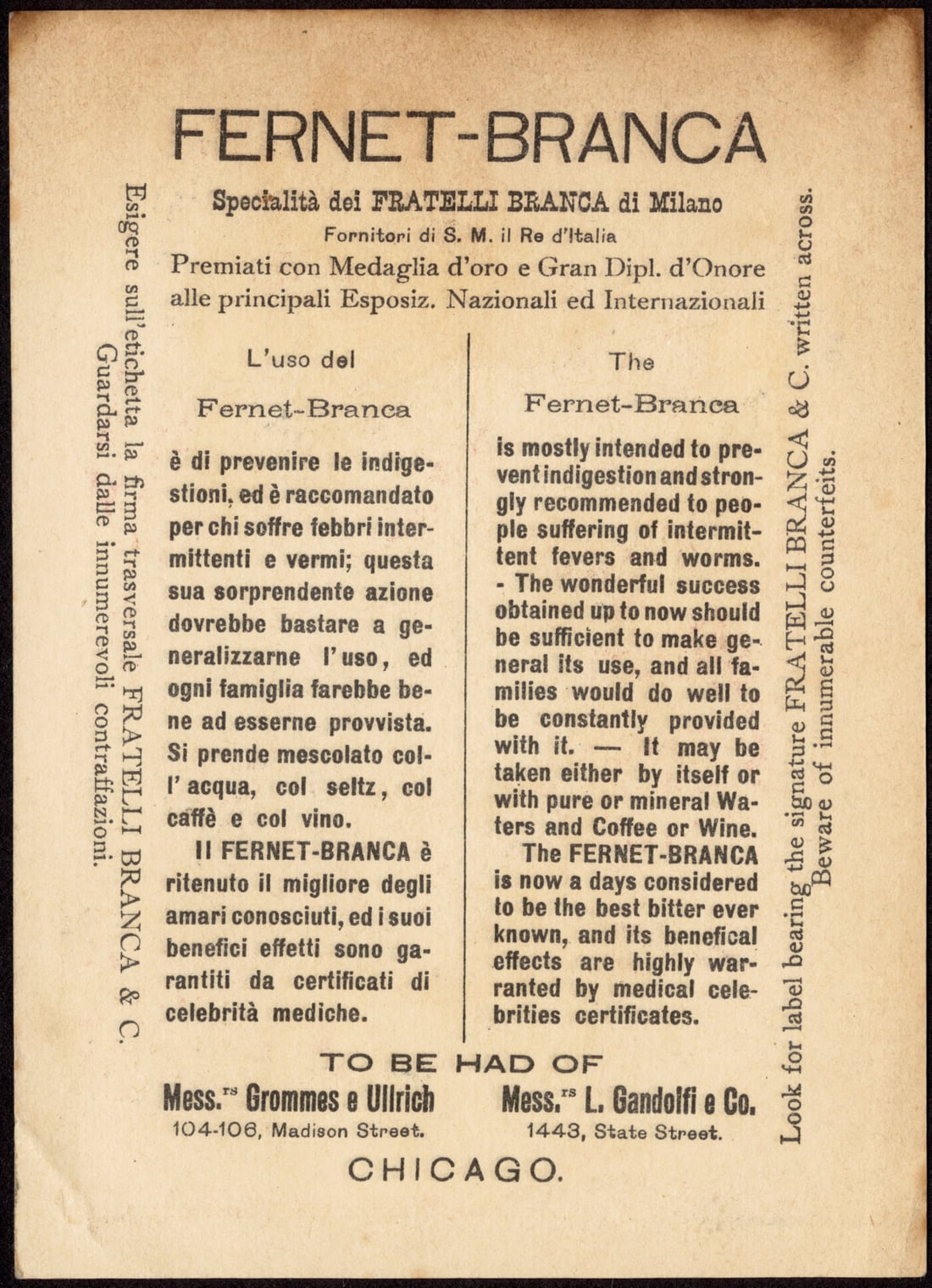
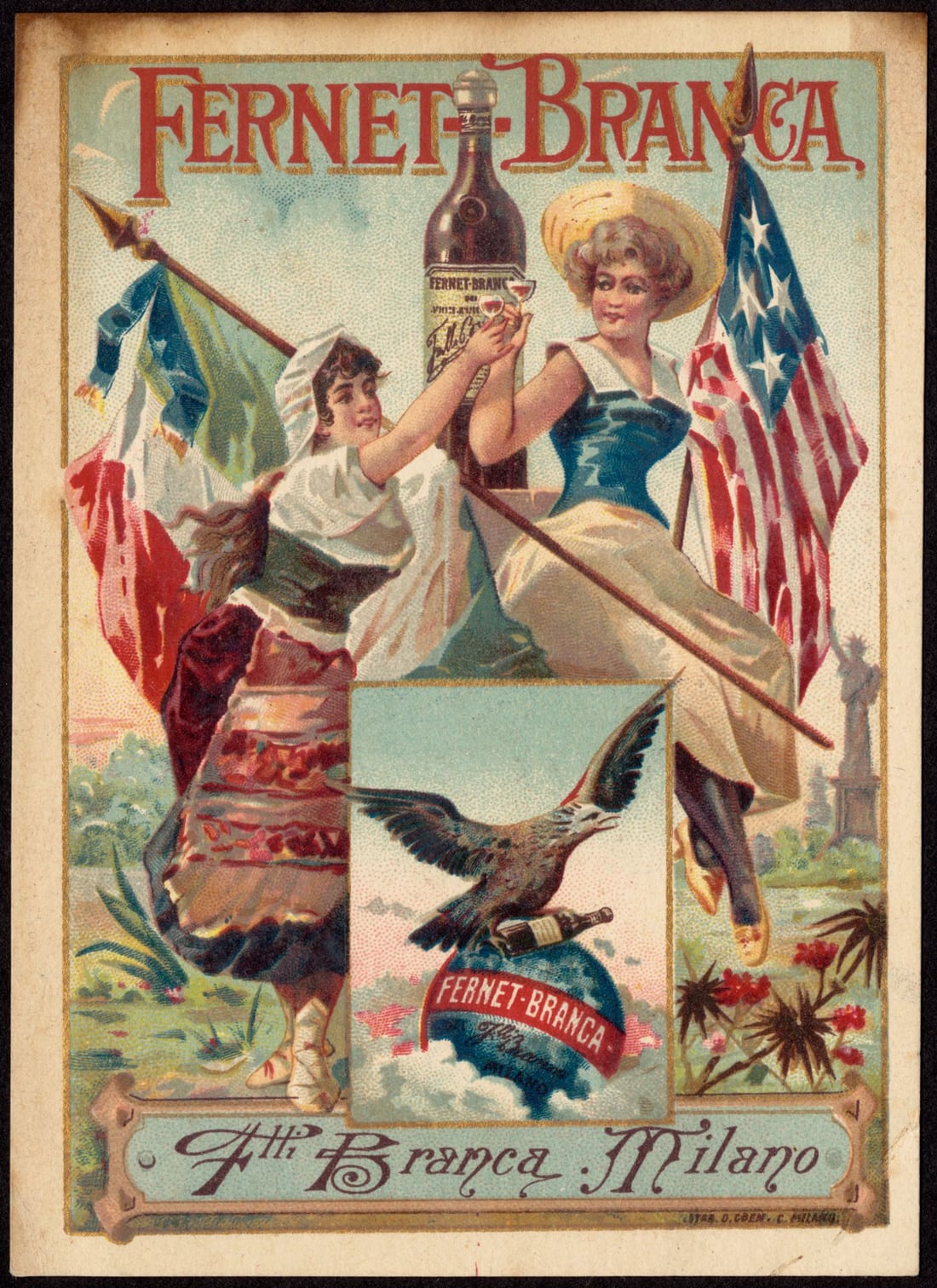
The house understood the power of the image early on. In the 1890s, an eagle appeared in its calendars, clutching a bottle in its talons and perched on the terrestrial globe, against the setting sun; the house and the catalogue of the Italian Ministry of Culture date its appearance to 1895 and attribute it to Leopoldo Metlicovitz, a painter born in Trieste. The eagle moved on to the posters. The one of 1898, printed in Milan by the Tensi brothers, bears at the bottom a fighting line: “the only ones who possess the true and authentic process”. It is the line of a house that has competitors. The eagle trademark was not registered until 1905 or 1906: on 27 November 1905 according to the house, in January 1906 at the Milan Chamber of Commerce according to the Dizionario Biografico degli Italiani.
In 1891, Stefano Branca died. His widow, Maria Scala, born in Alessandria in 1853, took over the running of the company; according to the house, she ran it until their eldest son, Dino, was old enough to take it over, which he did in 1907. In 1932, after a donation from Dino in her memory, the Ospedale Maggiore in Milan had her portrait painted; the hospital's note recalls that, as a young widow, she ran the company with a real head for business. Dino extended the trade abroad. When the wave of prohibition reached several countries, the house went back to its origins, according to the Oxford Companion, and once again presented its fernet as a medicinal tonic.
Fernet followed Italian emigrants as far as Argentina; the house founded a company there, in Buenos Aires, in 1941. The business is still controlled by the family: Niccolò Branca, of the fifth generation, has chaired it since 1999, and his son Edoardo, of the sixth, is preparing to succeed him.
The legend set against the sources
The legend
As told by the house, in its old advertisements
Fernet is said to have been invented by a Swedish doctor, Dr Fernet, with whom Bernardino Branca is said to have developed the formula. The advertising, as summarised by the Oxford Companion and Difford's Guide, invoked the longevity of the doctor and his family.
What the sources say
None of the sources consulted knows of this doctor. The Oxford Companion to Spirits and Cocktails considers it highly unlikely that Bernardino Branca worked with a Dr Fernet, and Difford's Guide speaks of a family invented for the advertising. The house itself no longer mentions him: in the history it publishes, the formula has only one author, Bernardino Branca.
The character is older than the house. From the early 18th century, according to the Oxford Companion, apothecaries and liqueur makers told the story of a certain Fernet, or a similar name, who was said to have lived more than a century thanks to an elixir of his own invention, and used it to sell their own. These elixirs are the ancestors of the fernets: they already contain saffron, aloe, cinchona, white agaric. In the 19th century, the word was used to sell several similar products, Rolling Stone Italia points out, and Branca's first advertisement, in 1865, says simply “Fernet”.
Even the house's dates have rivals. Another manufacturer, Vittone, claims a fernet three years older and is trying, according to the Oxford Companion (2021), to prove it. And the eagle, dated to 1895 by the house, is dated to 1893 by Difford's Guide and to 1899 by the Dizionario Biografico degli Italiani. Branca did not invent the word; it made it a proper name, by dint of advertisements and an eagle.
So, legend or history?
Before you read the answer, what do you think?
Choose a degree: it is the question a historian asks of every story.
Degree of certainty : Legend
Legend. Dr Fernet is an advertising character, and his name was in use before Branca.
No historian has found any trace of Dr Fernet, and his longevity repeats an advertising motif much older than the house: that of the learned man who lives more than a century thanks to his elixir. The name Fernet was used to sell elixirs as early as the 18th century. The attested history lies in other names: a Milanese apothecary, his sons, a widow who ran the company after 1891, and a poster artist who gave it its eagle.
How we know
Each date in this story refers to one of the sources below. The degree of certainty can be read from the pattern of the rule: solid for attested, dashed for probable, dotted for tradition, double for legend.
Key dates
-
1845 Bernardino Branca develops his bitter in Milan, according to the house -
1865 First advertisement, in La Perseveranza, under the name “Fernet” alone -
1876 Advertisement in the first issue of the Corriere della Sera -
1891 Death of Stefano Branca; his widow, Maria Scala, takes over -
1895 The eagle appears in the Branca calendars, according to the house -
1898 The eagle poster printed in Milan by the Tensi brothers -
1905-1906 The eagle trademark registered -
1907 Dino Branca takes over the running of the company -
1941 Founding of the Argentine company, in Buenos Aires
Attested- established by documents contemporary with the events.
Probable- plausible and consistent with the sources, without direct proof.
Tradition- handed down by the house or by local memory, with no document to confirm or refute it.
Legend- contradicted by the sources, or invented after the fact.
What remains uncertain
- The 1845 date, handed down by the house and repeated by the Oxford Companion with no known contemporary document; the Vittone house claims a fernet three years older.
- The text and date of the advertisements that named Dr Fernet, known here through the Oxford Companion and Difford's Guide, and which we have not found.
- The 1865 and 1876 advertisements, known only through the house's website.
- The appearance of the eagle: 1895 according to the house and the catalogue of the Italian Ministry of Culture, 1893 according to Difford's Guide, 1899 for the trademark according to the Dizionario Biografico degli Italiani; the catalogue itself gives the 1898 poster as “attributed” to Metlicovitz.
- The date and countries of the “medicinal” advertising of the prohibition era: the Oxford Companion gives neither.
- Maria Scala's dates as head of the company, 1891–1907, given by the house; the note on her portrait confirms that she ran the company, without dates.
- The number of plants: twenty-seven according to the house, “more than forty” according to Rolling Stone Italia.
- The registration date of the eagle trademark: 27 November 1905 according to the house, January 1906 at the Milan Chamber of Commerce according to the Dizionario Biografico degli Italiani, which cites Remondi; a filing followed by a registration would reconcile the two, though nothing says so.
- The numbering of the generations: the Oxford Companion makes Niccolò Branca the sixth generation; Forbes Italia (2026) gives him as the fifth and his son Edoardo as the sixth.
Sources
- François Monti, « Fernet », in The Oxford Companion to Spirits and Cocktails , Oxford University Press , 2021.
- Lew Bryson, « Fratelli Branca », in The Oxford Companion to Spirits and Cocktails , Oxford University Press , 2021.
- Ministero della Cultura, Istituto centrale per il catalogo e la documentazione, Fernet Branca, manifesto pubblicitario, scheda 0500675517 (Raccolta Salce, inv. 01780) , Catalogo generale dei Beni Culturali .
- Laura Mocci, « Metlicovitz, Leopoldo », in Dizionario Biografico degli Italiani, vol. 74 , Istituto della Enciclopedia Italiana (Treccani) , 2010.
- Ca' Granda, Ospedale Maggiore Policlinico de Milan, Mario Ornati, Ritratto di Maria Scala Branca, 1932 , Google Arts & Culture .
- Fratelli Branca Distillerie, The company , 2026.
- Fratelli Branca Distillerie, An amaro that will make history , 2026.
- Fratelli Branca Distillerie, The secret recipe , 2026.
- Difford's Guide, Fratelli Branca Distillerie S.r.l : history .
- Federico Bellanca, Gin, Gimlet, Cynar, quando la cura stava nell'alcol , Rolling Stone Italia , 2025.
- Fratelli Branca Distillerie, The art of communication , 2026.
- Forbes.it, La famiglia di sesta generazione dietro il Fernet-Branca , Forbes Italia , 2026.