House stories · Marie Brizard
Did Marie Brizard receive her recipe from a sailor she had nursed?
For a long time the house of Marie Brizard told how, in 1755, its founder had nursed a sailor from the West Indies, who gave her the recipe for anisette in thanks. The company's historian has dated this story: it appears in this form in an advertisement of 1966. Behind the legend stands a very real businesswoman, in the Bordeaux of the Atlantic trade.
The story
The grateful sailor is an advertising invention; the Bordeaux merchant who founded a house in 1755, on the other hand, is attested.
Bordeaux, the middle of the 18th century. The port lived on wine, on sugar from the islands and on the triangular trade. In the streets near the quays, families of craftsmen distilled anise, a common practice in the town. Pierre Brizard, cooper and distiller, was already producing it before his death in 1743. His daughter Marie, born in 1714, the third of fifteen children, never married.
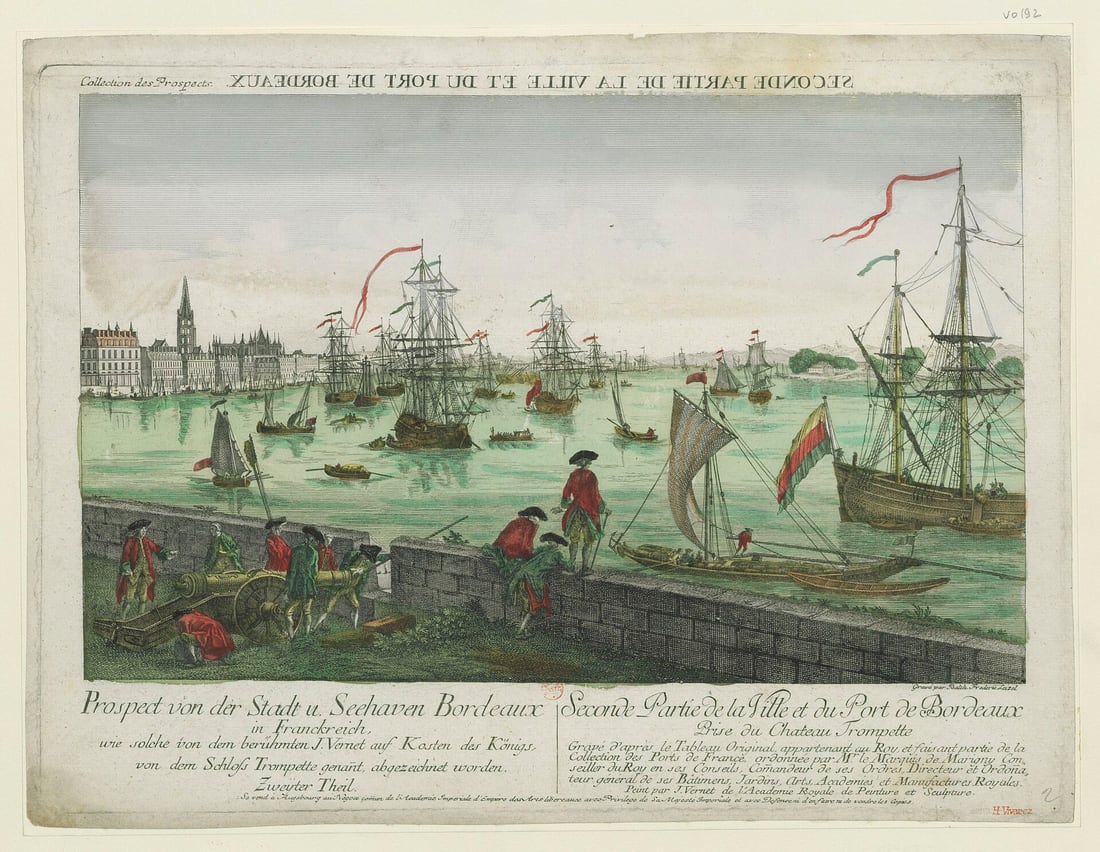
Anisette is a liqueur. Green aniseed, often combined with other plants and spices, is macerated in alcohol, which is then distilled and sweetened. The liquid is colourless. Like all anise-flavoured drinks, it turns cloudy as soon as water is added: anethole, the essential oil of anise, stays dissolved only in alcohol, and then forms fine droplets. The scent of anise is softened in it by sugar.
In 1755, together with Jean-Baptiste Roger, the husband of her niece Anne, she founded a trading house: “Marie Brizard et Roger”. This is what the historian Hubert Bonin establishes from the company's archives. Why a partner? The usual account has it that a woman could not sign on her own. It is less simple than that: under the Ancien Régime, an unmarried woman who had come of age had wider legal capacity than a wife. Roger may have brought capital rather than a signature. The question remains open.
The house prospered. After the deaths of Roger in 1795 and of Marie Brizard in 1801, Roger's descendants, then the Glotin and Achard families, ran it until the 1990s. In 1874 it moved to rue Fondaudège, into a vast industrial establishment that now appears in the French Ministry of Culture's heritage inventory.
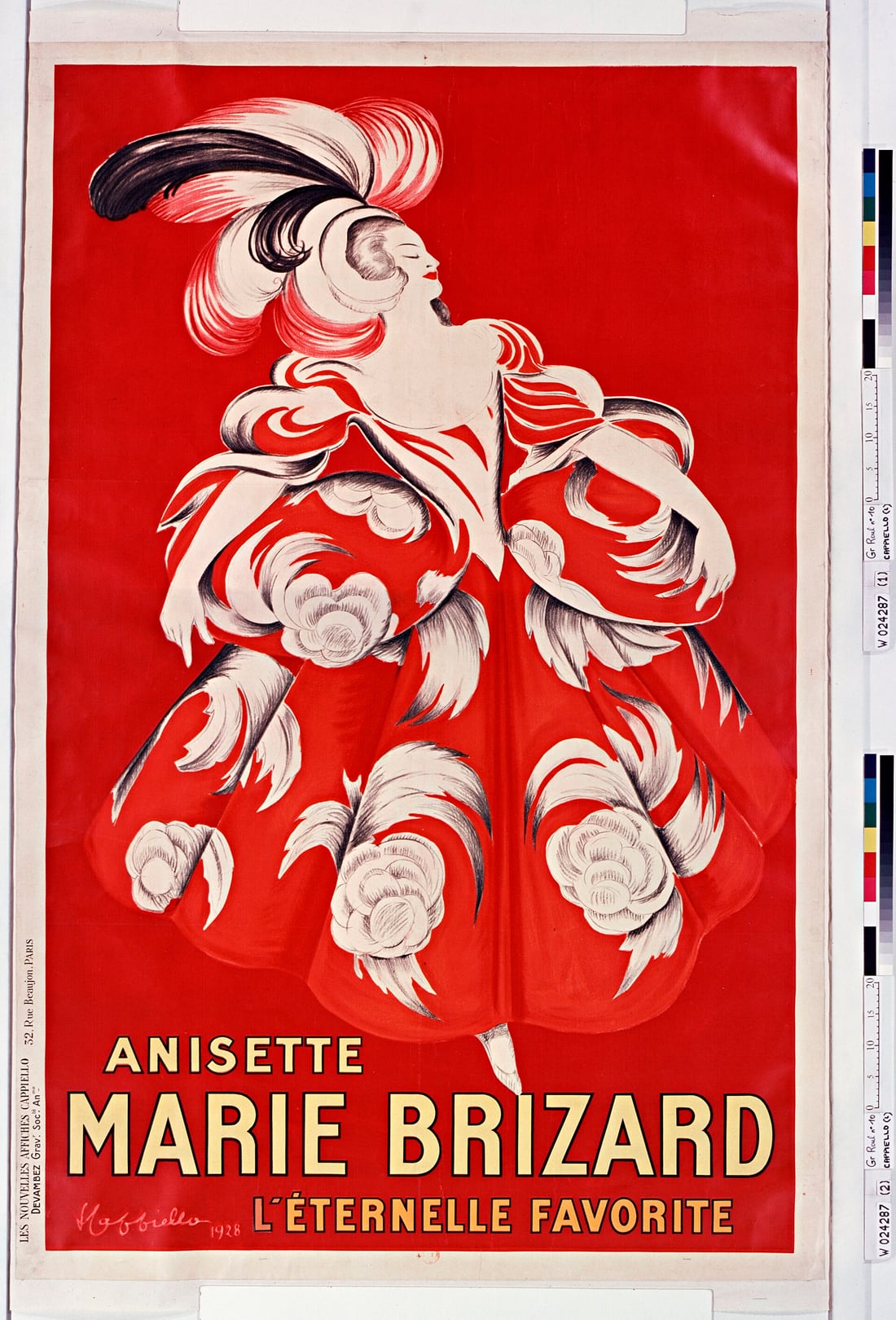
In the 20th century, Marie Brizard became a character. In 1912, the poster artist Leonetto Cappiello depicted her as a young woman of the age of Louis XV, in a white crinoline with bottles in her arms, beneath the words “créées en 1755” (created in 1755). The date had become a selling point. Then, in 1966, an advertisement gave a name and a ship to an old motif: Thomas, a sailor from L'Intrépide.
Marie Brizard's Bordeaux was also the Bordeaux of the slave trade. According to Le Monde, taken up by Rue89 Bordeaux in 2024, anisette was among the goods shipped for the trade. A slave-ship captain named Paul-Alexandre Brizard left a logbook, now held at the Musée d'Aquitaine, but his kinship with Marie has not been established. Asked about it, Hubert Bonin considers that any direct involvement by the house cannot be attested, for lack of archives covering the 18th century.
The legend set against the sources
The legend
As told by the house, in its advertising and on its website until the 2010s
On 11 January 1755, crossing the Place Royale, Marie Brizard came upon a sailor from the West Indies, Thomas, who had landed from L'Intrépide burning with fever. She took him in and nursed him. Once he had recovered, he entrusted her, in thanks, with the recipe for an elixir based on green anise. And so, the story goes, Marie Brizard anisette was born.
What the sources say
In the Annales du Midi, in 2006, Hubert Bonin lists several versions of the origin, without any documentary trace, and reads them as constructions combining exoticism, femininity and charity. In 2017, at the City University of New York, Anna Soo Hoo followed the story through time, building on Bonin: it changes hero with each generation. The recipe was obtained “by chance” in 1889, from a patient in a hospice in 1927, from a West Indian patient in the 1960s, from a sailor at the end of the century.
The story also invents a need: anisette was already being made in Bordeaux, and Marie's father produced it. The date itself varies, 1750 or 1755. The brand's current website has dropped Thomas; it keeps the founding in 1755 and an order from Louis XV in 1763, which we have not been able to verify. What remains is what no advertisement had thought worth telling: a founder who traded, not one who nursed.
So, legend or history?
Before you read the answer, what do you think?
Choose a degree: it is the question a historian asks of every story.
Degree of certainty : Legend
Legend. The grateful sailor appears in no document of the period.
Thomas and L'Intrépide are an advertising invention, whose finished form dates from 1966, and the brand itself has withdrawn it. The legend turned a merchant into a charitable nurse and a local recipe into an exotic gift. What is attested is more interesting: in 1755, an unmarried woman founded in Bordeaux a house that would last for more than two centuries.
How we know
Each date in this story refers to one of the sources below. The degree of certainty can be read from the pattern of the rule: solid for attested, dashed for probable, dotted for tradition, double for legend.
Key dates
-
1714 Marie Brizard is born in Bordeaux -
1743 Death of Pierre Brizard, already a producer of anisette -
1755 Founding of “Marie Brizard et Roger” -
1801 Death of Marie Brizard -
1874 The house moves to rue Fondaudège -
1912 Cappiello's poster: the founder in period costume -
1966 An advertisement names Thomas and L'Intrépide
Attested- established by documents contemporary with the events.
Probable- plausible and consistent with the sources, without direct proof.
Tradition- handed down by the house or by local memory, with no document to confirm or refute it.
Legend- contradicted by the sources, or invented after the fact.
What remains uncertain
- The exact role of Jean-Baptiste Roger: a legal requirement or a contribution of capital.
- The order from Louis XV in 1763, put forward by the brand.
- The link between the house's anisette and the slave trade, and the kinship of the captain Paul-Alexandre Brizard.
- The date in the legend: 1750 or 1755 depending on the version.
Sources
- Hubert Bonin, Les femmes d'affaires dans l'entreprise girondine Marie Brizard : mythes et réalités , Annales du Midi, t. 118, n° 253 , 2006.
- Anna Soo Hoo, Thomas from the Antilles , CUNY Academic Commons , 2017.
- Marie Brizard & Roger International S.A. History , International Directory of Company Histories, vol. 22, St. James Press , 1998.
- Ministère de la Culture, Distillerie Marie-Brizard, notice IA00135722 .
- Samuel Clauzier, Ces entreprises néo-aquitaines qui peinent à assumer leur passif colonial , Rue89 Bordeaux , 2024.