House stories · Bushmills
Has Bushmills really been distilling since 1608?
Every bottle of Bushmills bears a date, 1608, and the company presents itself as the oldest licensed whiskey distillery in the world. The document exists: on 20 April 1608, King James I granted Sir Thomas Phillips the right to make spirits in County Coleraine and in the Route, in the north of County Antrim. But it mentions neither a village nor a distillery, and the first trace of a distillery at Bushmills comes much later.
The story
The 1608 licence was a royal privilege granted to an officer of the colonisation of Ulster for a whole territory; it did not found the Bushmills distillery, which the sources show only in the 18th century.
On 20 April 1608, a licence was granted in the name of King James I to Sir Thomas Phillips. For seven years, he could make spirits — the “aquavitae” of the texts — in County Coleraine, “otherwise called O'Cahan's country”, and in “the territory called the Route”, in the north of County Antrim. The village of Bushmills, on the River Bush, lies in the Route. The text does not name it.
Phillips was not a distiller. He was a soldier, one of those “servitors” who had fought for the Crown during Tyrone's Rebellion and expected in return a share of the lands confiscated from the Gaelic lords of Ulster. During O'Doherty's Rebellion, he had Donnell Ballagh O'Cahan, the lord of the country covered by his licence, taken to a Dublin dungeon. The licence came on top of other favours: four townlands east of the Bann, the Coleraine market, the river ferries.
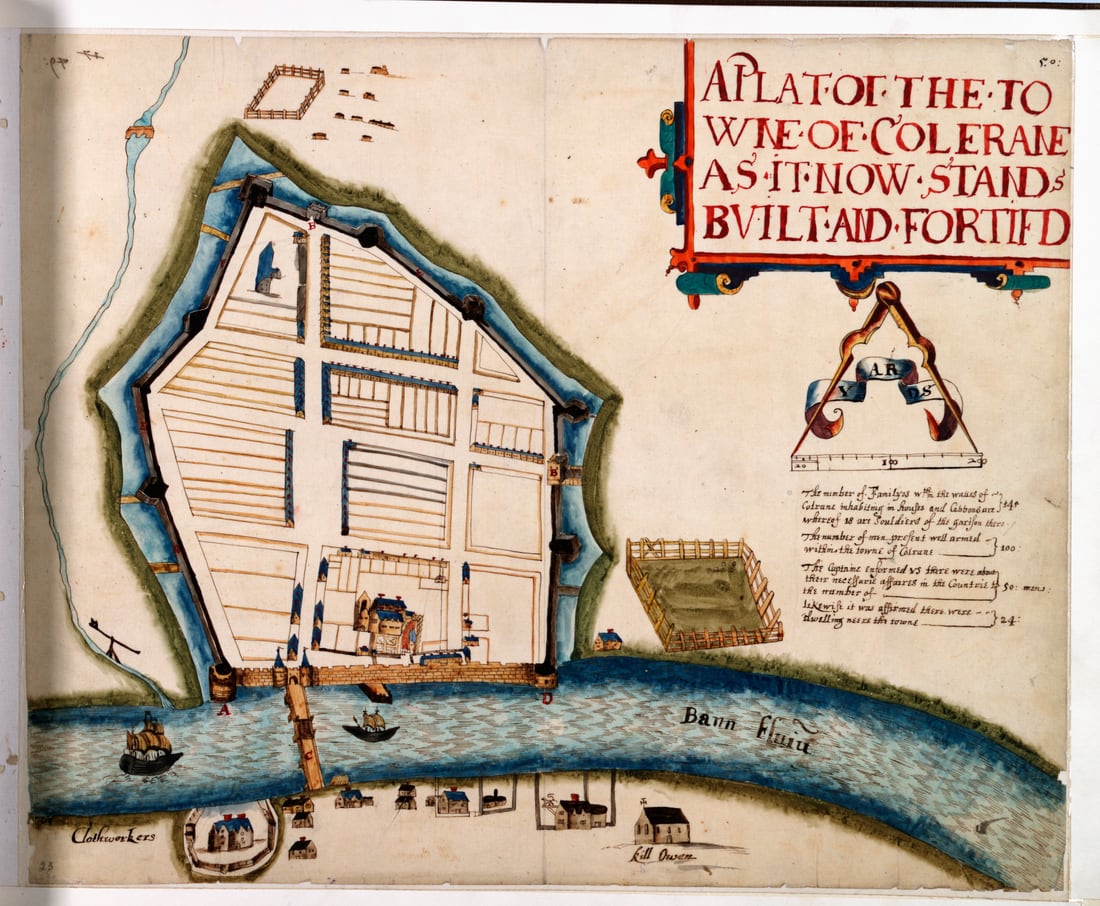
Why a licence? An Irish act from the reign of Philip and Mary already forbade making spirits without the consent of the Lord Deputy, so as not to waste grain. It was not enforced: spirits were made every day, says the preamble to these licences, “in abundance, by all sorts of persons”. The Crown therefore chose to reserve this right to a few people, noblemen and gentlemen. Phillips did not keep his for long. When the City of London took charge of the colonisation of County Coleraine, it demanded an end to the privileges that stood in its way, and Phillips had to surrender, along with other property, his patent to make aquavitae.
The Bushmills distillery enters the sources only much later. In 1887, the journalist Alfred Barnard reported that its first mention dated from 1743, when it was in the hands of smugglers, and that it was recognised as a legal distillery in 1784. It was then producing about 10,000 gallons a year, mainly for the West Indies and America. A fire destroyed it in 1885; it was rebuilt. The company that operates it today was incorporated on 3 April 1930.
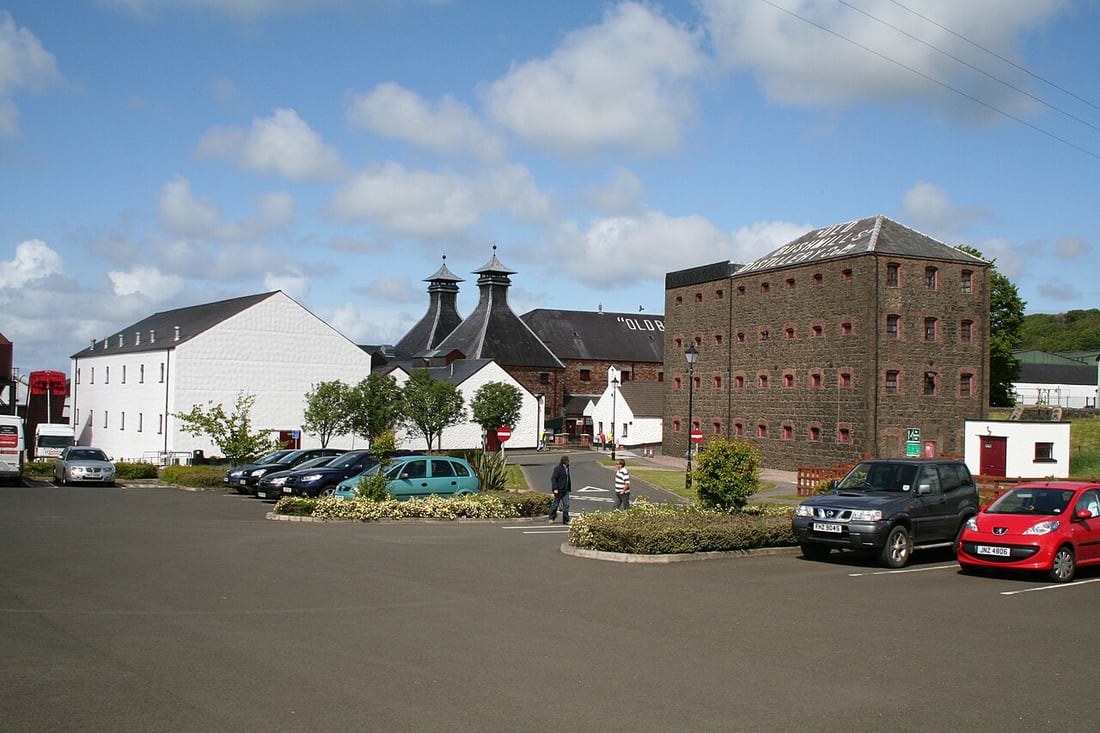
What comes out of it is an Irish whiskey. According to the house, its single malts are made from malted barley alone, distilled three times in copper pot stills. The water comes from a tributary of the Bush, Saint Columb's Rill, which Barnard already saw running through the distillery. The product specification of the geographical indication then requires at least three years in wooden casks on the island of Ireland and a strength of at least 40% vol. Colourless as it leaves the still, the distillate takes its colour from the cask; the law allows it to be adjusted with caramel.
In the early 1970s, Irish Distillers bought Bushmills and brought all the distilling on the island together in a single company. In April 2008, for the four-hundredth anniversary of the licence, the Bank of Ireland issued £5, £10 and £20 notes in Northern Ireland bearing an image of the distillery on the reverse. In 2014, Diageo sold the brand to the Mexican group José Cuervo in exchange for the half of Don Julio tequila it did not yet own and 408 million dollars; Becle, Cuervo's parent company, still owns it.
The legend set against the sources
The legend
As told by the house
From the end of the 16th century, illicit distillers were at work around Bushmills, drawn by the water of the Bush and the barley of the region. In 1608, under pressure from the Crown, Bushmills and its surroundings sought legal recognition; James I then granted Sir Thomas Phillips a licence to distil and sell spirits in the region, and the smugglers at last became lawful distillers. Hence the date on the label, and the title of the oldest licensed whiskey distillery in the world.
What the sources say
The licence is quite real. George Hill published its terms in 1877, from the repertory of the Chancery rolls of Ireland: one man, seven years, two entire territories. It names neither Bushmills nor a distillery, and nothing indicates that Phillips distilled. Nothing in this text points to a request from the inhabitants: it reserves the right to distil to an officer of the conquest, who had to surrender it shortly afterwards.
Between 1608 and the first trace of a distillery at Bushmills, no continuity is documented. Barnard dates that trace to 1743 and the legal recognition to 1784, without citing any document, and the transcription of his chapter that we have read does not mention 1608. The name of Hugh Anderson, often associated with 1784, appears in no independent source that we have found.
The company itself sometimes qualifies its formula. In the statement it publishes under the UK Modern Slavery Act, it writes that the distillery has operated without interruption since it was rebuilt after the fire of 1885, “although whiskey has been distilled in the area since 1608”.
So, legend or history?
Before you read the answer, what do you think?
Choose a degree: it is the question a historian asks of every story.
Degree of certainty : Legend
Legend as to the distillery; the 1608 licence itself is attested.
The licence of 20 April 1608 exists, and it does cover the Bushmills area. But it was given for seven years to an officer of the conquest, over a whole territory, and he had to surrender it shortly afterwards; no source links it to the distillery, which appears only in the 18th century. To make 1608 the birth of Bushmills is to turn a privilege of the colonisation of Ulster into a founding act.
How we know
Each date in this story refers to one of the sources below. The degree of certainty can be read from the pattern of the rule: solid for attested, dashed for probable, dotted for tradition, double for legend.
Key dates
-
1556-1557 An Irish act forbids making spirits without the Lord Deputy's licence -
1608 Seven-year licence to Sir Thomas Phillips for County Coleraine and the Route -
around 1610 Phillips has to surrender his licence on the arrival of the London settlers -
1743 First mention of a distillery at Bushmills, in the hands of smugglers, according to Barnard -
1784 The distillery is recognised as a legal distillery -
1885 Fire and rebuilding of the distillery -
1930 Incorporation of the company that operates the distillery today -
1972 Irish Distillers buys Bushmills -
2008 Bank of Ireland notes for the four-hundredth anniversary of the licence -
2014 Diageo sells Bushmills to José Cuervo
Attested- established by documents contemporary with the events.
Probable- plausible and consistent with the sources, without direct proof.
Tradition- handed down by the house or by local memory, with no document to confirm or refute it.
Legend- contradicted by the sources, or invented after the fact.
What remains uncertain
- The use Phillips made of his licence: nothing says that he distilled or had distilling done, nor where.
- The exact date on which he surrendered the licence to the London settlers.
- The mention of 1743 and the smugglers, reported by Barnard without a document; his book was consulted through an online transcription.
- The role of Hugh Anderson in 1784.
- The date on which “1608” appeared on the label.
- The year of the purchase by Irish Distillers: 1972 according to the Oxford Companion, 1973 according to the product specification of the geographical indication.
- The text of the licence is quoted from George Hill, who refers to Erck's repertory; the original entry has not been consulted.
Sources
- George Hill, An Historical Account of the Plantation in Ulster at the Commencement of the Seventeenth Century, 1608-1620 , M'Caw, Stevenson & Orr , 1877.
- T. W. Moody, Sir Thomas Phillips of Limavady, Servitor , Irish Historical Studies 1, n° 3 , 1939.
- Alfred Barnard, The Whisky Distilleries of the United Kingdom , Harper's Weekly Gazette , 1887.
- The Old Bushmills Distillery Co., Our legacy , 2026.
- The Old Bushmills Distillery Company Limited, Modern Slavery and Human Trafficking Statement , 2022.
- Companies House, The Old Bushmills Distillery Company Limited, NI000601 .
- David Wondrich, « whisky, Irish », in The Oxford Companion to Spirits and Cocktails , Oxford University Press , 2021.
- Department of Agriculture, Food and the Marine, Technical file setting out the specifications with which Irish Whiskey/Uisce Beatha Eireannach/Irish Whisky must comply , 2014.
- Bank of Ireland, Bank of Ireland to feature Old Bushmills Distillery on new Northern Ireland note issue , 2008.
- RTÉ, Diageo confirms Bushmills swap deal , 2014.
- Gary McDonald, Bushmills sitting on record volumes of maturing whiskey as sales ease again , The Irish News , 2026.