House stories · Jose Cuervo
Did the King of Spain give the Cuervos the first tequila licence?
In Tequila, between the foot of the volcano and the canyon of the Rio Grande, the house of Cuervo dates its history to 1758 and claims to have held, since 1795, the first licence granted by the King of Spain to produce the drink. A historian from Guadalajara has reread the documents published in support. They speak of land received by a confraternity, and mezcal wine was sold under licence well before 1795.
The story
The Cuervos really did cover Tequila with agaves at the end of the 18th century; but the 1795 “first licence” is shown by no independent source, and the colonial regime had been farming out the mezcal trade, intermittently, since 1637.
On 2 November 1758, in the village of Tequila, the corregidor went out to two plots called Toyusca and Totolasco, with the neighbours whose land bordered them. No one objected. He gave possession of them, in the king's name, to José Antonio de Cuervo. But Cuervo did not receive these lands for himself. He took them in the name of the confraternity of the Souls in Purgatory, of which he was steward, and to which they had been awarded at auction for 1,000 pesos.
Tequila then lived mainly from sugar cane. In New Galicia, however, “vino mezcal”, the spirit drawn from the cooked heart of the agave, had long been distilled. As early as 1637, in Guadalajara, the exclusive right to sell this wine and coconut wine, the estanco, was put up for auction to pay for the city's water supply. Abolished in 1652, it was re-established in 1672 and approved by the queen regent in 1673. In Tequila, mezcal wine was circulating from 1709 at least: the corregidor then threatened anyone who sold it with fines and the lash; between 1754 and 1759, the farmer of the local estanco, Francisco Barbachano, issued licences there to other farmers.
The man who changed the landscape was José Prudencio Cuervo. He did not come from a rich family. Himself steward of the confraternity of the Souls in 1765, he acquired the main haciendas of Tequila one by one. His will of 1787 describes mainly cane plantations and mills; he mentions in it, almost in passing, some 50,000 agave plants. In that of 1801, he counts 336,407. The historian René de León Meza sees him as the initiator of intensive agave cultivation in Tequila.
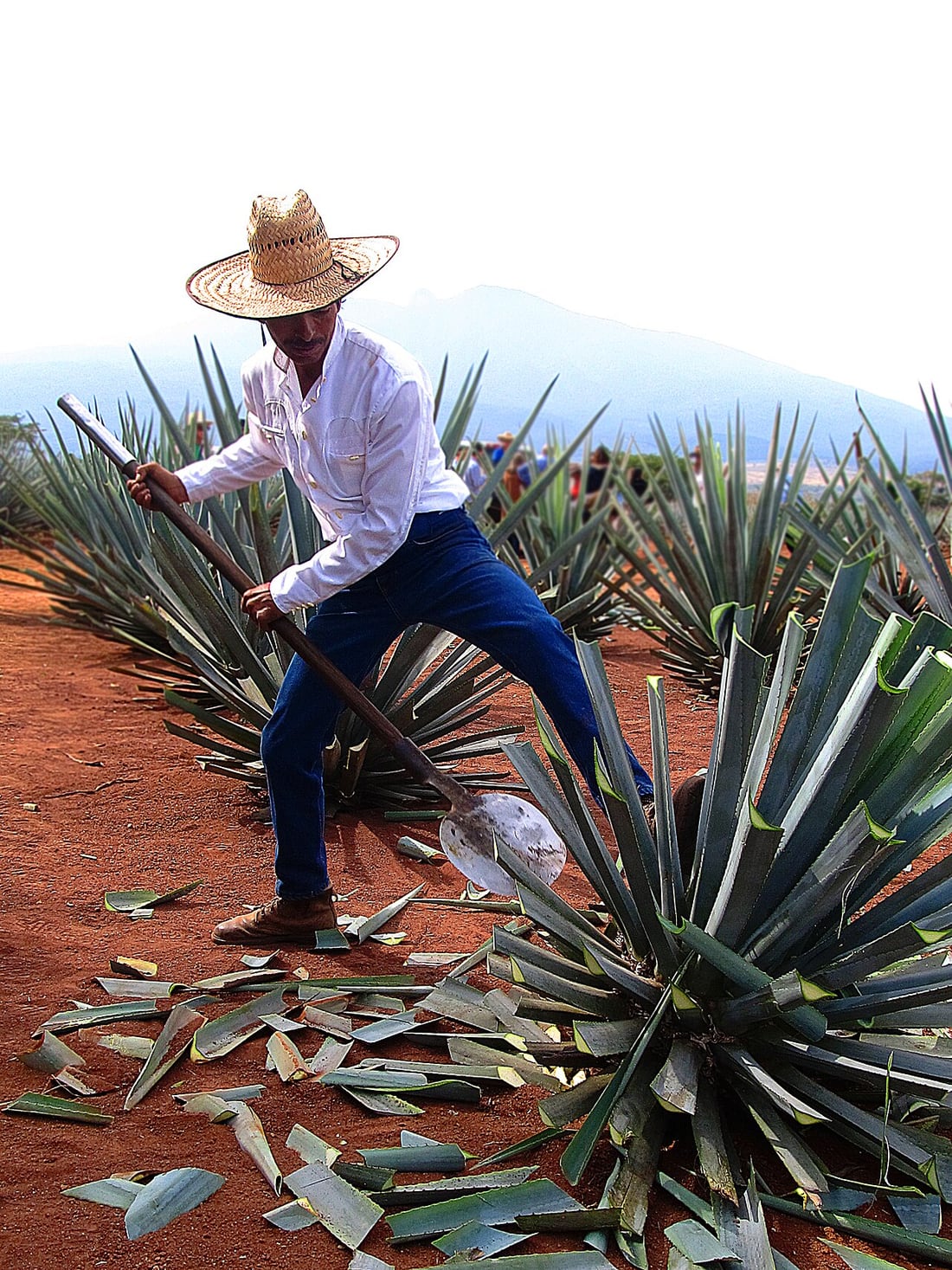
Tequila is born of the jima: the jimador keeps only the heart of the plant, the piña. The Mexican standard admits only one plant, Agave tequilana Weber variety azul, an agave and not a cactus. The piñas are cooked or hydrolysed, which turns their reserves into sugars; the juice ferments, then the must is distilled. At least 51% of the sugars must come from the agave, and all of them for the “100% agave” category. Tequila has a strength of 35 to 55% vol. Blanco spends less than two months in cask, or none at all; reposado stays there at least two months, añejo at least a year, in oak.
The house dates the founding of La Rojeña to 1812. According to the Oxford Companion to Spirits and Cocktails, it was a son-in-law of the family, Vicente Albino Rojas, who gave the distillery its name; the brand took its present name in 1900, when José Cuervo Labastida took over the business. The Beckmann family, descendants of the Cuervos, holds about 86% of it through Becle, listed on the stock exchange since 2017.
In 2006, UNESCO inscribed the agave landscape and the ancient industrial facilities of Tequila on the World Heritage List: 34,658 hectares around Tequila, El Arenal and Amatitán. This landscape has another side. The sociologist Sarah Bowen observes that the price paid to agave growers has often fallen below their production costs, that farm workers are even worse off, and that the benefits of the appellation of origin have scarcely reached them; the industry is dominated by a few firms, most of them owned by multinationals.
The legend set against the sources
The legend
As told by the house, and the Oxford Companion, which repeats its account
In 1758, King Ferdinand VI granted José Antonio de Cuervo lands in Tequila on which to plant agave. In 1795, a royal ban having been lifted, King Charles IV issued José María Guadalupe de Cuervo a royal cédula, regarded as the first licence to produce and distribute tequila. In 1812, La Rojeña was born, the oldest distillery still in operation in Latin America.
What the sources say
In 2009, the historian Miguel Claudio Jiménez Vizcarra reread the two documents published by the journal Artes de México to illustrate this story: one presented as a land purchase deed, the other as the 1795 “licence”. According to him, they would be the recto and verso of a single sheet, which seem to relate to the 1758 deed by which the confraternity of the Souls, represented by its steward José Antonio de Cuervo, took possession of Toyusca and Totolasco. There is no question in it of a gift from the king, or of agave.
The fiscal history of the colony also contradicts the idea of a first licence. The trade in mezcal wine had been farmed out in Guadalajara since 1637, not without interruptions and local bans, and in Tequila itself a tax farmer was issuing licences in the 1750s. Historians of the estanco have found no trace of any involvement of the Cuervos in these farms. No independent source consulted cites the 1795 cédula; the Oxford Companion repeats it without a reference.
José Prudencio Cuervo's two wills, on the other hand, are kept in the Archive of Public Instruments in Guadalajara: they document the family's real role.
So, legend or history?
Before you read the answer, what do you think?
Choose a degree: it is the question a historian asks of every story.
Degree of certainty : Legend
Legend as to the 1795 licence. The lands of 1758 were those of a confraternity.
The Cuervos did make the history of tequila: at the end of the 18th century, José Prudencio Cuervo covered his lands with agaves, and his wills prove it. But no independent source shows Charles IV's “first licence”; the text published under that title seems to be, according to the historian who reread it, the continuation of a deed of taking possession from 1758; and mezcal wine had been sold under licence, intermittently, for more than a century.
How we know
Each date in this story refers to one of the sources below. The degree of certainty can be read from the pattern of the rule: solid for attested, dashed for probable, dotted for tradition, double for legend.
Key dates
-
1637 The estanco of coconut wine and mezcal is created in Guadalajara -
1673 A royal cédula confirms the re-establishment of the estanco -
1709 The corregidor of Tequila bans the sale of mezcal wine in his jurisdiction -
1754-1759 Francisco Barbachano, farmer of the Tequila estanco, issues licences -
1758 Toyusca and Totolasco taken into possession for the confraternity of the Souls -
1795 Charles IV's “first licence”, according to the house -
1801 Will of José Prudencio Cuervo: 336,407 agave plants -
1812 Founding of La Rojeña, according to the house -
1900 José Cuervo Labastida takes over the business -
2006 The agave landscape of Tequila inscribed on the World Heritage List
Attested- established by documents contemporary with the events.
Probable- plausible and consistent with the sources, without direct proof.
Tradition- handed down by the house or by local memory, with no document to confirm or refute it.
Legend- contradicted by the sources, or invented after the fact.
What remains uncertain
- Margarita de Orellana's article in Artes de México no. 27 has not been consulted directly: its captions and transcriptions are known through the notes of Jiménez Vizcarra (2009).
- The dates of José María Guadalupe de Cuervo: 1762–1805 according to the Beckmann foundation, died in 1812 according to the Oxford Companion; hence a doubt as to who named La Rojeña, and when.
- The exact family relationships between José Antonio, José Prudencio and José María Guadalupe de Cuervo, and the dates of birth of the first two, are given only by the family's foundation.
- The 1812 date and the title of oldest distillery in operation in Latin America rest on the house alone.
- A possible ban: according to Machuca et al. (2013), after the abolition of the estanco in 1652, New Galicia banned coconut wine, at least officially; according to Jiménez Vizcarra, mezcal wine was never banned there. The narrative mentions only the local ban of 1709, attested by Machuca et al.
- A cédula later than 1758 cannot be absolutely ruled out: none has been found in the sources consulted, and Jiménez Vizcarra disputes that a ban existed in New Galicia at the end of the 18th century; local bans are nonetheless attested earlier, in Tequila in 1709.
- UNESCO writes that agave has been used to produce tequila since the 16th century; René de León Meza finds no agave cultivation in Tequila itself before 1727, a date taken from a document without a shelfmark; Machuca et al. cite an ordinance of the corregidor of Tequila against the sale of mezcal wine as early as 1709. The two do not speak of the same territory.
- Eric Van Young's work on José Prudencio Cuervo and Sarah Bowen's book Divided Spirits (2015) have not been consulted directly.
- The recto and verso: Jiménez Vizcarra saw only the transcriptions published by Artes de México; he writes that “one comes to think” they are a single sheet.
Sources
- Jose Cuervo, History , 2026.
- David Mahoney, « Jose Cuervo », in The Oxford Companion to Spirits and Cocktails , Oxford University Press , 2021.
- Miguel Claudio Jiménez Vizcarra, « Reflexiones sobre el origen del vino mezcal-tequila. Mitos y verdades. El caso de Amatitán », III Simposio Internacional del Tequila , Benemérita Sociedad de Geografía y Estadística del Estado de Jalisco , 2009.
- Paulina Machuca, Diana Carrano et José de Jesús Hernández López, « El estanco del vino de cocos y mezcal en la Nueva Galicia, siglos XVII-XVIII », Letras Históricas, n° 8 , Universidad de Guadalajara , 2013.
- C. René de León Meza, « Reflexiones en torno al origen tardío de la producción del tequila en el pueblo de Tequila », Fronteras de la Historia, vol. 22, n° 1 , 2017.
- Fundación Beckmann, Jose Cuervo: The oldest tequila distillery in the world (part 1) , Google Arts & Culture .
- Secretaría de Economía, NOM-006-SCFI-2012, Bebidas alcohólicas. Tequila. Especificaciones , Diario Oficial de la Federación , 2012.
- Matt Shipman, Tequila, mezcal and social science — a Q&A with sociologist Sarah Bowen , NC State University, repris par Phys.org , 2015.
- UNESCO, Centre du patrimoine mondial, Paysage d'agaves et anciennes installations industrielles de Tequila , 2006.
- Expansión, José Cuervo nació antes que México , Expansión , 2026.