House stories · Angostura
Is Angostura's oversized label a mistake that nobody corrected?
A red-brown liquid, so concentrated that it is measured by the drop, in a bottle dressed in an oversized paper label that reaches up past the neck. The brand explains this label by a mistake made by two brothers, a lost competition and a shrewd judge. No one has ever found the competition, the judge or the year.
The story
Angostura was born as a military doctor's remedy and has kept its secret; its oversized label is very real, but the lost competition that would explain it is a legend with neither date nor witness.
In 1820, a young German doctor landed on the banks of the Orinoco, at Angostura, in Venezuela. Johann Gottlieb Benjamin Siegert, born in Silesia in 1796, had come to serve as a surgeon in the army of Simón Bolívar, which was fighting for the independence of Spain's colonies. Angostura was the insurgents' provisional capital. Soldiers there were dying of fevers and digestive disorders.
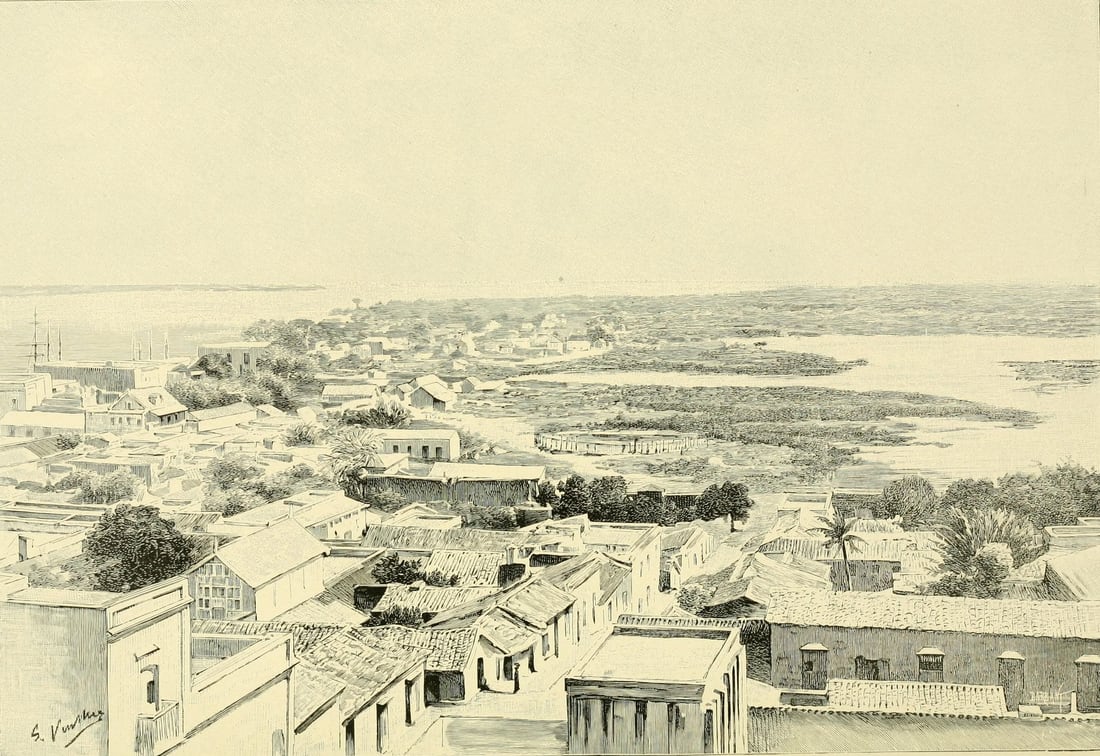
Siegert prepared an aromatic bitters from barks, roots and spices macerated in alcohol, which he prescribed as a tonic. Tradition dates the preparation to 1824. The remedy was soon being sold to the sailors who came up the river, and travelled with them. In 1846 the town of Angostura took the name Ciudad Bolívar; the product kept the town's old name, which became a brand.
After Siegert's death in 1870, his sons moved the business to the more stable British island of Trinidad, in the mid-1870s. They were defending their name in the English courts as early as 1878. The product had left the pharmacy: around 1900, a Paris poster by Jules-Alexandre Grün shows it behind a bar counter.
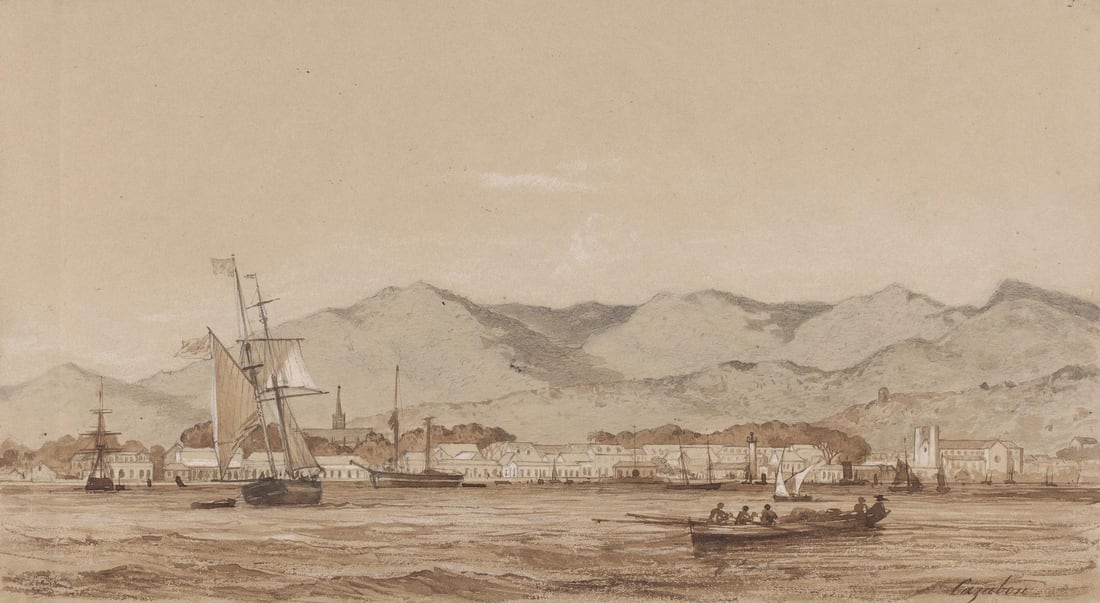
One detail is intriguing: the name does not match the recipe. There is a tree called angostura, whose bark was also used against fever, but it is not one of the ingredients. The word designates a town, not an ingredient. The recipe itself is known to only a few people. Secrecy has been part of the product from the start: a military doctor's remedy did not publish its formula, and the house kept up this discretion long after becoming a global brand.
What is known of the contents can be said in a few words. Angostura is an aromatic bitters: barks, roots, spices and plants are macerated in alcohol. The house names gentian among its ingredients and keeps the rest to itself. The red-brown liquid is 44.7% vol.; its bitterness is mingled with warm spices. So concentrated that it is not drunk on its own, it is used in dashes, a few drops in a glass.
In 2009 and 2010, Angostura ran short in bars in New York and elsewhere. Rumour spoke of a lost recipe or a plant that could no longer be found. The house explained that the shortage came from a bottle problem at its supplier. Even a stock shortage, in this story, takes the form of a mystery.
The legend set against the sources
The legend
As told by the house
Dr Siegert's sons were preparing for a competition. One ordered the bottles, the other the labels, without consulting each other: the labels arrived too big. Short of time, they entered their bottles dressed this way all the same. They lost, but a judge advised them to keep the label, so distinctive that it could be recognised from afar. They kept it.
What the sources say
No version of the story names the competition, the year or the judge. The journalist Robert Simonson, who investigated the brand, describes it as known for its silence about its beginnings: it produces no archive in support of its stories, like most old houses, which know little about their own history. The label itself contradicts the story: it reproduces the house's medals, including, according to several authors, the one from the Vienna World's Fair of 1873. So the Siegerts did win competitions, and the one they supposedly lost remains hard to date.
Other elements of the story are fragile: the 1824 date, undocumented, when other authors put forward 1820 or 1830, and Siegert's presence at Waterloo, never verified.
What is certain: Siegert's service in Bolívar's army, the town's change of name in 1846, the house's move to Trinidad, and the absence of angostura bark from the product.
So, legend or history?
Before you read the answer, what do you think?
Choose a degree: it is the question a historian asks of every story.
Degree of certainty : Legend
Legend. The lost competition has no date, no place and no judge.
The oversized label is very real, and today it is what gives the bottle its identity. But the story of the lost competition rests on no document, and the house itself displays medals that make it unlikely. No one knows why the label is too big. The story filled that silence with a charming mistake and a kindly judge.
How we know
Each date in this story refers to one of the sources below. The degree of certainty can be read from the pattern of the rule: solid for attested, dashed for probable, dotted for tradition, double for legend.
Key dates
-
1820 Siegert arrives in Angostura, in Bolívar's army -
1824 The “amargo aromático”, according to tradition -
1846 Angostura takes the name Ciudad Bolívar -
1873 Medal at the Vienna World's Fair, reproduced on the label -
1875 The house settles in Port of Spain, Trinidad -
1878 Siegert v. Findlater, a lawsuit in London -
2010 A shortage attributed to a bottle problem
Attested- established by documents contemporary with the events.
Probable- plausible and consistent with the sources, without direct proof.
Tradition- handed down by the house or by local memory, with no document to confirm or refute it.
Legend- contradicted by the sources, or invented after the fact.
What remains uncertain
- The date the bitters was created: 1820, 1824 or 1830 depending on the author.
- The exact date of the move to Trinidad: 1875 or 1876.
- Siegert's presence at Waterloo.
- The real origin of the oversized label.
Sources
- Matt Pietrek, « Angostura bitters », in The Oxford Companion to Spirits and Cocktails , Oxford University Press , 2021.
- Caribbean Beat, J.G.B. Siegert: a taste for adventure , 2008.
- Bar-Vademecum, Angostura Bitters and Angostura Bark Bitters , 2017.
- Robert Simonson, The story behind Angostura bitters' label , Punch , 2017.
- Robert Simonson, The Bitter Truth , 2024.
- Australian Bartender, Angostura bitters shortage hits New York , 2010.