House stories · Kweichow Moutai
Did a broken bottle win Moutai a gold medal in 1915?
In 1915, at the international exposition in San Francisco, a Chinese delegate is said to have dropped a bottle of Maotai spirit to force the jury's attention, and thereby carried off a gold medal. The story is very widespread in China, and the State enterprise that produces Moutai has made it its claim to fame. The archives speak of a very real prize, which the official Chinese list of awards says was silver, and of no broken bottle.
The story
Maotai was indeed awarded a prize in San Francisco in 1915, but the broken bottle is a legend, and the gold medal is contradicted by the list of awards of the Chinese delegation itself.
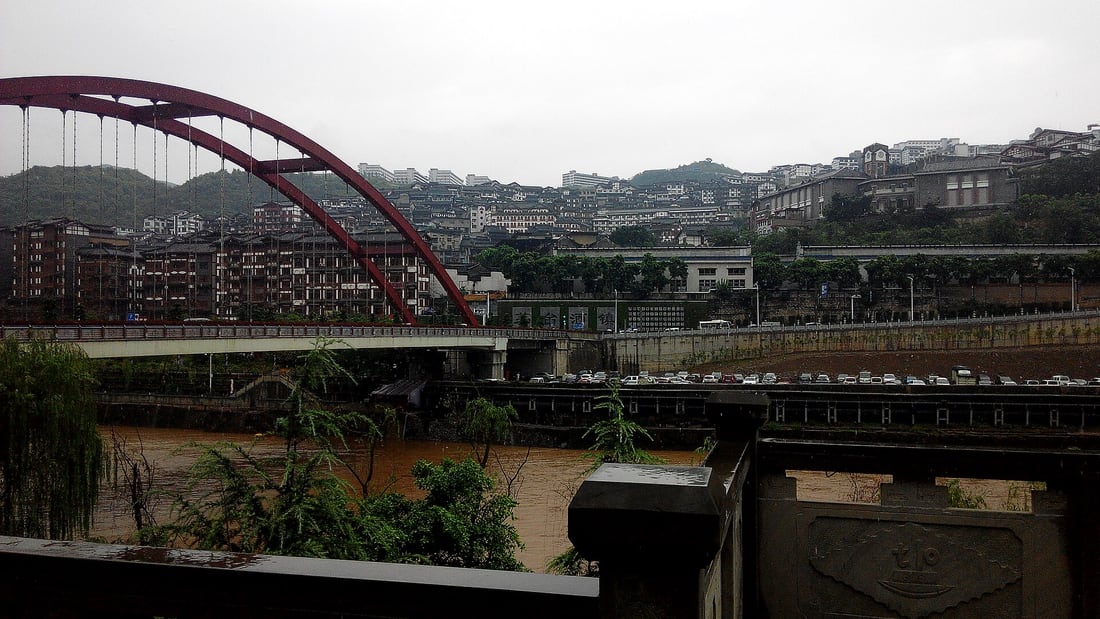
Maotai is a small town squeezed into the bottom of the Chishui valley, in the north of Guizhou. Under the Qing, the river was dredged so that salt from Sichuan could be brought upstream, and Maotai became its great port. The town's distilleries belonged mainly to salt merchants. The Miao rebellion, in the middle of the 19th century, destroyed more than twenty of them; others opened afterwards, among them Chengyi and Ronghe. A third opened in 1929.
A baijiu is made there, a grain spirit. Crushed wheat, moulded into bricks, ferments for a month or more in a warm, humid room: this is qū, the ferment, which is then mixed with red sorghum and water. This almost solid paste ferments for about a month in a pit, then is distilled with steam. The sorghum is added in only two batches; the same paste is then steamed again, returned to the pit and redistilled, over a cycle of one year: nine steamings, eight fermentations, seven distillations. According to the Oxford Companion to Spirits and Cocktails, the spirits age for three to more than twenty years in large jars of porous earthenware, before being blended in their hundreds. The style is called “sauce aroma”; the main bottling is 53% vol.
In 1915, the young Republic of China made a strong showing at the Panama-Pacific International Exposition in San Francisco. Guizhou sent Maotai spirit, supplied by Chengyi and Ronghe. Among some 1,200 Chinese awards, one went to the liquor presented by the Guizhou government. A single prize for two distilleries: they fought over it, and on 14 June 1918 the governor of the province settled the matter. The medal would remain with the chamber of commerce; each distillery could print the award on its labels.
In March 1935, the retreating Red Army passed through Maotai during the Long March. A notice from its General Political Department, dated 16 March, ordered that the distilleries and their equipment be protected, and that only fair purchases be made there. After the communist victory of 1949, between 1951 and 1953, through buyout, confiscation or being placed under administration, the town's three distilleries were taken from their families and merged into a single State enterprise, the future Kweichow Moutai.
On 21 February 1972, in the Great Hall of the People, Zhou Enlai received Richard Nixon, and maotai was served at the banquet. Since nationalisation, it had already been the spirit of State dinners; Nixon's visit made it known to the world, and officials remained its leading customers. That is where it was hit: in December 2012, at the start of Xi Jinping's anti-corruption campaign, the Central Military Commission banned expensive liquor from army banquets, and the company's share price fell. It recovered: in 2017, the listed company overtook Diageo as the world's leading spirits company by value.
The legend set against the sources
The legend
As told by the house, and a tradition widespread in China
In San Francisco, the Chinese stand attracted no one: in their rough earthenware containers, the spirits left the jurors indifferent. A delegate then feigned clumsiness and dropped a bottle, which shattered on the floor. The smell filled the pavilion, the jury came running, and maotai received a gold medal.
Other versions make the gesture a deliberate challenge, a bottle thrown down “to raise national prestige”. The company celebrated the centenary of this gold medal in 2015, and still claims it in 2025.
What the sources say
No contemporary document cited by historians mentions a broken bottle. The academic Huang Ping, who went through the official report on the Chinese participation and the archives of Renhuai district, places the episode among the anecdotes that turned a prize into a legend.
The gold is contradicted by the same sources. The list of awards drawn up by Chen Qi, China's commissioner at the Exposition, gives the Guizhou government's liquor a silver medal. The 1918 decree speaks of “a prize”, with no metal; the diploma and the medal, deposited with the chamber of commerce, can no longer be found. In 1954, the back label of the State enterprise ranked maotai “second” among the world's liquors; those of 1982 and 1984 say nothing of gold, that of 2003 claims it. A local chronicle of the 1930s, however, already spoke of a “gold medal”, and the Red Army notice of 1935, as reproduced by the Xinhua agency, of an “international gold prize”. Questioned in 2015 by the daily Changjiang Shangbao, a former chairman of the company, Ji Keliang, judged that the nature of the prize “does not matter”.
Nor, strictly speaking, does the prize belong to the State enterprise, born thirty years later. The descendants of the founders of Ronghe, who revived their distillery in the 1980s, challenged its claim in court in 2015; the courts ruled that Kweichow Moutai could invoke it as heir to the distilleries it had absorbed.
So, legend or history?
Before you read the answer, what do you think?
Choose a degree: it is the question a historian asks of every story.
Degree of certainty : Legend
Legend as to the broken bottle; the medal, for its part, was silver.
Maotai was indeed awarded a prize in San Francisco in 1915, and the prize mattered enough for two distilleries to fight over it. But nothing attests the broken bottle, and the gold medal is contradicted by the Chinese delegation's list of awards, which places the Guizhou spirit among the silver medals. The story turned an exhibition prize into a gesture of national pride, and the State enterprise, born of distilleries taken from their families, made it its claim to fame.
How we know
Each date in this story refers to one of the sources below. The degree of certainty can be read from the pattern of the rule: solid for attested, dashed for probable, dotted for tradition, double for legend.
Key dates
-
1915 Panama-Pacific Exposition: a silver medal, according to the Chinese list of awards -
14 June 1918 The governor of Guizhou divides the prize between Chengyi and Ronghe -
1929 A third distillery opens in Maotai -
16 March 1935 The Red Army in Maotai; a notice protects the distilleries -
1953 The three distilleries, bought out, confiscated or placed under administration, merged into a State enterprise -
1972 Zhou Enlai's banquet for Richard Nixon in Beijing -
2003 The “gold medal” appears on the 2003 back label -
2012 Expensive liquor banned from army banquets; the share price falls -
2017 The Guizhou High Court lets the State enterprise claim the prize
Attested- established by documents contemporary with the events.
Probable- plausible and consistent with the sources, without direct proof.
Tradition- handed down by the house or by local memory, with no document to confirm or refute it.
Legend- contradicted by the sources, or invented after the fact.
What remains uncertain
- The exact identity of the liquor that won the prize: Chen Qi's list speaks of the liquor of the “Guizhou government”; that it was maotai is inferred from the decrees of 1918, which award the prize to the Chengyi and Ronghe distilleries.
- The official list of awards published by the Exposition itself has not been consulted; Chen Qi's report (dated 1916 or 1917 depending on the author) and the 1930s chronicle are cited through Huang Ping's study and the investigation by Changjiang Shangbao.
- The founding dates of Chengyi and Ronghe, which authors place between the 1860s and the 1880s; they are not used here for lack of a verified source.
- The chronology of nationalisation: the State distillery was founded in 1951 according to Renmin Ribao, and the takeover of the three distilleries is dated 1953 by Meiri Jingji Xinwen; how far each distillery was bought out or confiscated has not been established.
- The date of the appeal ruling (2017), inferred from the Sixth Tone article, published in 2018, which places it “last year”.
- The text of the Red Army notice of 16 March 1935 is known from its reproduction in a Xinhua dispatch of 2016, which does not say where the original is kept.
Sources
- Huang Ping, From a Small Town to the World Stage: A Historical Survey of the Development of Maotai Liquor in China (1915-1935) , International Journal of Business Anthropology, vol. 11, n° 1 , 2021.
- Changjiang Shangbao, repris par Qingdao News, 茅台所获百年金奖疑造假 (Le centenaire de la médaille d'or de Maotai, une contrefaçon ?) , 2015.
- Sixth Tone, Brewing Trouble, chapitre 2 : A Brand Worth Suing For , 2018.
- Cao Shengyuan, « 赖茅 »市场再陷混乱调查:茅台坐拥商标60年不启用 , Meiri Jingji Xinwen (每日经济新闻) , 2012.
- Xiao Shizhong, Wang Jingguo et Yu Jikun, agence Xinhua, 长征时红军战士真的用茅台酒洗脚吗? , 2016.
- Jordan Mackay, « Kweichow Moutai », in The Oxford Companion to Spirits and Cocktails , Oxford University Press , 2021.
- Derek Sandhaus, Unearthing China's Ancient Terroir in Maotai , Punch , 2014.
- National Archives, Richard Nixon Presidential Library, President Richard Nixon and Premier Chou En-Lai Share a Toast during a Banquet , 1972.
- Diana Bates, If you could put China's problems in a bottle… , Fortune , 2013.
- Kweichow Moutai, Moutai Returns to its Origin of World Fame, 110 Years from its Debut on Panama Expo (communiqué) , PR Newswire , 2025.
- Renmin Ribao (人民日报), 贵州茅台 守正创新,改革发展 建设世界一流企业,服务人民美好生活 , 2023.
- Yuan Yuan, Calloused hands and dancing robotic arms work in sync in China's liquor heartland , Beijing Review , 2025.