Why do so many spirits come in a square bottle?
Blown glass wants to be round. It took a mould, an effort and a reason to make it square. The houses each tell the story of their own invention; the shipwrecks tell another, older one.
At the Rijksmuseum in Amsterdam, a display case holds shards of greenish glass brought up from the wreck of the 't Vliegend Hart, a ship of the Dutch East India Company lost off Zeeland in 1735. The label calls them kelderflessen, “cellar bottles”, and explains that they were square and were used, among other things, to keep genever. On the other side of the Atlantic, the wreck of the Queen Anne's Revenge, Blackbeard's ship, which ran aground in North Carolina in 1718, has yielded nearly a hundred fragments of them.
Two centuries later, the shelves are full of square bottles, and every house tells how it was the first to have the idea. Who is telling the truth?
Glass wants to be round
The question is less trivial than it seems. A gather of glass blown at the end of a pipe naturally takes a round shape: that is where the material and the breath lead. To get four flat sides, you need a mould. Seventeenth-century glassmakers used dip moulds, of wood, metal or clay, into which the hot glass was lowered from above. So that it could be drawn out again, the body had to flare slightly: hence the characteristic silhouette, wider at the shoulders than at the base.
An extra effort, then. There had to be a reason.
The case before the brand
That reason is written into the Dutch name. The kelder here is not a cellar but a partitioned wooden chest that held the bottles upright, side by side. English-speaking archaeologists call them case bottles. A round bottle leaves empty space around it and rolls; a square bottle fills its whole compartment. Depending on the model, a case held from four to twelve, and the flared shape meant they could be lifted out without jamming. The Parks Canada glass glossary, a reference tool for archaeologists, made the case bottle a type in its own right, one that excavation catalogues associate with gin.
Dutch genever, the ancestor of gin, travelled this way from the ports of the United Provinces to trading posts, ships and colonies. The blog of the Queen Anne's Revenge excavation repeats an old fable in passing: gin was supposedly invented in the mid-seventeenth century by the physician Franciscus Sylvius. It does not hold up: Sylvius was born in 1614, when juniper spirit was already in circulation, as another Journal entry points out.
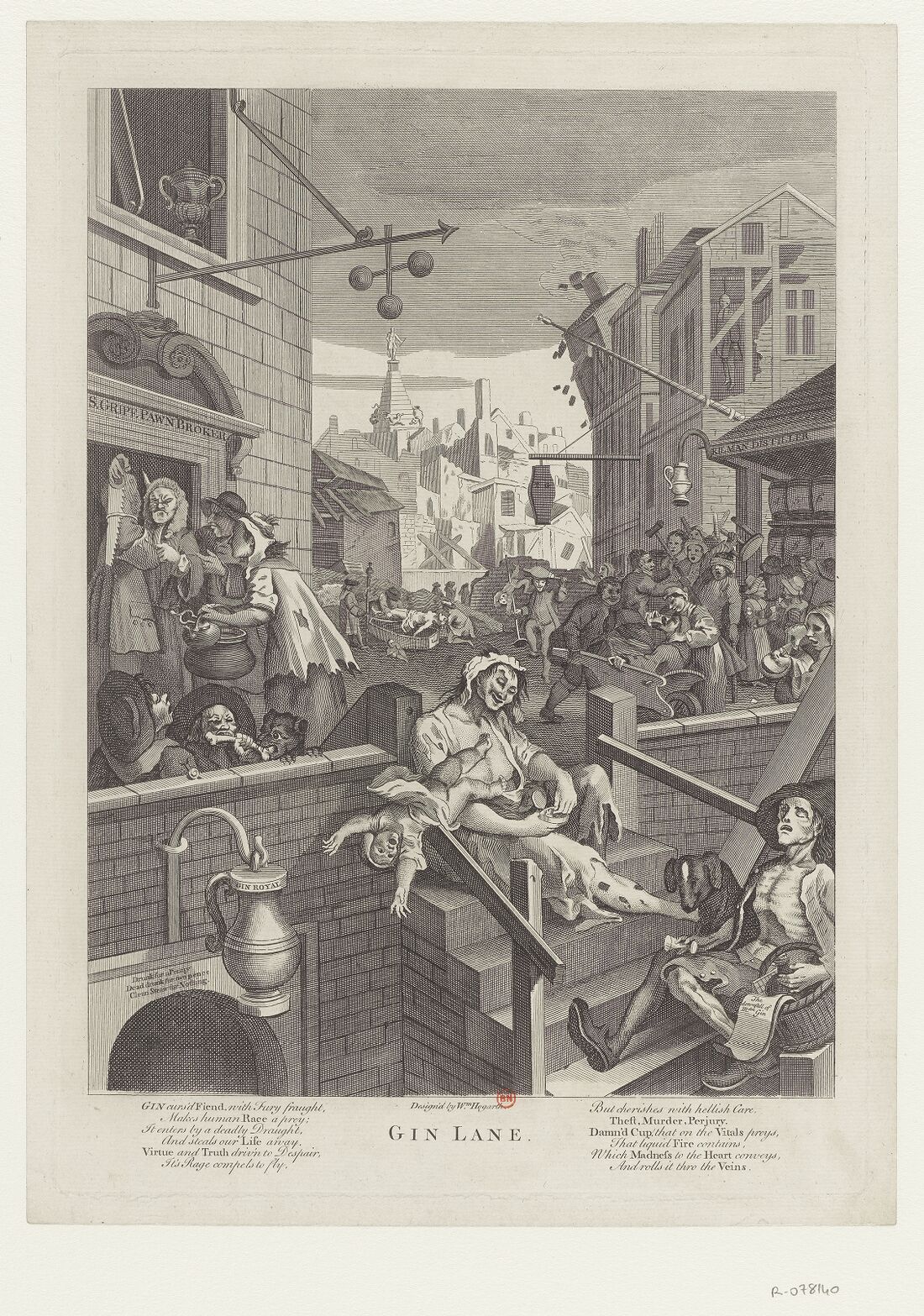
In the streets of London, at the same time, alcohol circulated not in bottles but by the barrel and the jug, as the Hogarth engraving reproduced here shows. The square bottle was a shipping object. The story of this period is that of the exhibition Gin Lane.
Three houses, three stories
At the end of the nineteenth century, the shape left the hold and moved into the shop window.
Saint-James, 1882. Paulin Lambert, a Marseille merchant who had been trading in tafia from Martinique for some twenty years, filed that year at the registry of the Marseille commercial court the trade mark “Rhum des plantations de Saint-James”, sold in a square bottle of its own. The Oxford Companion to Spirits and Cocktails notes the irony: the plantations did not yet exist; Lambert did not buy the Trou-Vaillant estate, near Saint-Pierre, until 1890. As for the date of 1765 that the house puts forward, it is the date on a plaque at the sugar works, not that of the rum or of the bottle. The house explains the square shape by sea transport: less breakage, more bottles per case. That is highly plausible, since it is exactly the logic of the kelderflessen, but we have found no document from 1882 that says so. The history of the house is on its page.
Johnnie Walker, 1860? The brand's story credits Alexander Walker, the founder's son, with the square bottle in 1860 and the label slanted at 24 degrees. One date, however, runs up against the law. The British register of trade marks did not open until 1 January 1876; its trade mark number one is the red triangle of Bass beer. According to trade press that has consulted the company's archives, the Walker label was entered in it in 1877, with earlier use claimed, and then defended before the Court of Session in Edinburgh in 1881. These sources also point out that square bottles were already common for patent medicines, sauces and gin when the whisky from Kilmarnock adopted them.
Cointreau, 1885. The Angers house dates to 1885 the filing of its square bottle, in brown glass, at the town's commercial court. That filing is the act that counts. The French law of 23 June 1857 lists among the marks that can be protected the “enveloppes” (wrappers), that is to say containers, and provides for their filing at the registry of the commercial court. A bottle shape could now belong to someone. The page of the house tells what came next.
What the shape says
So the square bottle was not invented by a brand. It was born for the case, in the genever trade, because a shape that does not roll and leaves no empty space travels better. It became a signature at the end of the nineteenth century, when trade mark law made it possible to own a shape and houses sought to stand out on a shelf. The dates of 1882 and 1885 are those of filings, not of inventions. The rest is storytelling.
The houses have not only rewritten the history of their bottles. Cocktails too have their competing birth certificates, and their dates are often more fragile still.