The angels' share: where does evaporating cognac go?
In the cellars of Cognac, the casks lose part of their contents every year, with no leak and no thief. The loss was entrusted to the angels. But in Cognac, the cellar walls are black, and that black has a Latin name.
In Cognac, on the quays of the Charente, you only have to look at the walls. The façades of the cellars, the roof tiles, the trunks of the surrounding trees are covered in a black film, like a soot that comes from no chimney. It would be easy to take it for pollution.
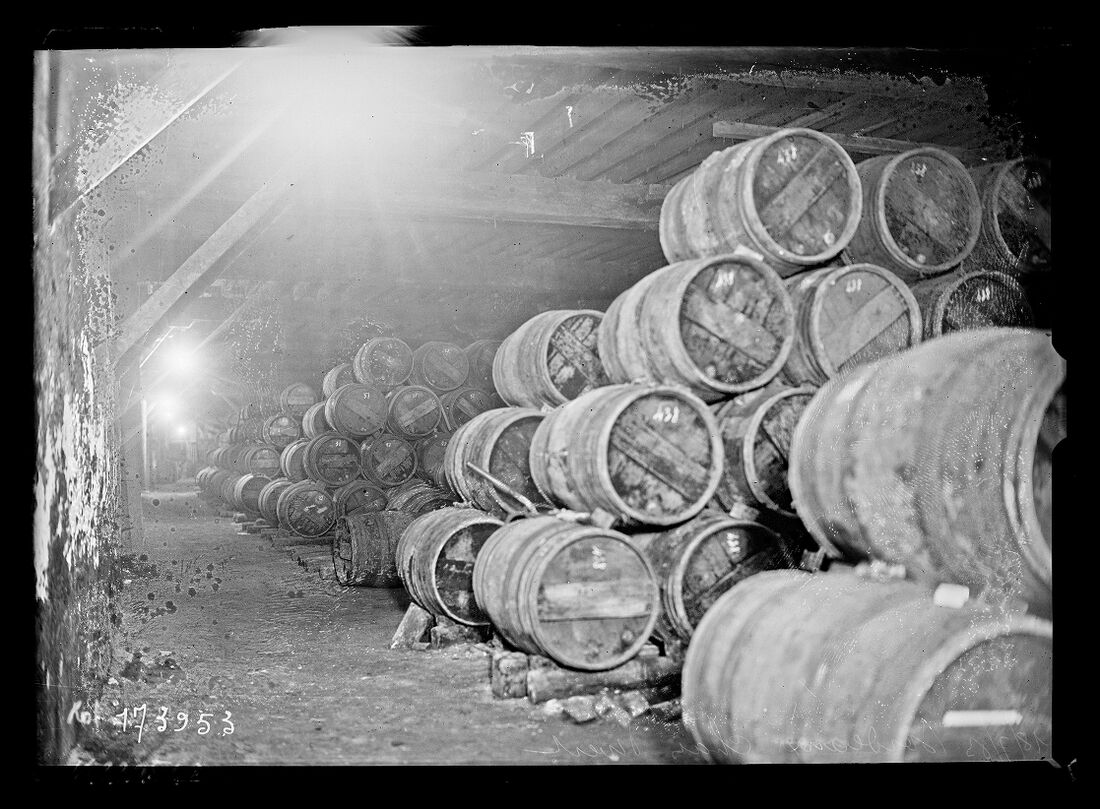
Inside, in the half-light, thousands of oak casks hold spirits that sometimes wait for decades. And every year these casks empty a little, without dripping or leaking. What disappears has been given a charming name: the angels' share. But if the angels take their share, what do they do with it?
More than twenty million bottles a year
The figure is spectacular. According to the Institut national de l'origine et de la qualité (INAO), the natural evaporation of cognac represents “the equivalent of more than 20 million bottles a year that go off into the wild”. A rate of about 2% a year is commonly cited. For Scotch whisky, a report submitted to the Scottish Government in 2023 settles on the same order of magnitude: a typical cask loses about 2% of its ethanol every year.
These figures are orders of magnitude, not measurements. Researchers who study the barrel give a wider range, from 1 to 9% depending on conditions. The result depends on the cask, its age, its place in the cellar, and above all on the air around it. A Scottish study carried out in two warehouses showed that temperature alone accounted for more than 98% of the differences in losses: the warmer it is, the more alcohol escapes.
The wood breathes
A cask is not a sealed container. The oak soaks up the spirit, and its staves very slowly let water and alcohol pass outwards, while oxygen comes in. It is this dialogue between liquid, wood and air that the exhibition Time and wood tells, and it is what turns a colourless spirit into an amber cognac.
What evaporates is not pure alcohol. It is a mixture of water and ethanol, in proportions that depend on the humidity of the cellar. In a damp cellar, the air is already laden with water: the spirit loses mainly its alcohol, and its strength falls. In a dry cellar, water escapes more readily, and the strength falls more slowly. The cognac trade body puts it in its own way: as it ages, cognac learns to “lose its alcoholic strength”, this is its “angels' share”, and the cellar master moves his spirits “between dry and damp cellars” to make use of it.
The detail of the phenomenon is still a subject of research. The Hennessy house, a Charente cooperage group and a laboratory at CentraleSupélec recently proposed a doctoral thesis on the “coupled transfers of water and ethanol” in the staves. The angels' share is as old as the cellars; its fine physics is not.
The black on the walls
Back outside. In the 1870s, a pharmacist, Antonin Baudoin, took an interest in the black crust covering the cellar walls; according to the mycologist James Scott, he reported it to the Société botanique de France in 1878. In February 1881, the mycologist Richon published the description of a fungus he named Torula compniacensis, “the torula of Cognac”. The reference specimen, now kept in a Canadian herbarium, was collected in July 1881 from the walls of a spirits distillery on the banks of the Charente.
The fungus then fell into near oblivion for eighty years. It came back in the early 2000s, as concern about black moulds grew. At the University of Toronto, James Scott's team took it up again and showed that it did not belong to the genus in which it had been placed. In 2007, the team created a new genus for it, Baudoinia, in honour of the pharmacist. The Cognac fungus is now called Baudoinia compniacensis.
Mycologists then worked out what feeds it. It uses ethanol as a source of carbon, and low concentrations of alcohol in the air encourage its spores to germinate. It colonises everything downwind of the cellars: stone, tiles, signs, branches, car bodies. Related species have been found near distilleries in Scotland, the Caribbean and North America, and near industrial bakeries. The angels' share has not risen to heaven: part of it has settled on the walls, and is eaten there.
A lawsuit in Tennessee
The fungus ended up in court. In Lincoln County, Tennessee, Brown-Forman builds ageing warehouses for Jack Daniel's whiskey. Neighbours, Christi and Patrick Long, noticed that their houses, their trees and their cars were turning black. In early 2023, they sued not the distillery but the county's planning department, which they accused of failing to enforce the ventilation rules for warehouses. A few weeks later, Judge J. B. Cox halted the construction of a new warehouse, designed for more than 67,000 casks, until the planning commission had approved the project.
The health authorities that have looked into the fungus, in Indiana as in Scotland, have found no established health risk. The dispute is about façades that need cleaning, and about a question of neighbourliness that Cognac has known for more than a century.
What the angels do with their share
The cognac that evaporates does not vanish: water and alcohol pass through the oak, mingle with the air of the cellar, then with that of the town. Part of this alcohol feeds a fungus that blackens the walls and bears, in Latin, the name of Cognac. The angels, in short, leave a trace.
The phenomenon is not peculiar to the Charente: it affects all wine spirits, all whiskies and all rums aged in wood. The name eau-de-vie, for its part, has another history, a more medical one.