House stories · Jack Daniel's
Who taught Jack Daniel to make whiskey?
For a century, the house told how the young Jack Daniel had learned his trade from a preacher, Dan Call, and in 1866 founded the first registered distillery in the country. In 2016, for its 150th anniversary, it brought another master into its history: Nathan “Nearest” Green, a man who had known slavery. What do the records, the historians and the journalists say?
The story
Jack Daniel probably learned to distil from Nathan “Nearest” Green, a formerly enslaved man whom the house took a hundred and fifty years to name; the date of 1866 that every bottle bears is supported by no known record.
About a hundred kilometres south-east of Nashville, a hollow runs deep into the hills as far as a limestone cliff. At its foot, a cave lets out cold water all year round, free of iron according to the house. It was there that Jack Daniel would one day set up his distillery. But his apprenticeship began elsewhere, on the farm of Dan Call, a preacher and distiller, who had taken the boy in. The boy, Jasper Newton Daniel, known as Jack, was born around 1849 according to his biographer Peter Krass.
At Call's still, tradition has it, worked an enslaved man: Nathan Green, known as “Uncle Nearest”. According to the research of the entrepreneur Fawn Weaver, he belonged to a local firm, Landis & Green, which hired him out to the preacher. In the slave-holding South, the National Museum of African American History and Culture points out, enslaved people provided most of the labour in distilleries. After abolition, Green, now free, worked for Jack Daniel; so did his sons George and Eli.
Daniel went into partnership with Call, who sold him his share in 1882 under pressure from temperance campaigners. In 1907 or 1908, childless, he handed the business over to his nephew Lem Motlow; he died in 1911. When Tennessee banned the manufacture of alcohol, production moved to Missouri, and did not return to Lynchburg until 1938. In 1956, Motlow's heirs sold the brand to the Brown-Forman group, of Kentucky.
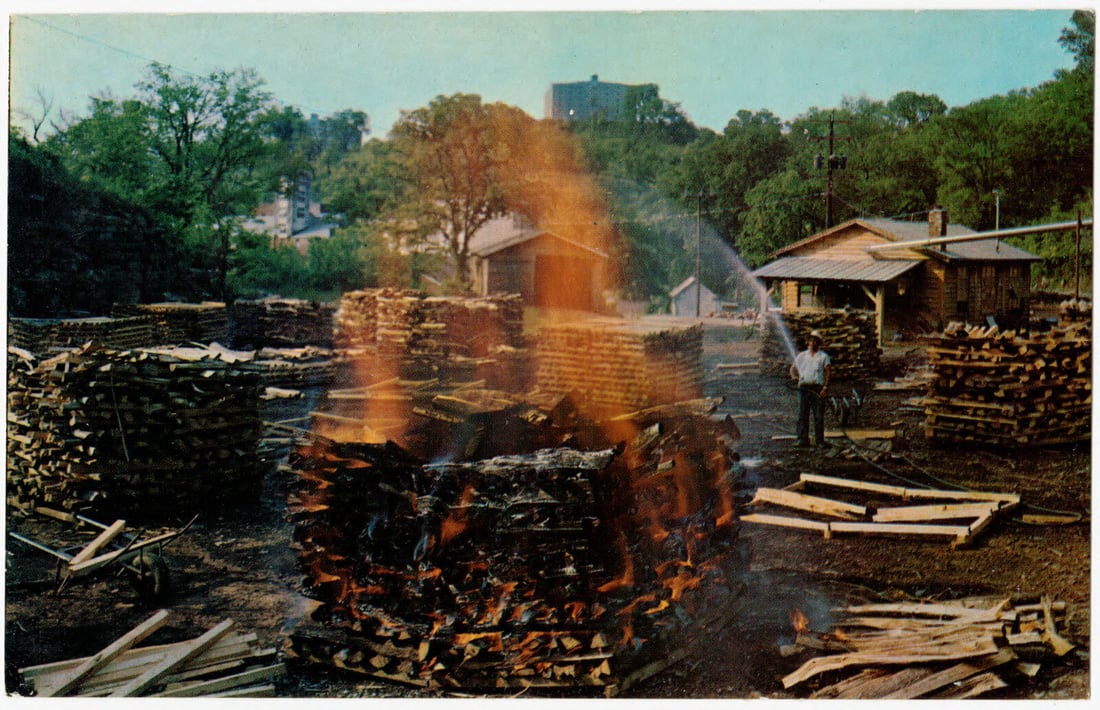
The whiskey is born of grains fermented by the so-called “sour mash” method, which adds to the new mash part of the residues of the previous distillation. Once distilled, it comes out colourless. Before going into cask, it trickles drop by drop through three metres of sugar maple charcoal: this is the “Lincoln County Process”, named after Lynchburg's former county. It then ages in new white oak casks, charred on the inside, where it takes on its amber colour, before being bottled at 40% vol. Federal law does not distinguish it from bourbon; a Tennessee law of 2013, however, reserves the name “Tennessee whiskey”, with one exception, for spirits made and aged in the State and passed through maple charcoal.
In 2016, for the house's 150th anniversary, a press officer for the group drew the journalist Clay Risen's attention to Green's story. In June, the New York Times ran a headline on “help from a slave”. Since then, the house has presented Green as its first head distiller, “what we today call the master distiller”.
The legend set against the sources
The legend
As told by the house, in two successive versions
For a century, the official account could be told in a few words: the young Jack learned the trade from the preacher Dan Call, then in 1866 founded his distillery, “the very first registered distillery in the United States”. The date still appears on the label.
Since 2016, the house has told a different story: taken in on Call's farm in 1864, Jack learned to make whiskey “from the preacher and an enslaved man”, Nathan Green, whom he would later hire as head distiller. The date of 1866, for its part, has stayed.
What the sources say
Green's name was not invented in 2016. As early as 1967, Ben A. Green, an author unrelated to him, mentions him in Jack Daniel's Legacy and attributes this remark to Call: “Uncle Nearest” is the best whiskey maker he knows. Clay Risen nonetheless warned that the story rests on oral tradition and on “the thinnest of archival trails”. Fawn Weaver has since investigated among the descendants; but she has launched a whiskey brand that bears Green's name, and her investigation is not disinterested.
In 2026, the author Drew Hannush, who went back over censuses, tax rolls and land records, goes further: no document, he writes, places Green at the still as an enslaved man, and the 1870 census gives his age as twenty-seven, which would put his birth around 1843 and not around 1820. That he was a mentor to the young Jack remains plausible; the image of the old enslaved distiller, on the other hand, comes from tradition.
Charcoal filtration is not one man's invention. It used to be attributed to a certain Alfred Eaton, around 1825; the Oxford Companion to Spirits and Cocktails notes that American distilling manuals describe it as early as the first decade of the 19th century. The National Museum of African American History and Culture links it to West African knowledge: this is a hypothesis.
The date of 1866 is the most fragile. The biographer Peter Krass has the business starting in 1875; an article of 1896 puts forward 1874, another of 1904, 1872. In 1972, the form that entered the distillery on the National Register of Historic Places repeated 1866 and “the oldest registered distillery”, citing the house's brochures among its sources.
So, legend or history?
Before you read the answer, what do you think?
Choose a degree: it is the question a historian asks of every story.
Degree of certainty : Probable
Probably Nearest Green, a formerly enslaved man; that he distilled for Call while enslaved belongs to tradition, and 1866 to legend.
That Jack Daniel learned the trade from Nathan Green is probable: the name was in print as early as 1967, and the presence of Green and his sons alongside Daniel is reported by tradition and then by Fawn Weaver, but the archives remain thin and do not say whether he was already distilling for Call in the days of slavery. The date of 1866, for its part, is supported by no known record: it comes from the house, and it is the house that the official documents copied.
How we know
Each date in this story refers to one of the sources below. The degree of certainty can be read from the pattern of the rule: solid for attested, dashed for probable, dotted for tradition, double for legend.
Key dates
-
1866 Founding and registration claimed by the house -
1875 Start of the business according to the biographer Peter Krass -
1882 Dan Call withdraws, under pressure from the temperance movement -
1907 or 1908 Jack Daniel hands the distillery over to his nephew Lem Motlow -
1938 Production returns to Lynchburg -
1956 Sale of the brand to Brown-Forman -
1967 Ben A. Green prints the name “Uncle Nearest” -
1972 Listing on the National Register, with the date 1866 -
2013 Tennessee law on the name “Tennessee whiskey” -
2016 The house puts Nearest Green forward, for its 150th anniversary
Attested- established by documents contemporary with the events.
Probable- plausible and consistent with the sources, without direct proof.
Tradition- handed down by the house or by local memory, with no document to confirm or refute it.
Legend- contradicted by the sources, or invented after the fact.
What remains uncertain
- Jack Daniel's date of birth: 1846 according to Ben A. Green, 1849 according to Peter Krass, 1850 according to his gravestone.
- The founding date: 1866 according to the house; 1872, 1874 or 1875 according to the other sources.
- Nathan Green's date of birth (c. 1820 or c. 1843), his status at Call's still, and the years in which he worked for Daniel; the archives are thin.
- That Green belonged to the firm Landis & Green, known from the research of Fawn Weaver, who has a commercial interest in this story.
- The date of the handover to Lem Motlow (1907 according to the Tennessee Encyclopedia and the house, 1908 according to the Oxford Companion) and that of the move out of Tennessee (1909 or 1910).
- The origin of maple charcoal filtration.
- The books by Ben A. Green and Peter Krass, and the New York Times article, consulted through quotations and reviews; Drew Hannush's investigation, published outside any scholarly journal.
- The composition of the mash (80% maize, 12% barley, 8% rye) and the strength off the still (70% vol.) given by the house: the page that publishes them could not be consulted; they have been removed from the account.
Sources
- Doug Frost et David Wondrich, « Jack Daniel's », in The Oxford Companion to Spirits and Cocktails , Oxford University Press , 2021.
- Clay Risen, « whisky, Tennessee », in The Oxford Companion to Spirits and Cocktails , Oxford University Press , 2021.
- Clay Risen, Jack Daniel's Embraces a Hidden Ingredient: Help From a Slave , The New York Times , 2016.
- Cynthia Graber et Nicola Twilley, The Secret History of the Slave Behind Jack Daniel's Whiskey (avec Clay Risen et Fawn Weaver) , Gastropod , 2019.
- National Museum of African American History and Culture (Smithsonian), The Man Behind Tennessee Whiskey .
- Stefanie Benjamin, The story of Nearest Green, America's first known Black master distiller , The Conversation , 2021.
- Drew Hannush, What Did We Get Wrong About Jack Daniel and Uncle Nearest? , Whiskey Lore , 2026.
- Peter Krass, Blood and Whiskey: The Life and Times of Jack Daniel , John Wiley & Sons , 2004.
- Ben A. Green, Jack Daniel's Legacy , 1967.
- Lynn Tolley, « Jack Daniel Distillery », in Tennessee Encyclopedia , Tennessee Historical Society , 2017.
- Tennessee Historical Commission, pour le National Park Service, Jack Daniel Distillery, National Register of Historic Places Inventory – Nomination Form , 1972.
- Attorney General and Reporter of Tennessee, Opinion No. 15-23, Tennessee Whiskey (texte reproduit par Ezel) , 2015.
- Jack Daniel's (Brown-Forman), Our History , 2026.
- Jack Daniel's (Brown-Forman), Our Mash ; Charcoal Mellowing ; Barrel Making , 2026.